The microbrand watch scene has moved well beyond niche forum curiosity.
August 2026 community analytics show a category with real scale, active buying intent and a collector base that’s increasingly discovering watches through mobile feeds rather than traditional retail channels.
For independent brands, the message is fairly direct: the audience is there, but it rewards substance, access and founder-level participation.

At a glance
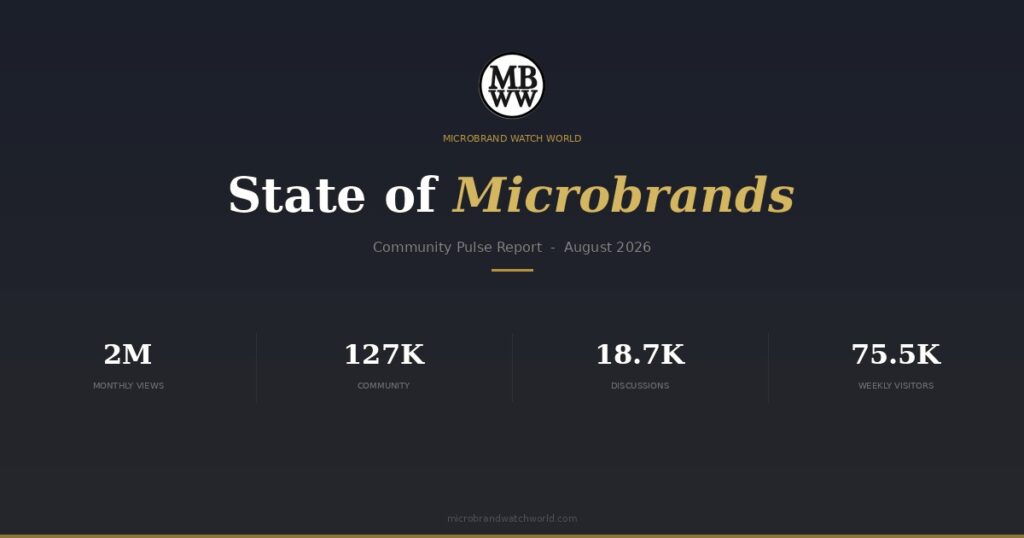
- The r/MicrobrandWatches community reached 127,000 members and around 2 million monthly views in August 2026.
- More than 74% of traffic comes from mobile devices and apps, with iOS app users making up the largest single segment at 42%.
- Traska led discussion volume, while Fears recorded the strongest engagement rate at 61.4%.
A mobile-first collector base is setting the pace
The r/MicrobrandWatches community added 4,037 members in August, rising from 123,000 to 127,000 members over the month.
That growth is notable because it appears steady rather than spiky, with a 90% retention rate pointing to sustained interest from collectors rather than a short-lived traffic burst.
The way enthusiasts are arriving matters just as much as the numbers.

More than 74% of community traffic now comes through mobile devices and apps, while iOS app users alone account for 42% of the audience.
Desktop users across old and new Reddit represent 26% combined, which underlines how wrist shots, quick recommendation threads and founder replies are increasingly being consumed in a mobile-first environment.
For watch brands, that changes the practical rules of engagement.

Photography has to read instantly, dial colours and proportions need to survive a small screen, and founders who can answer plainly in comment threads have an advantage over brands that communicate only through polished launch posts.
Traska leads the conversation while Fears earns deeper engagement
Among individual brands, Traska generated the highest raw discussion volume during the month, with the Venturer GMT continuing to drive sustained collector conversation.
That makes sense in the current microbrand climate, where everyday travel watches with strong finishing, useful complications and approachable positioning tend to attract broad attention.

Kurono Tokyo remained high in the ranking, helped by the kind of collector admiration that follows design-led releases with a clearly recognisable identity.
Fears posted the most impressive engagement rate at 61.4%, meaning its posts produced the strongest interaction per view among the highlighted brands.
Monta also stayed firmly in the mix, with the Noble and Atlas prompting comparison-led discussions, while Makina’s Uriel VII drew a 42% engagement rate.

Baltic’s Titanium Aquascaphe kept the French brand in conversation, showing how material updates and familiar silhouettes can still generate attention when the execution is clear.
- Traska led by discussion volume, with the Venturer GMT as the key talking point.
- Fears produced the highest engagement rate at 61.4%.
- Makina’s Uriel VII reached a 42% engagement rate.
- Monta’s Noble and Atlas continued to prompt collector comparisons.
- Baltic’s Titanium Aquascaphe remained a visible part of the conversation.
Discovery brands are giving the category fresh oxygen
A healthy microbrand scene depends on more than a handful of established favourites.
August’s community activity also showed several names entering or regaining collector attention, including Tutima Glashütte, Saturn Watches and Kiwame Tokyo as newly visible discoveries.

FLOWATCH, Atomishine, Swordfish and Saltaire were identified as rising names, suggesting growing month-over-month discussion rather than one-off mentions.
WatchDives and Revelot appeared as hot launch names, while Christo-Bausele drew attention around a final made-to-order run.
Not every emerging brand will convert early discussion into lasting demand, but this kind of churn is important.

It shows that collectors are still willing to look beyond familiar logo stacks, especially when a watch brings a distinct point of view, a compelling price position or a release format that feels participatory.
Wrist shots and recommendations reveal purchase intent
The strongest activity categories say a lot about how microbrand buyers behave.
Collection posts and wrist shots accounted for 28% of all posts, making owned and worn watches the dominant form of community currency.

Recommendation threads followed at 22%, which is a particularly useful signal because those posts often come from collectors narrowing down an imminent purchase.
Brand-specific discussion represented 20% of the conversation, showing that enthusiasts aren’t just browsing broadly but actively comparing models, movements, design choices and ownership experiences.
This is where microbrands continue to differ from the traditional luxury watch world.

The path from curiosity to purchase is often public, conversational and heavily influenced by owners who are willing to show how a watch wears outside studio lighting.
Founder participation is becoming a real advantage
The clearest signal for brands may be the performance of founder and owner posts.
Posts from founders and brand owners generated nearly twice the average views, at roughly 35,000 compared with 18,000 for typical posts.

Engagement rates followed the same pattern, with founder participation reaching 38% against a broader average of 22%.
That doesn’t mean every brand needs to turn its founder into a permanent public personality.
It does suggest that collectors value direct answers, production transparency and the feeling that a watch is being made by people who are willing to stand behind the decisions.

For small independent watch companies, that can be more powerful than a larger advertising budget.
The State of Microbrands 2026 picture is of a category that’s growing, mobile, highly conversational and still unusually open to newcomers.
For collectors, that means more choice and faster discovery; for brands, it means the strongest products now need an equally credible presence in the places where enthusiasts actually spend their time.