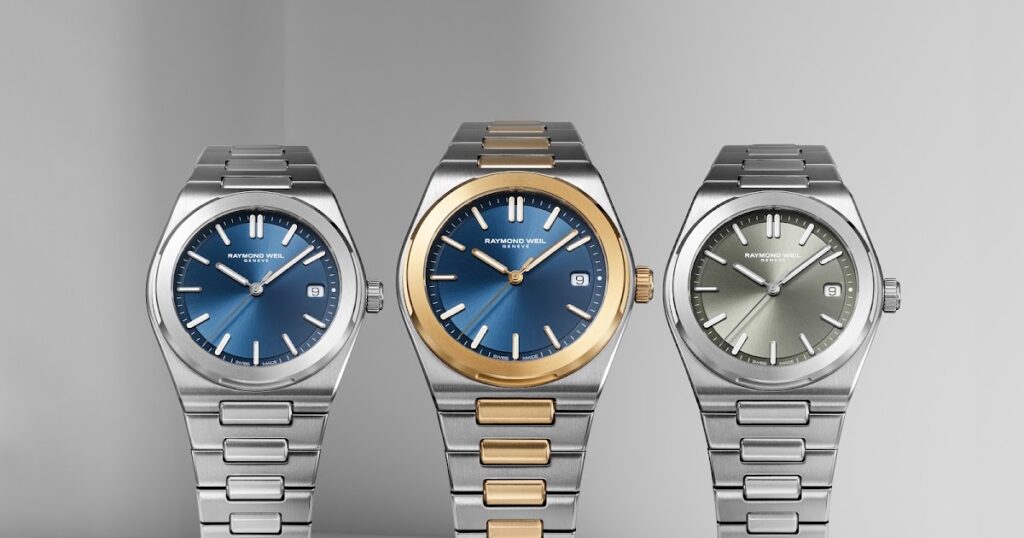
Raymond Weil has entered new territory with A.R.T., the brand’s first collection designed around an integrated bracelet.
For a house long associated with approachable Swiss watchmaking, the move is notable because the integrated bracelet has become one of the defining silhouettes of the contemporary sports-luxury watch.
A.R.T. gives Raymond Weil a fresh platform in a category where case shape, bracelet architecture and wrist feel matter as much as the dial itself.

At a glance
- Raymond Weil has introduced A.R.T., its first integrated bracelet watch collection.
- The collection places bracelet and case architecture at the centre of the design.
- The launch moves Raymond Weil into a highly competitive everyday luxury-watch format.
A new case-bracelet chapter for Raymond Weil
The integrated bracelet watch is no longer just a niche design language for collectors with a taste for 1970s geometry.
It has become a practical, recognisable format for buyers who want a watch that can sit between dress and sport without feeling compromised.
That makes A.R.T. an important addition to the Raymond Weil catalogue.

Rather than treating the bracelet as a separate component, an integrated design makes the case and bracelet read as one continuous object on the wrist.
When done well, that architecture can give a watch a lower, more fluid presence, with the first links playing a major role in how the whole piece wears.
Why the integrated bracelet format matters
Integrated bracelet watches are difficult to get right because the appeal is less about one isolated detail and more about proportion.

The case flanks, end links, bracelet taper and clasp experience all need to feel intentional.
For Raymond Weil, A.R.T. is therefore more than a styling exercise.
It signals the brand’s interest in a segment where buyers are especially sensitive to finishing, ergonomics and visual identity.

The category also suits daily wear, which is where Raymond Weil has traditionally found much of its strength.
A strong integrated bracelet watch needs to look considered with tailoring, but it also has to feel robust and easy enough for regular use.
Positioning in the modern Swiss watch landscape
Raymond Weil’s move arrives at a time when many collectors are looking for watches with a clear design proposition and a recognisable silhouette.

The integrated bracelet gives A.R.T. that immediate visual anchor.
It also allows the brand to speak to buyers who may not be looking for a conventional round watch on a leather strap, but still want Swiss watchmaking from an established name.
That audience is broad.

It includes first-time mechanical watch buyers, collectors looking for a versatile everyday piece and enthusiasts who appreciate the discipline required to make an integrated bracelet feel coherent rather than decorative.
With A.R.T., Raymond Weil isn’t simply adding another model line.
It is opening a new design lane for the brand, one that could become an important part of its identity if the collection develops with the right balance of restraint, wearability and detail.