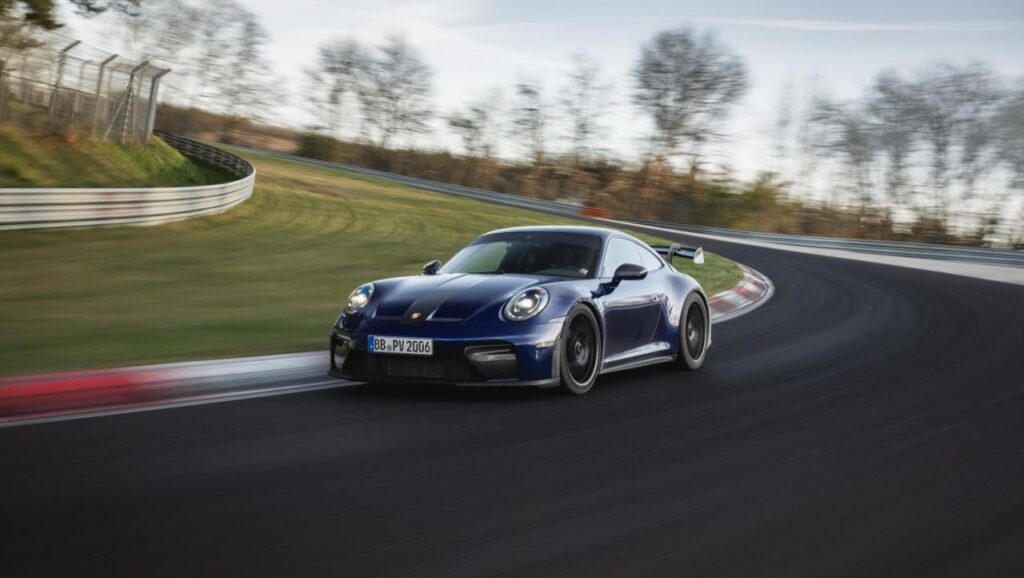
Porsche’s most famous sports car isn’t about to become a battery-only machine.
CEO Michael Leiters has confirmed that the 911 will continue with combustion and hybrid power, preserving the engine character that has defined the model for generations. For a car so closely tied to sound, response and rear-engined feel, that decision matters.
At a glance
- Porsche has ruled out a fully electric 911 for now, with CEO Michael Leiters confirming combustion and hybrid power will remain central to the model.
- The decision reflects the 911’s close connection to engine character, driver feel and the qualities that make it distinct within Porsche’s range.
- Porsche will continue expanding its electric portfolio, but the 911 is set to follow a more measured hybrid path.
A flat-six future with hybrid help
The message from Porsche is clear enough. The 911 is not being prepared for a full EV transformation.

Instead, Porsche will keep developing the car around internal combustion and hybrid technology, giving the model room to meet changing regulations without abandoning the traits that built its reputation.
That distinction is important because electrification doesn’t mean every Porsche has to follow the same path.
The company is investing heavily in electric vehicles and widening its EV line-up, but the 911 occupies a different place in the brand’s hierarchy.
It isn’t just another performance model with a historic badge. It’s the car that still defines how many drivers understand Porsche as a brand.
Why the 911 resists a simple EV conversion
The 911 has always been an unusual sports car, and much of its identity comes from the way its engine placement, sound and power delivery shape the driving experience.
Leiters has made the point that the car’s character remains tied to its engine in a way that a fully electric setup can’t yet reproduce.
That doesn’t make the 911 anti-technology. It makes it a harder car to reinvent without losing something fundamental.
A full EV 911 would bring obvious advantages in instant torque and emissions compliance, but it would also force Porsche to rethink the relationship between weight, response, balance and feedback.
For a model that has evolved through careful iteration rather than reinvention, that’s a much bigger move than simply replacing one powertrain with another.
Porsche’s measured approach to electrification
Porsche’s position on the 911 doesn’t signal a retreat from electric performance.
The brand has already committed significant resources to EV development, and its wider product strategy continues to include battery-powered models.
The difference is that Porsche appears willing to let each model follow the technology that suits its character rather than forcing one answer across the entire range.
For the 911, that answer is hybridisation.
Hybrid systems can help with efficiency, performance delivery and regulatory pressure, while allowing the combustion engine to remain part of the car’s emotional and mechanical appeal.
That balance will be crucial. A hybrid 911 still has to feel like a 911 first, not like a technical compromise designed only to satisfy future rules.
Details & Specifications
| Brand | Porsche |
|---|---|
| Model | 911 |
| Future powertrain direction | Combustion and hybrid power |
| Fully electric version | Not planned for the 911 at this stage |
| Confirmed by | Porsche CEO Michael Leiters |
| Brand context | Porsche continues to expand its electric vehicle portfolio |
For enthusiasts, the significance is straightforward. The flat-six remains part of the 911 story, and Porsche is choosing evolution over a clean break.
If the company gets the hybrid balance right, the 911 can keep moving forward without surrendering the mechanical personality that made it indispensable in the first place.