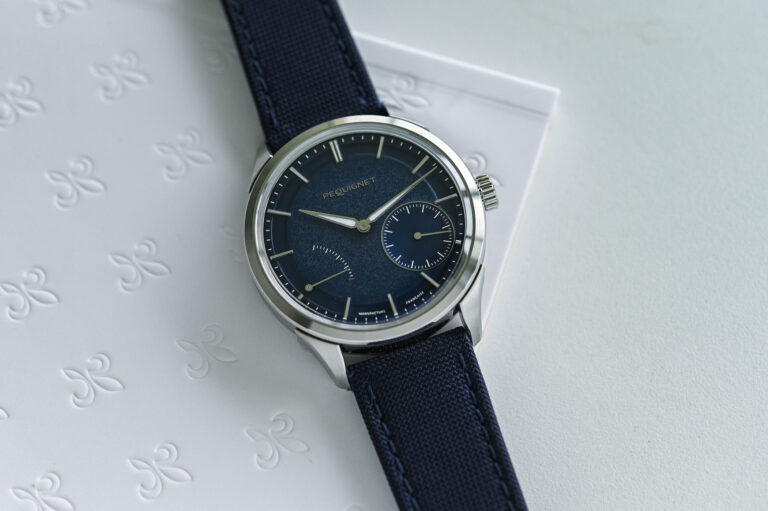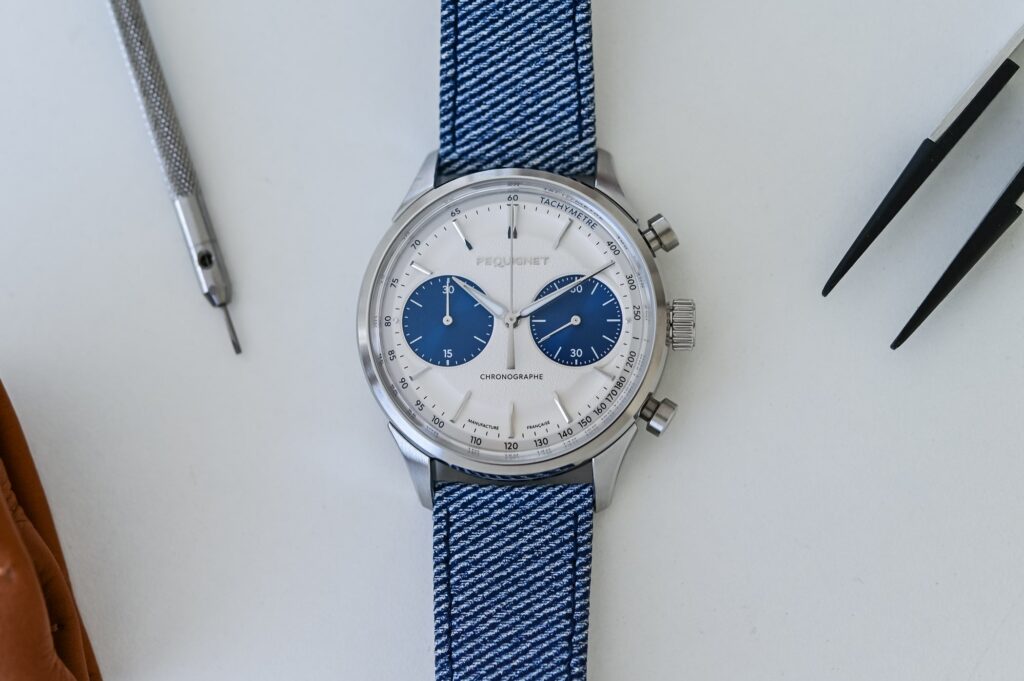
Pequignet occupies a distinctive corner of European watchmaking, not quite Swiss in identity, but close enough to the border to share some of the same mechanical instincts.
From its home in Morteau, the French manufacture has spent the past decade building a more serious in-house story, and the Royale Paris Chronograph is one of its clearest expressions yet.
It’s a compact automatic chronograph with classical proportions, contemporary dial architecture and a movement solution that deserves a closer look.
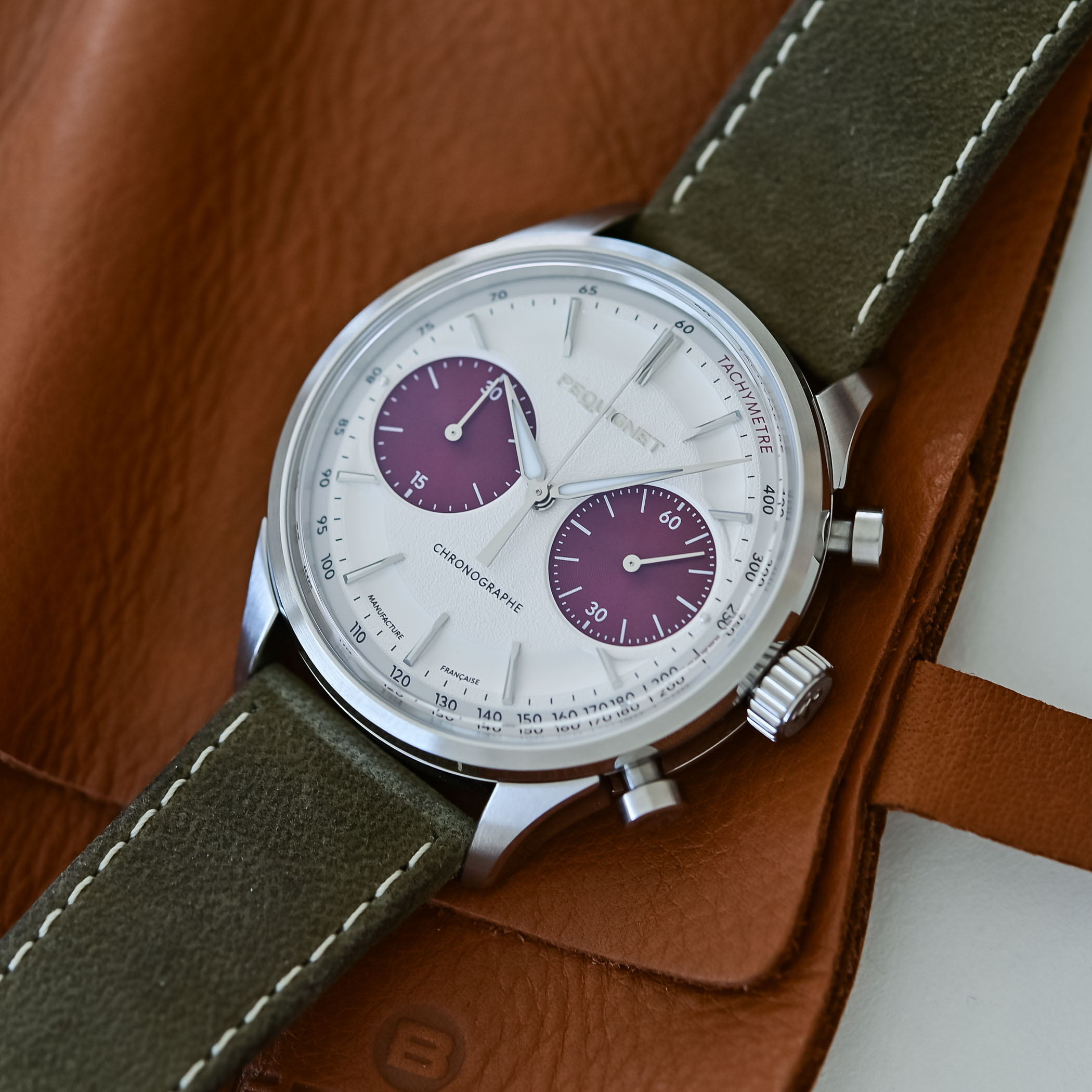
At a glance
- Pequignet has expanded its Royale Paris line with a 39.5mm automatic chronograph in stainless steel.
- The watch combines a textured multi-level dial with a Calibre Initial automatic base and a Dubois-Depraz chronograph module.
- It is priced at EUR 6,450 and is offered with blue or burgundy subdials, on leather or a stainless steel bracelet.
Morteau’s manufacture identity gives the watch its context
Morteau sits just north of Neuchâtel across the French border, and it remains one of the country’s most important centres for mechanical watchmaking.
That geography matters because Pequignet’s watches have never felt like simple Swiss-adjacent exercises.
The company was founded by Emile Péquignet in 1973 and has moved through several chapters since, including the introduction of its in-house Calibre Royale in 2010.
Today, under the ownership of Enowe, the brand continues to position itself as a French independent with genuine manufacture ambitions.
The Royale collection is central to that identity, mixing traditional calendar and timekeeping displays with clean modern cases and layered dials.
A compact chronograph with a dressed-up case
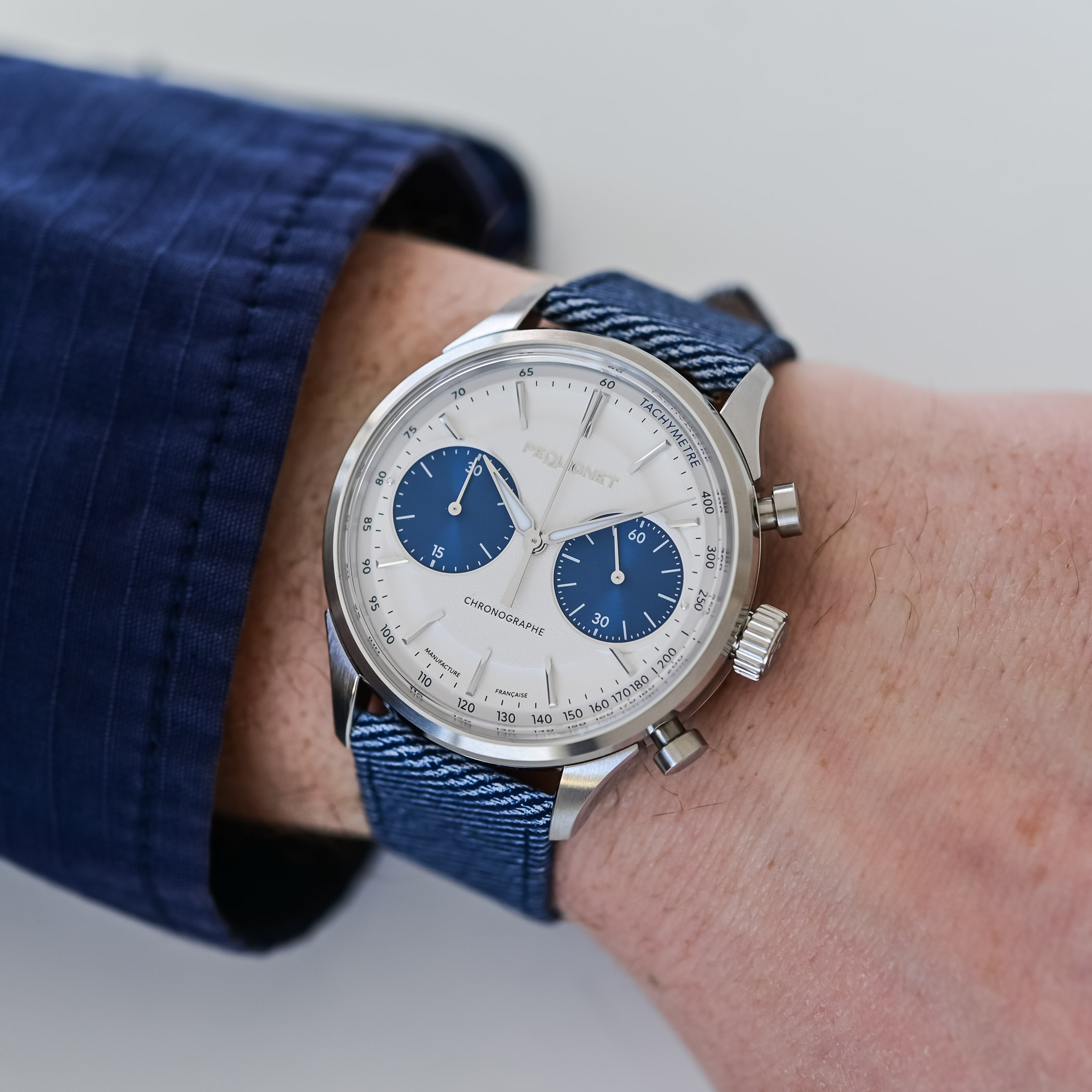
At 39.5mm wide and 12.7mm thick, the Royale Paris Chronograph is notably restrained for an automatic modular chronograph.
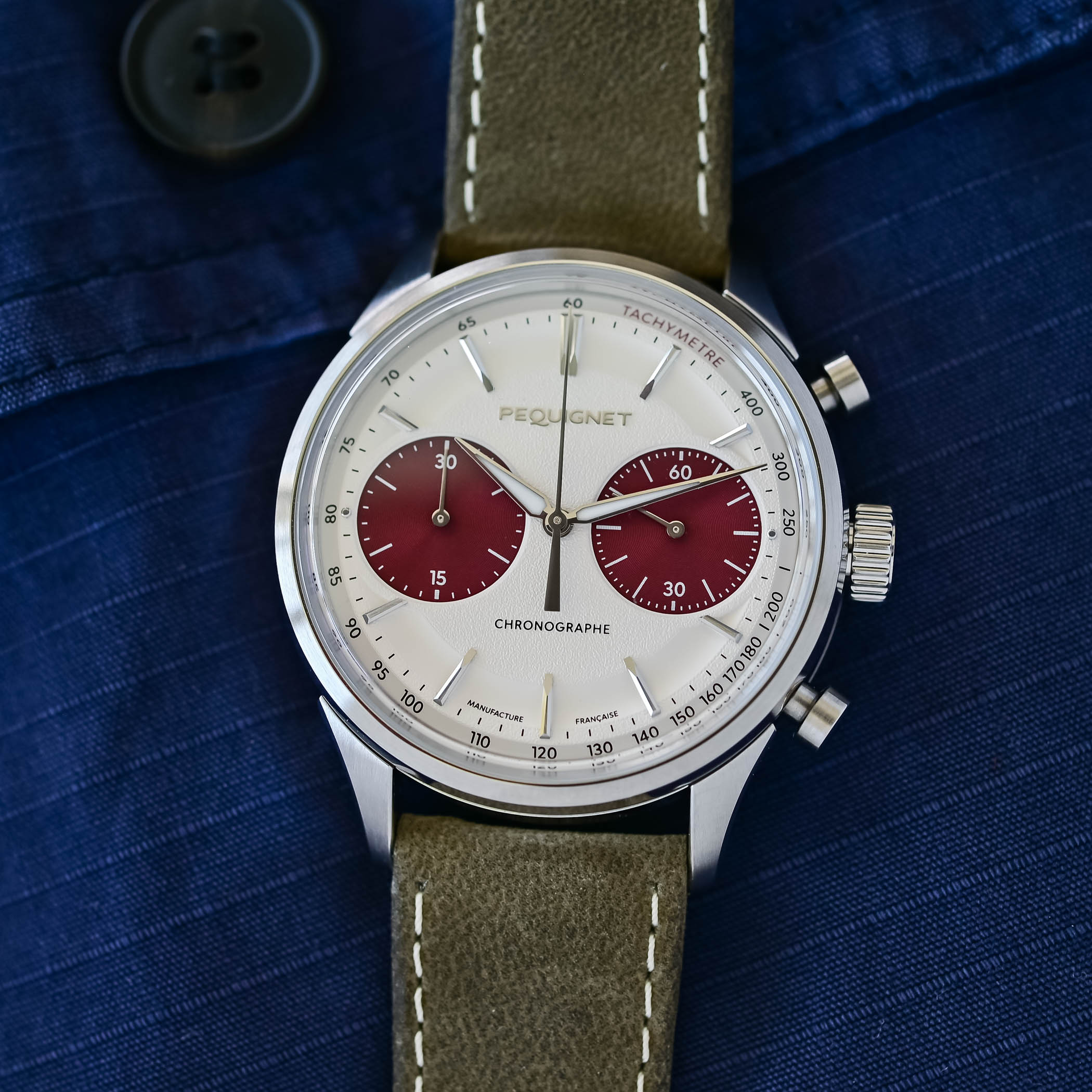
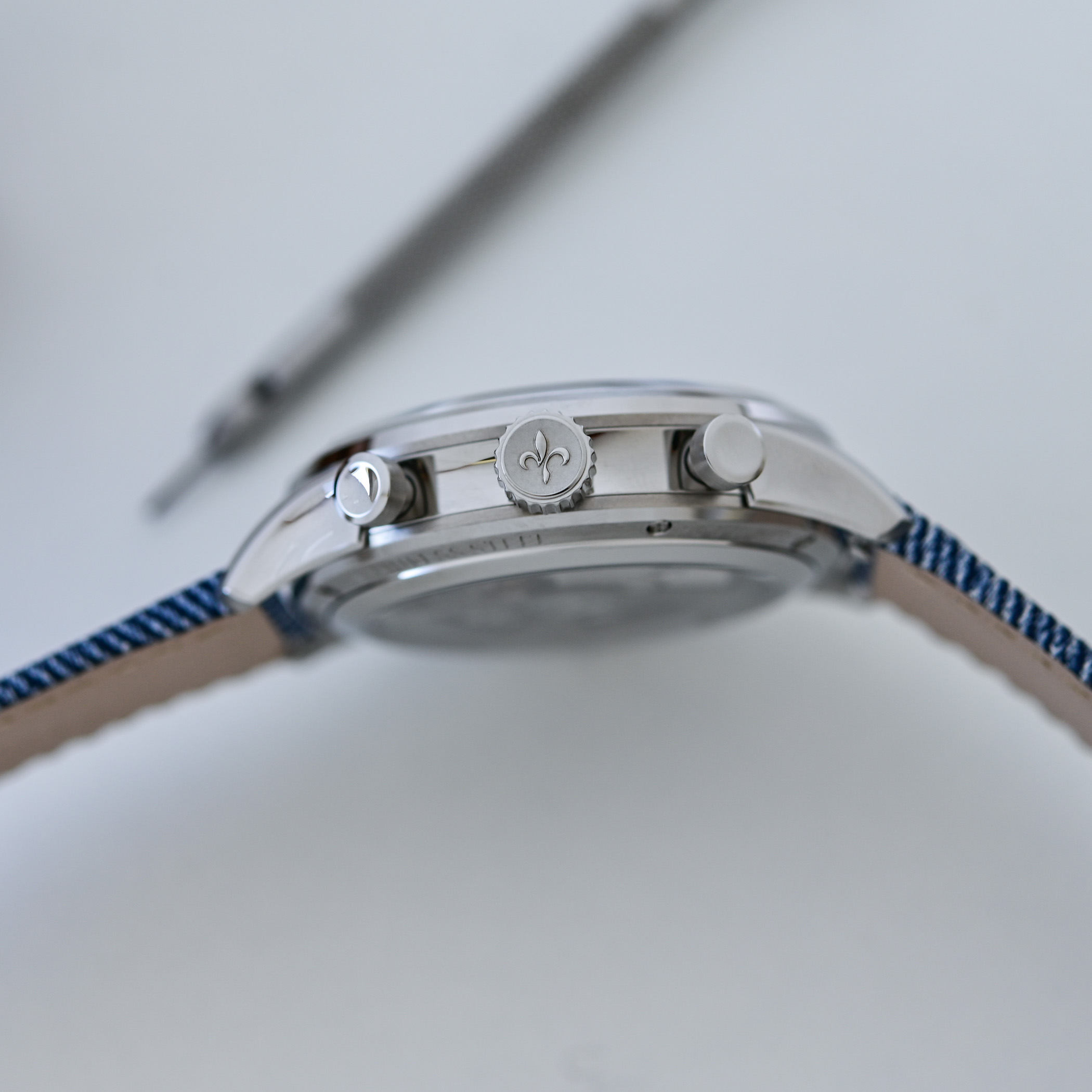
The stainless steel case uses the collection’s signature lug shape, with brushed surfaces and polished bevels giving it enough definition without making the watch feel overworked.
Recessed case flanks add a little architectural tension, while a sloping brushed bezel leads into a box-type sapphire crystal.
The right side is conventionally arranged, with a knurled crown between two piston-style chronograph pushers.
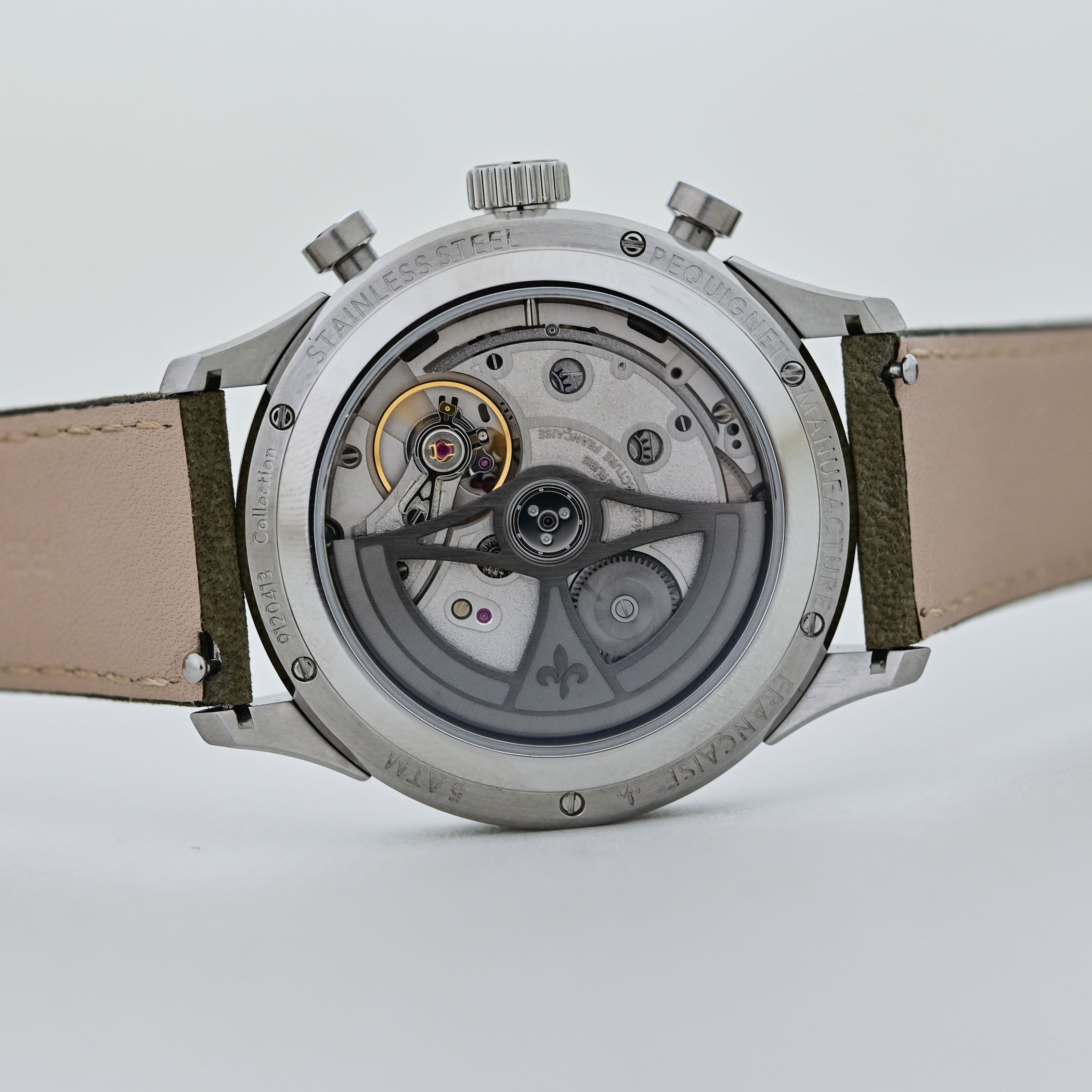
A sapphire display back gives an open view of the movement, which is one of the more interesting elements of the watch.
The dial favours depth over decoration
The Royale Paris line often uses asymmetry for added indications, but this chronograph is more balanced.
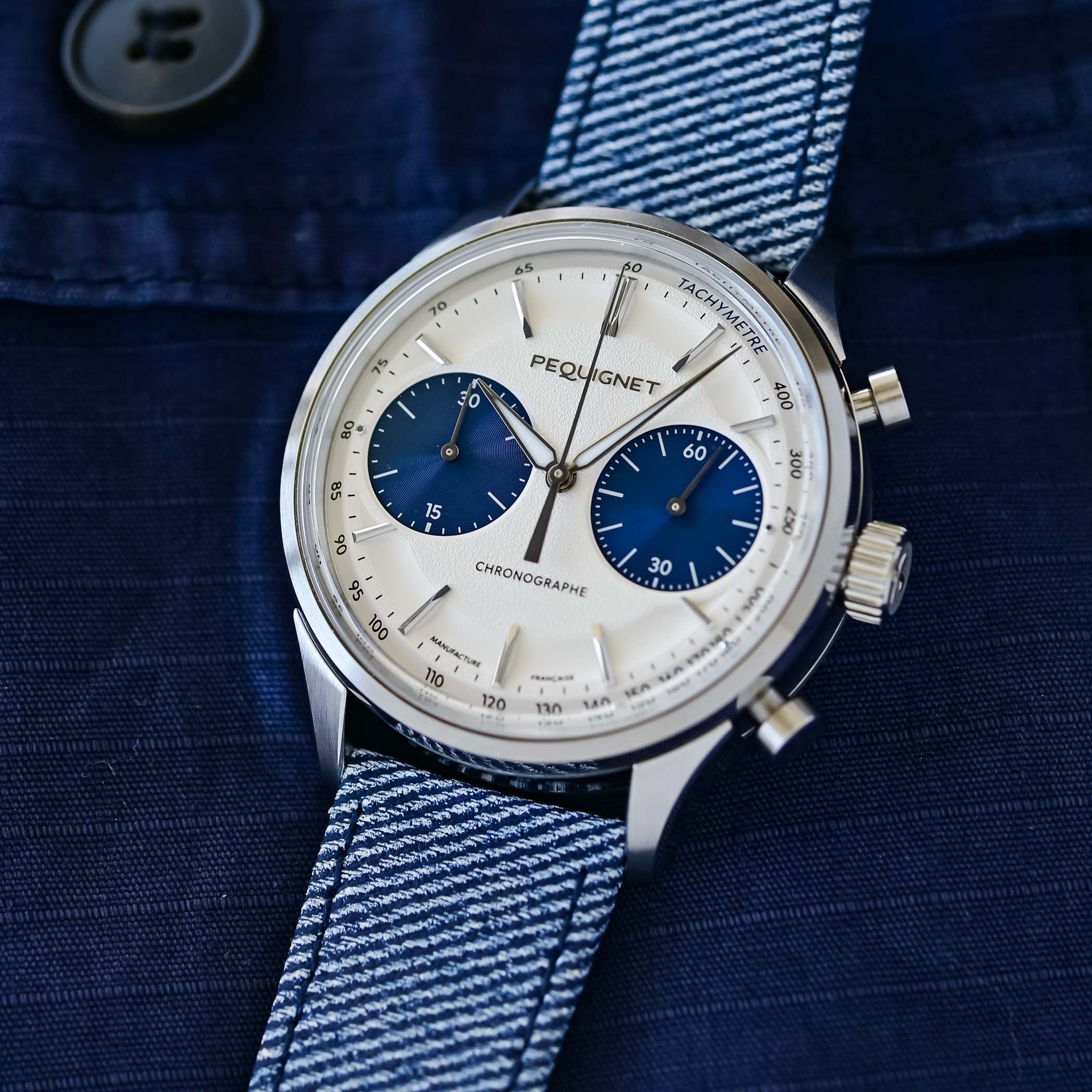
The dial pairs an opaline surface with recessed snailed counters, offered in either deep blue or burgundy red.
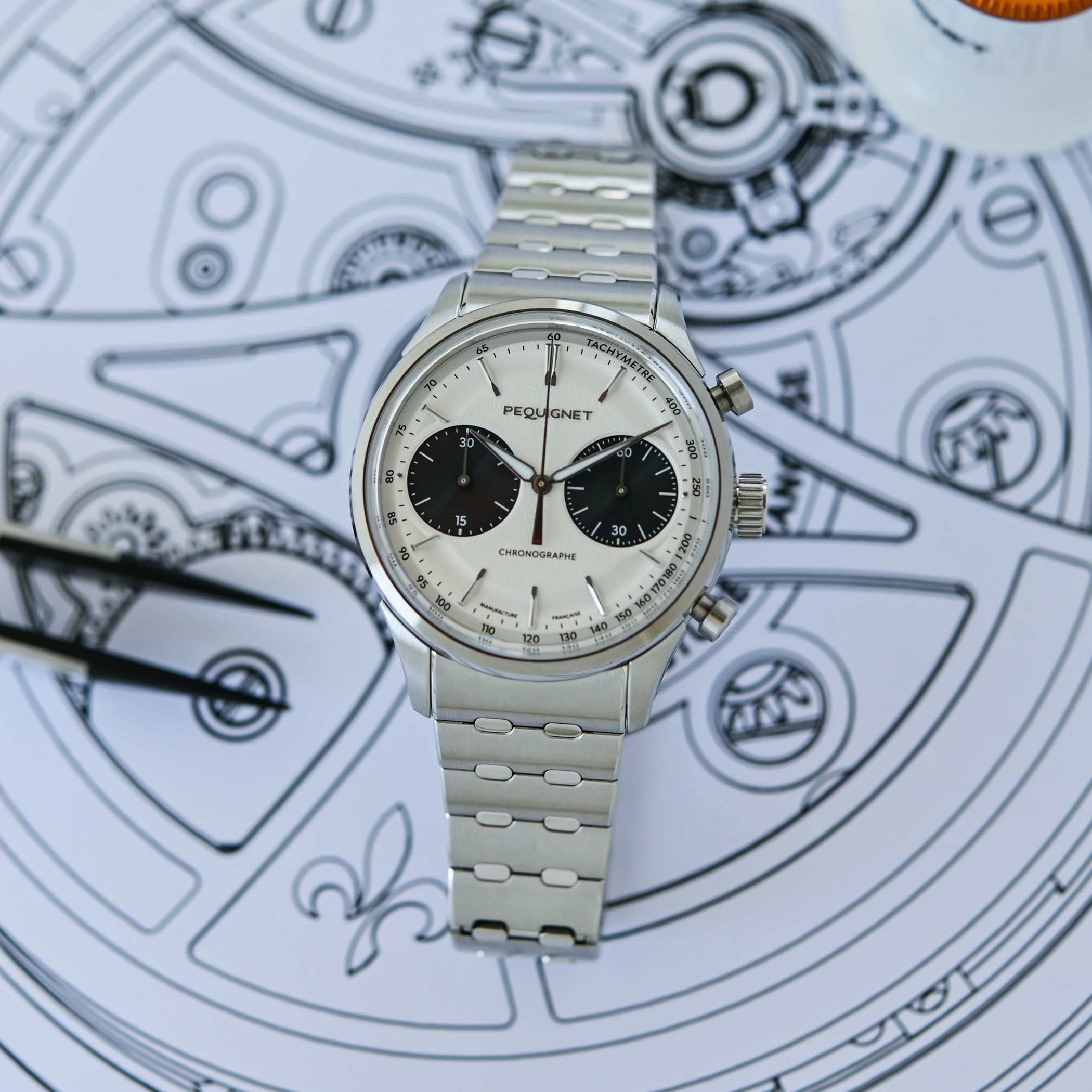
A panda configuration on a steel bracelet is also planned, giving the model a more classic sports-chronograph reading while keeping the same case architecture.
The centre section is grained, and a concave channel runs around the dial with applied hour markers bridging the change in level.
A smooth recessed tachymeter scale sits at the perimeter, integrating the chronograph function without dominating the design.
The polished hour and minute hands carry Super-LumiNova through the centre, while the central chronograph seconds hand remains clean and polished.
It’s not a maximalist dial, but the mix of graining, snailing, polished markers and varying levels gives it character while keeping the display easy to read.
The Calibre Initial Chronograph is the technical story
Rather than using the Calibre Royale found in many of Pequignet’s higher-profile pieces, this watch uses the slimmer automatic Calibre Initial as its foundation.
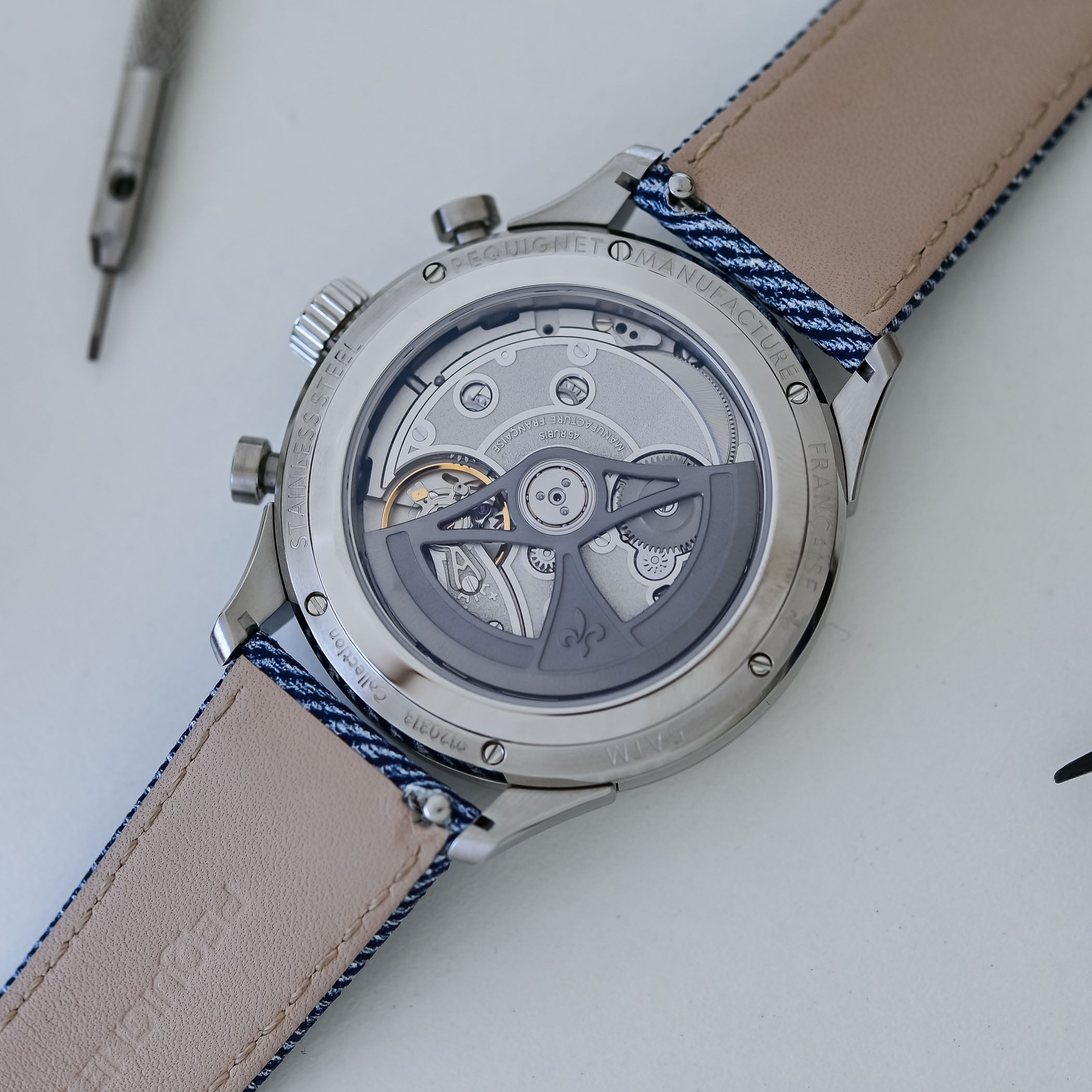
That base movement is paired with a cam-actuated chronograph module developed by Dubois-Depraz.
The movement runs at 28,800 vibrations per hour and delivers a useful 65-hour power reserve.
Its decoration leans modern, with a grained recessed section on the three-quarter bridge, brushed outlines and open areas that reveal more of the mechanics beneath.
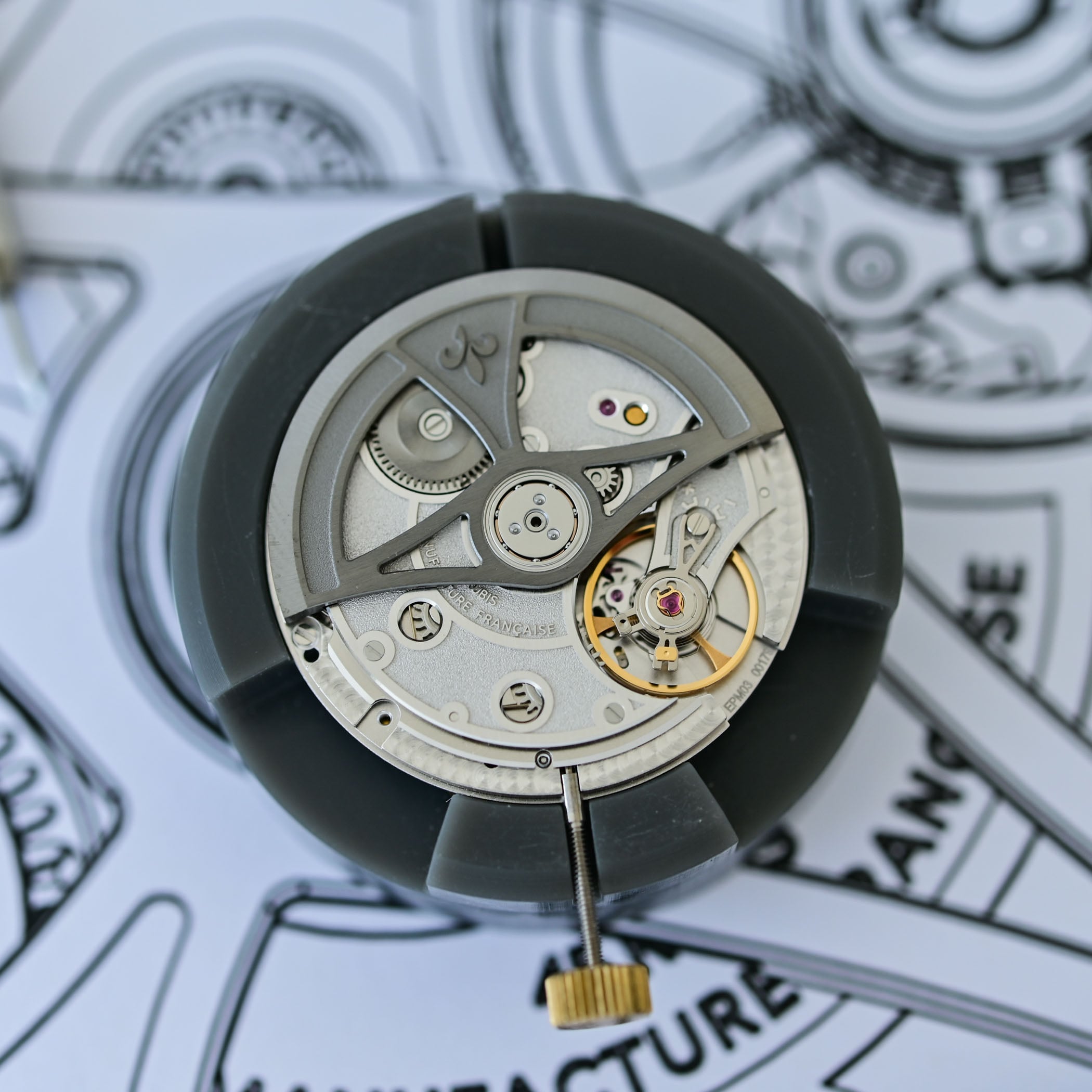
The darkened openworked central rotor carries Pequignet’s stylised Fleur de Lys emblem, a detail that suits the watch’s French identity without feeling too literal.
One practical point stands out for anyone familiar with modular chronographs.
Pequignet has used a mechanism that aligns the crown with the pushers, avoiding the uneven crown-and-pusher layout often seen when a chronograph module sits above a base movement.
Strap and bracelet options broaden the character
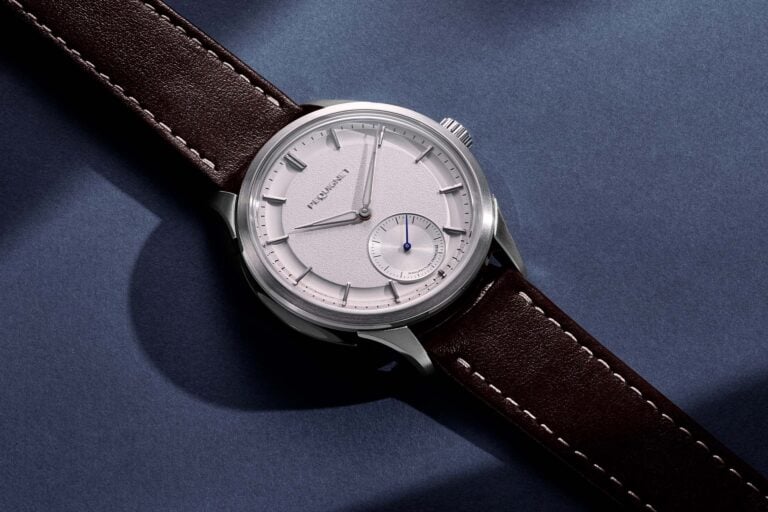
The Royale Paris Chronograph is available on nubuck leather, a denim-like leather strap or a stainless steel bracelet.
The straps use a steel pin buckle and give the watch a softer, more casual feel.
The bracelet is more architectural, with broad brushed links connected by smaller polished elements for contrast.
That makes the bracelet version feel closer to an everyday steel chronograph, while the leather options highlight the dressier side of the case.
Details & Specifications
| Brand | Pequignet |
|---|---|
| Model | Royale Paris Chronograph |
| Case size | 39.5mm diameter, 12.7mm thickness |
| Case material | 316L stainless steel with brushed surfaces and polished bevels |
| Crystal | Domed anti-reflective sapphire crystal |
| Caseback | Screwed caseback with sapphire display window |
| Water resistance | 50 metres |
| Dial | Opaline dial with grained centre, recessed tachymeter scale and snailed counters |
| Dial colours | Blue or burgundy subdials, with a panda version planned |
| Movement | Calibre Initial Chronograph with Dubois-Depraz module |
| Chronograph type | Cam-actuated chronograph |
| Frequency | 28,800 vibrations per hour |
| Power reserve | 65 hours |
| Functions | Hours, minutes, small seconds, central chronograph seconds and 30-minute chronograph counter |
| Strap or bracelet | Nubuck leather, denim-like leather or stainless steel bracelet |
| References | 9120313 with blue subdials, 9120413 with burgundy subdials |
| Price | EUR 6,450 |
The Royale Paris Chronograph is a persuasive example of where Pequignet is heading, with enough technical substance to interest enthusiasts and enough restraint to work as a daily watch.
Its appeal lies less in spectacle than in proportion, finishing and a distinctly French point of view within a segment still largely defined by Swiss names.