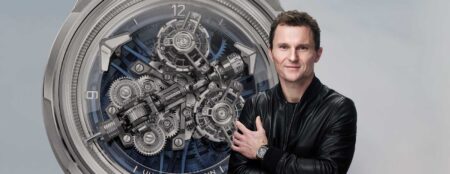
Maximilian Büsser has built MB&F by treating watchmaking less as a fixed category and more as a language for ideas, memory and mechanical theatre.
In the opening edition of Twelve on Time, the founder of MB&F offers a compact but revealing look at the watches, people and principles that continue to shape his view of horology.
What comes through isn’t a collector’s checklist or a brand manifesto, but a belief that watches matter most when they carry human intent.

At a glance
- Maximilian Büsser reflects on the watches, people and ideas that formed his relationship with watchmaking.
- The Urwerk UR-103, Beat Haldimann’s H2 and a 1995 IWC DaVinci all appear as touchpoints in his personal horological map.
- His advice to younger collectors is to understand a brand’s integrity and the reason behind a purchase before buying.
The Urwerk moment that changed the frame
For Büsser, the watch that altered his perception of watchmaking was the Urwerk UR-103 in 2003.
He describes it as the first three-dimensional kinetic art object that also gives the time, which says a great deal about the creative territory MB&F would later occupy.
The point isn’t simply that the UR-103 looked unconventional.
It suggested that a wristwatch could move beyond display, case and movement into something closer to mechanical sculpture.
That idea sits comfortably alongside MB&F’s own world, where machines often feel as if they’ve escaped from a childhood sketchbook and then been disciplined by serious watchmaking.
Craft, integrity and the people behind the watch
Asked what quality he values most in a watch, Büsser doesn’t begin with finishing, rarity or accuracy.
He points instead to the human qualities of the creator, and often to the journey shared along the way.
That answer neatly cuts against one of the more transactional habits of modern collecting.
For Büsser, a watch is not only an object but evidence of intent, risk and personality.
His view of care is similarly restrained.
A watch made with attention, in his eyes, is one where no detail pulls away from the whole.
It’s a useful standard because it avoids confusing loudness with craft.
The best details don’t always announce themselves first, but they do make the entire object feel resolved.
Against speculation and easy value
Büsser is blunt about one of the most overrated trends in contemporary watchmaking.
He identifies the treatment of watches as speculative assets, a point that will resonate with anyone who has watched parts of the market become more financial than emotional.
His concern for the industry also runs toward value.
The greatest challenge, as he sees it, is returning to a healthier value-for-money ratio.
That’s a notable comment from someone operating in the independent high-end space, where price is often attached to creativity, complexity and scarcity.
It also reflects a broader pressure on the watch world to justify not just cost, but meaning.
The watches and figures on his personal map
Büsser’s favourite complication isn’t a perpetual calendar or a chronograph.
His answer is the creator’s complicated brain, which is both playful and revealing.
When looking at watchmaking history, he singles out the period between 1750 and 1870 as the era that most fundamentally shaped the field.
That span produced virtually every known complication, laying the foundation for much of what mechanical watchmakers still refine today.
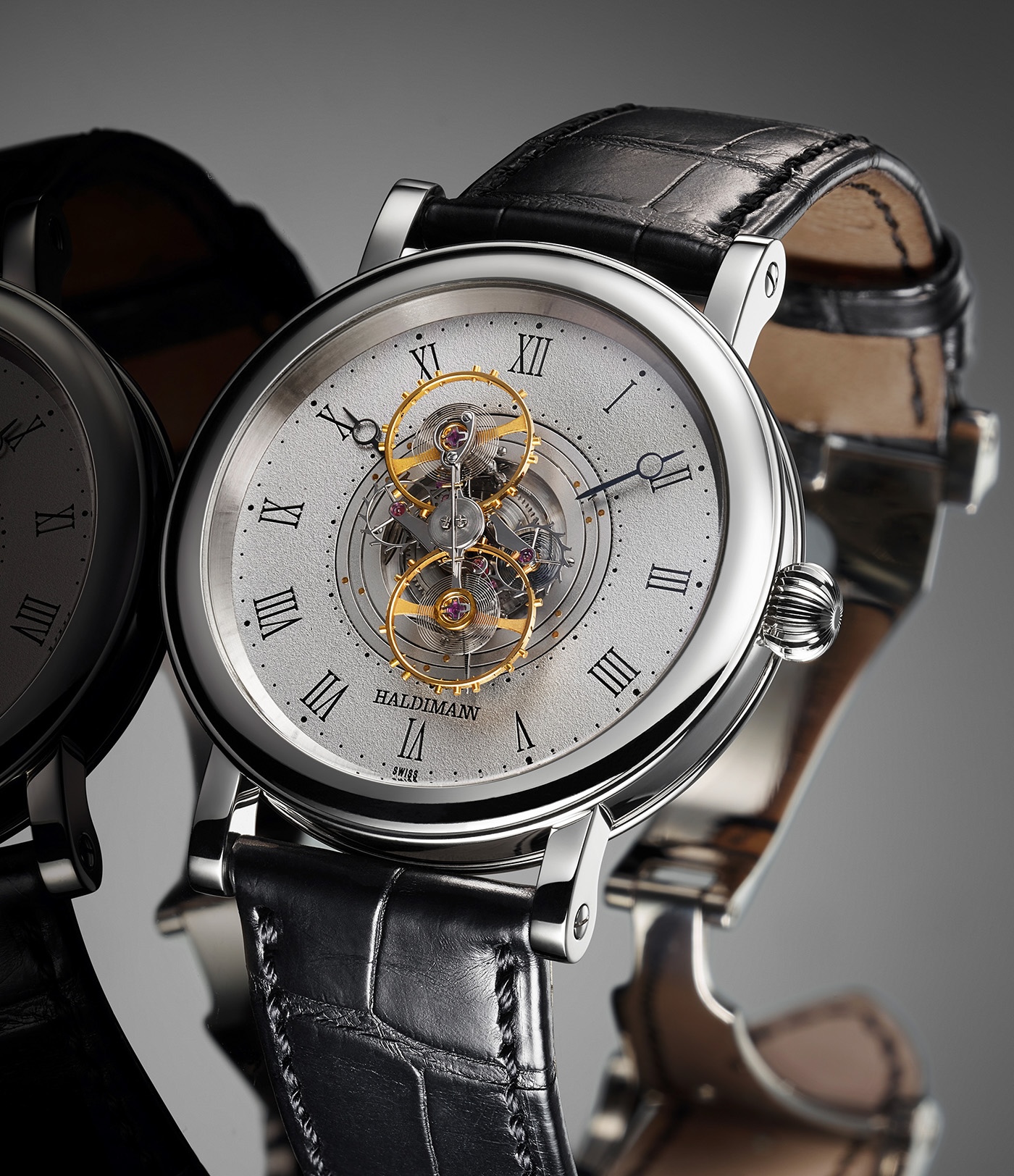
As for the watch he wishes he had created, Büsser names Beat Haldimann’s H2.
It’s a telling choice, rooted in independent watchmaking and in a fascination with ideas that challenge conventional display and purpose.
The watch he wears most privately these days is more classical in origin.
He points to his 1995 IWC DaVinci 10th anniversary model, which added a split-second chronograph to the Perpetual Calendar.
The industry figure who most shaped his view of watchmaking is Günter Blümlein, the influential executive associated with IWC, Jaeger-LeCoultre and A. Lange & Söhne under LMH.
Blümlein’s legacy is inseparable from the modern revival of serious Swiss and German watchmaking, and from the luxury group architecture that helped shape today’s Richemont landscape.
What younger collectors should take from it
Büsser’s advice for younger collectors is simple but demanding.
Before buying the next watch, they should understand the “why” and the level of integrity behind the brand.
That’s not the quickest route to a purchase, but it may be the most durable one.
It asks collectors to look past momentum and toward authorship, consistency and the values that sit behind the product.
In the end, Büsser’s answers describe a watch culture driven less by possession than by curiosity.
The lasting impression is of a creator who still sees timepieces as emotional machines, shaped by memory, personality and the stubborn pursuit of an idea.