The Omega Speedmaster Moonwatch is one of the rare watches whose story doesn’t need embellishment.
Born as a functional chronograph and later tied permanently to space exploration, it has become a benchmark for collectors who value continuity as much as technical progress.
As another anniversary approaches, the Moonwatch feels less like a watch preserved in time and more like one carefully refined across generations.

At a glance
- The Omega Speedmaster Moonwatch remains one of the defining chronographs in modern watch history.
- Its evolution has centred on preserving the familiar case, dial and hand-wound character while improving movement technology.
- The watch continues to appeal to collectors who want history, daily wearability and a design with unusually strong continuity.
From instrument watch to Moonwatch identity
The Speedmaster did not begin life as a lunar object.
Its earliest purpose was more grounded, as a clear and robust chronograph made for timing events with speed, precision and legibility.
That foundation still explains why the Moonwatch works so well today.

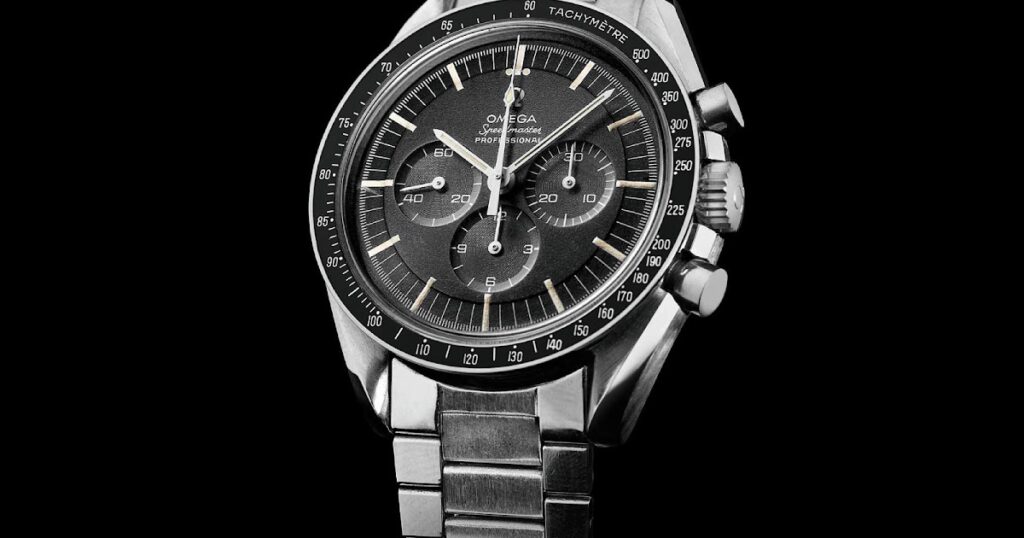
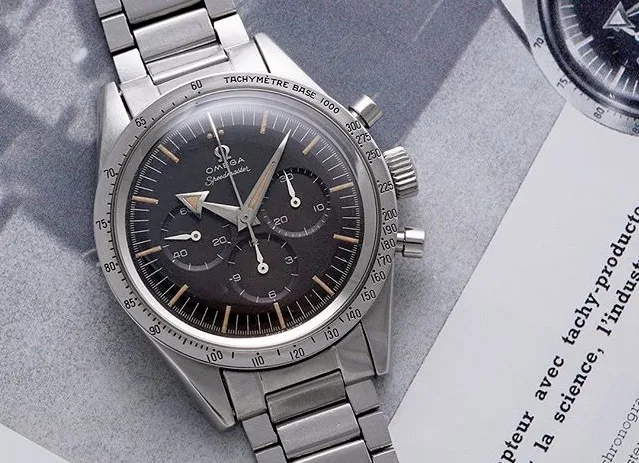
The black dial, contrasting hands, external tachymeter scale and uncluttered chronograph layout are not decorative nostalgia, but the remains of a deeply practical design language.
The Moonwatch identity came later, shaped by Omega’s role in the space age and by the model’s association with human spaceflight.
Few watches have managed to absorb such a large cultural story without losing the simplicity of the object itself.
The case and dial details that stayed familiar
The most important part of the Moonwatch’s evolution is what Omega chose not to erase.
The familiar asymmetrical case, lyre-style lugs, black dial, three-register chronograph layout and hand-wound personality remain central to the watch’s appeal.
That restraint matters because the Speedmaster’s proportions and visual balance are a large part of its authority.
Collectors often talk about the Moonwatch as if it were a single object, but small changes in hands, bezels, typography, bracelets and case finishing have created a rich field of nuance.
Those differences are part of the reason the Speedmaster has such a deep collector culture.
It can be read casually as a famous chronograph or studied closely as a long-running design with many subtle chapters.
Movement evolution without losing the ritual
The hand-wound movement is essential to the Moonwatch experience.
Winding it each day is not a compromise for many owners, but part of the relationship with the watch.
Across its life, the Speedmaster has moved through several movement generations, with Omega gradually updating performance while keeping the manual-wind chronograph format intact.
That balance is important.
A Moonwatch that looked right but abandoned its tactile ritual would feel like a different proposition entirely.
The contemporary Moonwatch brings modern chronometer expectations into a watch whose charm is still rooted in mid-century instrument design.
Why the Moonwatch still matters to collectors
The Speedmaster Moonwatch sits in an unusual position because it’s both accessible as an idea and endlessly detailed as a collecting subject.
A newcomer can understand it immediately, while a seasoned enthusiast can spend years studying references, bezels, bracelets and movement transitions.
It also avoids the fragility that sometimes surrounds historically important watches.
The Moonwatch remains wearable, versatile and recognisable without becoming theatrical.
That is a difficult combination to sustain over decades.
Omega has introduced many Speedmaster variations over the years, but the core Moonwatch continues to serve as the collection’s centre of gravity.
Details & Specifications
| Brand | Omega |
|---|---|
| Model | Speedmaster Moonwatch |
| Watch type | Manual-winding chronograph |
| Case style | Asymmetrical chronograph case |
| Dial | Black dial with three chronograph subdials |
| Key design feature | Tachymeter scale on the bezel |
| Collection significance | Historic Speedmaster model associated with space exploration |
The enduring strength of the Omega Speedmaster Moonwatch is that it doesn’t ask to be treated like a museum piece.
It carries one of watchmaking’s most famous stories, yet its real power is still found on the wrist, where the design remains as direct, useful and compelling as ever.