IWC can look deceptively simple from the outside.
The Schaffhausen watchmaker has a clean, functional design language, but its Pilot’s Watch family alone stretches from everyday steel models to heavyweight complications in gold.
For anyone trying to tell a Mark XX from a Big Pilot, or a practical chronograph from a collector-grade perpetual calendar, the differences are clearer once you understand what each model is trying to do.

At a glance
- IWC’s Pilot’s Watch family includes the Mark XX, Big Pilot, Pilot’s Watch Chronograph, perpetual calendar models, tourbillons and the space-focused Venturer Vertical Drive.
- The collection is built around aviation legibility, with high-contrast Arabic numerals, clean dials, practical crowns and purpose-led case proportions.
- Confirmed prices range from £5,500 for the Pilot’s Watch Mark XX to £43,000 for the Big Pilot’s Watch Perpetual Calendar ProSet, while the Constant Force Tourbillon is price on request.
Schaffhausen roots and aviation clarity
IWC was founded in Schaffhausen in 1868 by American watchmaker Florentine Ariosto Jones under the name International Watch Co.
The idea was unusual for its time, bringing progressive American production techniques into contact with Swiss watchmaking skill.
That mix of practicality and craft still matters when looking at the modern Pilot’s Watches.

The family traces its character to aviation watches of the 1930s and 1940s, when clarity was not a styling preference but a navigational tool.
A pilot needed to read the time quickly, and the IWC formula still leans on that principle through matte dials, strong contrast and large Arabic numerals.
Mark XX and Big Pilot define the entry points
The Pilot’s Watch Mark XX is the cleanest expression of IWC’s aviation design.

It follows the spirit of the Mark XI, a watch with genuine military history, but packages the idea in a modern 40mm stainless steel case.
The layout is deliberately restrained, with a single-colour dial, high-contrast numerals and no unnecessary visual noise.
Inside is IWC’s calibre 32111, an automatic movement with a substantial 120-hour power reserve.

Although black and white is the classic pilot-watch pairing, the Mark XX is also offered in green and blue, which gives the model more range without diluting its purpose.
The Big Pilot’s Watch takes the same essential vocabulary and turns up the scale.
Its 46.2mm case, oversized fluted crown and broad dial presence make it the more theatrical sibling, but those details come from practical aviation needs rather than pure showmanship.

The large crown was intended to be easier to grip while wearing thick aviation gloves.
On the Big Pilot’s Watch IW501001, the automatic calibre 52110 offers a 168-hour power reserve, while the dial includes a days-of-the-week subdial that helps separate it from the simpler Pilot’s Watch line.
The size is central to the appeal, but it’s also the point that makes the Big Pilot more divisive on the wrist.

IWC has offered a smaller 43mm version since 2021 without the days-of-the-week display, giving buyers a more wearable route into the look.
Chronographs, calendars and tourbillons take the range upward
The Pilot’s Watch Chronograph adds timing functionality while keeping the collection’s legibility-first mindset intact.
A chronograph inevitably makes the dial busier, but it also gives the watch a useful role for measuring defined intervals with greater precision.
The Pilot’s Watch Chronograph 41 reference IW388104 uses the automatic calibre 69385, with a 46-hour power reserve, and pairs a 41mm stainless steel case with a green dial and steel bracelet.
IWC also builds this format across multiple colourways and special editions, including ceramic versions such as the pale Lake Tahoe.
Higher in the collection, the perpetual calendar pieces show how far the Pilot’s Watch language can be pushed without abandoning its identity.
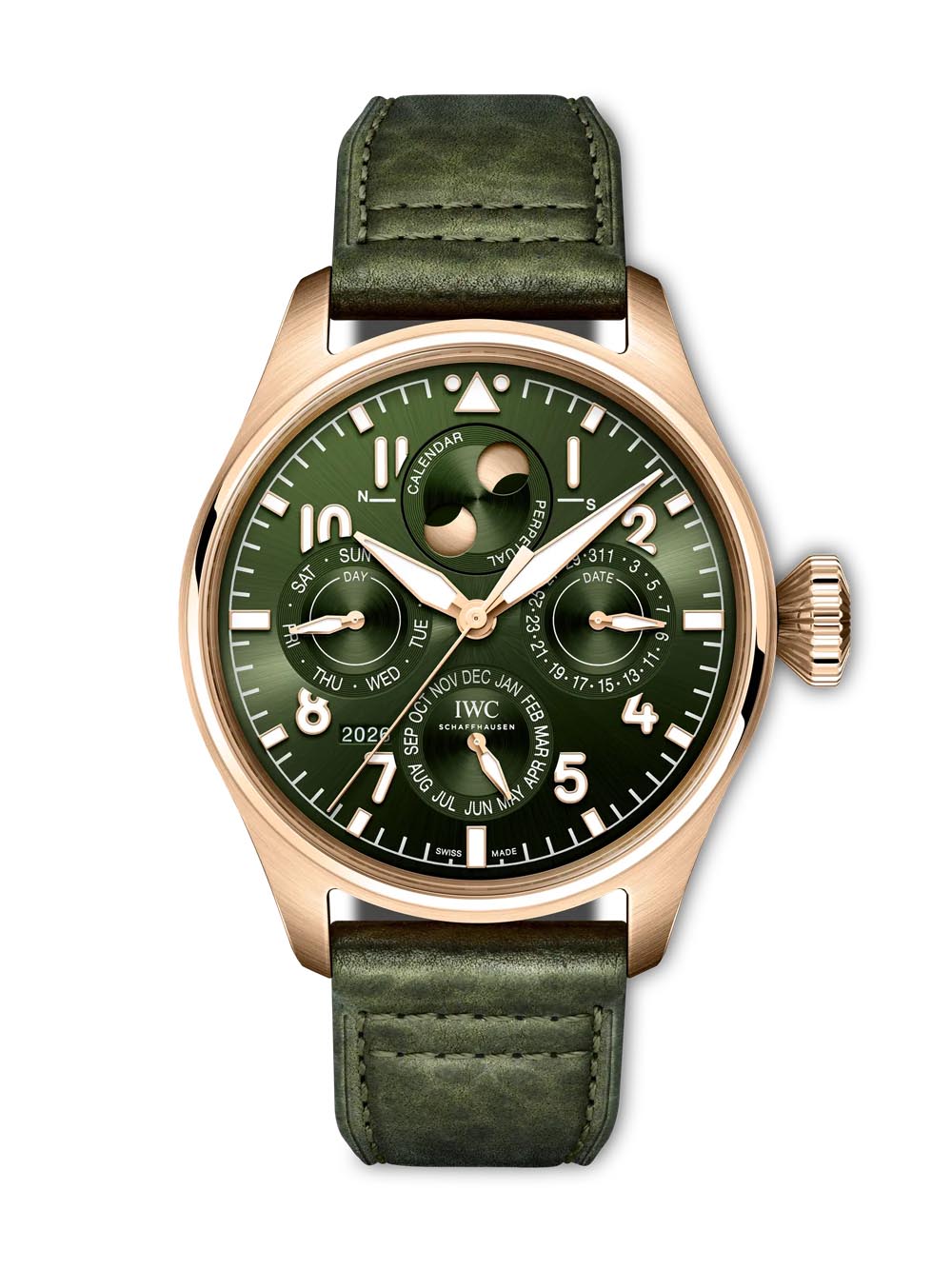
IWC splits these models across both Big Pilot’s Watch and standard Pilot’s Watch formats, placing one of watchmaking’s most respected complications inside an aviation-inspired case.
The Big Pilot’s Watch Perpetual Calendar ProSet, introduced in 2026, brings a notable rethink to how the calendar is adjusted.
Its calibre 82665 was reworked so the entire calendar can be moved forwards and backwards using only the crown.
The 42mm case in 18k 5N gold, olive green sunray dial and matching buffalo leather strap make it one of the more refined expressions of the Pilot’s Watch idea.
The tourbillon models sit at the most technical end of the family.
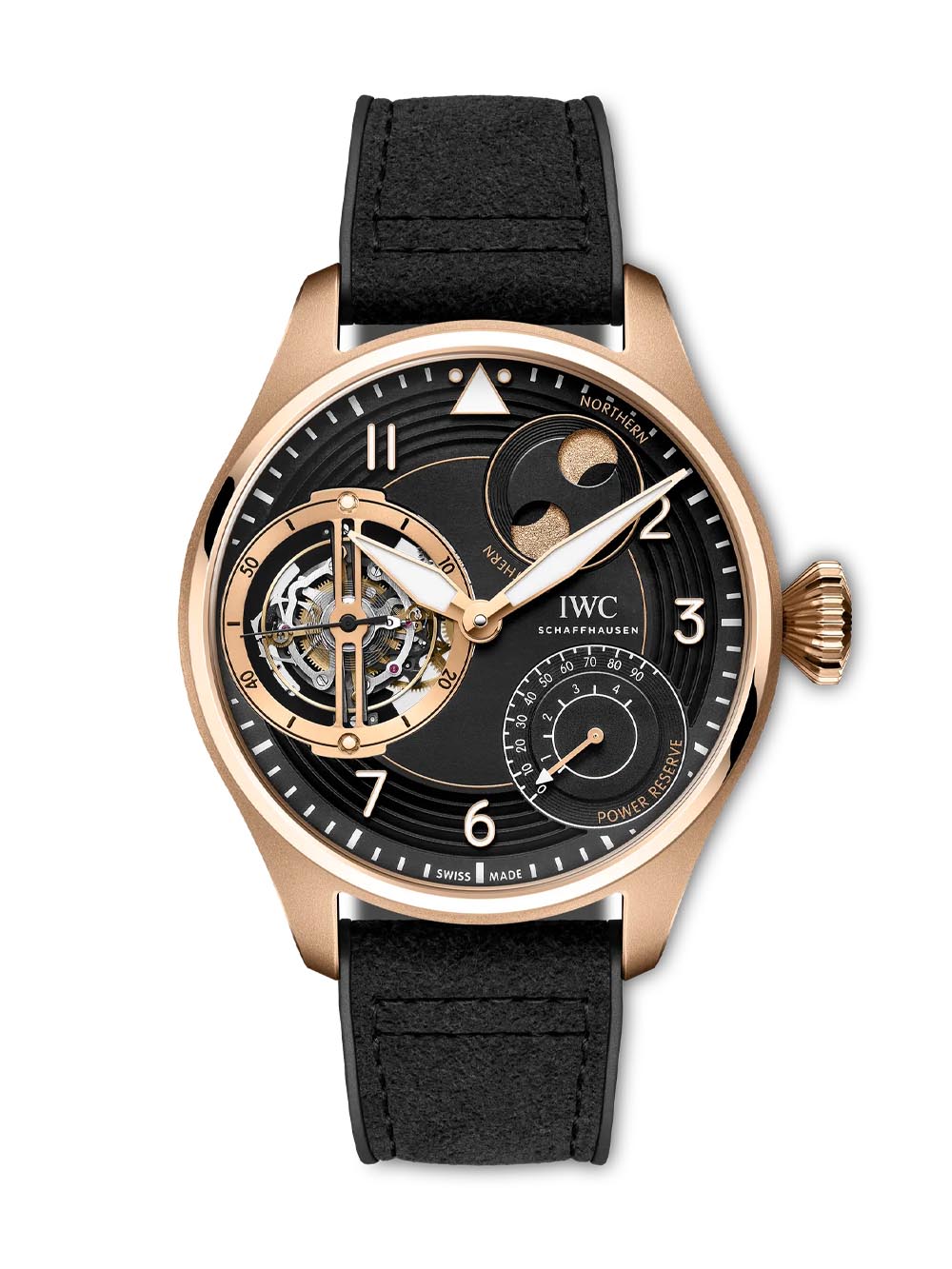
IWC has built several Big Pilot’s Watch tourbillons, including pieces within the Le Petit Prince sub-collection, plus a perpetual calendar edition.

In 2025, the Big Pilot’s Watch Shock Absorber Tourbillon Skeleton XPL combined a tourbillon with the brand’s SPRIN-g PROTECT shock absorber system.
For 2026, the Big Pilot’s Watch Constant Force Tourbillon added another layer of mechanical control.
Its constant force mechanism regulates energy delivery to the balance, limiting torque when the power reserve is full rather than simply compensating as the reserve runs down.

The Venturer Vertical Drive leaves the cockpit behind
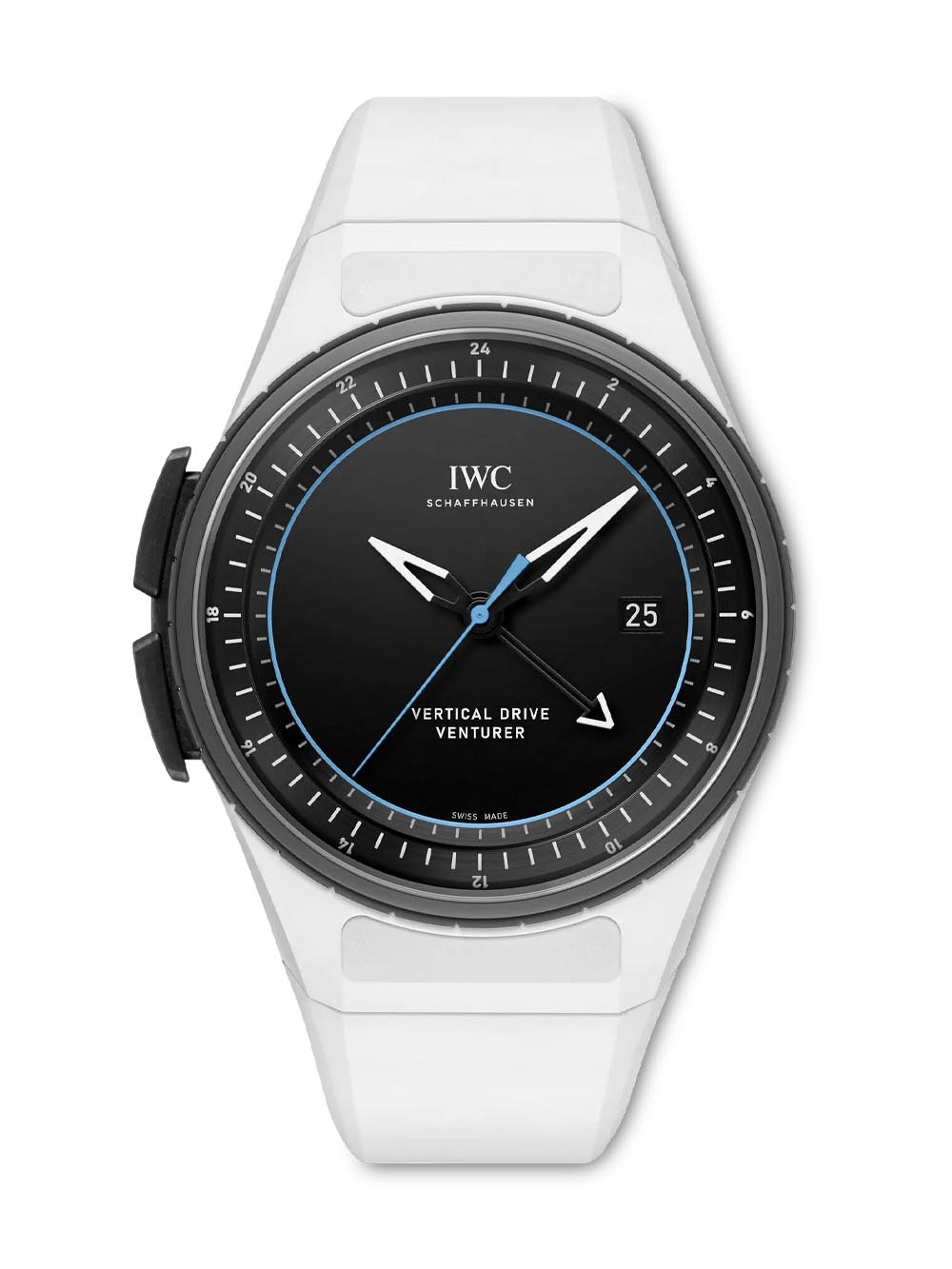
The Venturer Vertical Drive takes IWC’s functional tool-watch thinking into a different environment.
Rather than being shaped around aircraft use, it has been developed for space, with operation during a space-walk as a central requirement.
That means the watch has to be usable, set and wound while wearing a space suit.

It’s an extreme brief, but it fits the same broader IWC logic that runs through the Pilot’s Watch family, where design choices are expected to serve a practical role.
Details & Specifications
| Brand | IWC, founded as International Watch Co. in Schaffhausen in 1868 |
|---|---|
| Pilot’s Watch Mark XX | Ref. IW328202, 40mm stainless steel case, black dial, 100m water resistance, calibre 32111 automatic movement, 120-hour power reserve, stainless steel bracelet, £5,500 |
| Big Pilot’s Watch | Ref. IW501001, 46.2mm stainless steel case, black dial, 60m water resistance, calibre 52110 automatic movement, 168-hour power reserve, black calfskin strap, £10,500 |
| Pilot’s Watch Chronograph 41 | Ref. IW388104, 41mm stainless steel case, green dial, 100m water resistance, calibre 69385 automatic chronograph movement, 46-hour power reserve, stainless steel bracelet, £6,800 |
| Big Pilot’s Watch Perpetual Calendar ProSet | Ref. IW329602, 42mm 18k 5N gold case, olive green sunray dial, 60m water resistance, calibre 82665 automatic perpetual calendar movement, 60-hour power reserve, olive green buffalo leather strap, £43,000 |
| Big Pilot’s Watch Constant Force Tourbillon | Ref. IW590503, 46.2mm 18k Armor Gold case, black dial, 60m water resistance, calibre 94800 manual-winding movement, 96-hour power reserve, black rubber strap with Alcantara inlay, price on request |
For a first IWC, the Mark XX is the cleanest and most wearable place to start, while the Big Pilot’s Watch is the one to try if scale and historic character matter most.
From there, the range becomes a question of function and appetite, whether that means a chronograph for practical timing, a perpetual calendar for mechanical depth or a tourbillon for a more specialised kind of collecting.