Vacheron Constantin’s relationship with the Louvre has always made sense on paper, but its newest Métiers d’Art watches make the idea unusually tactile.
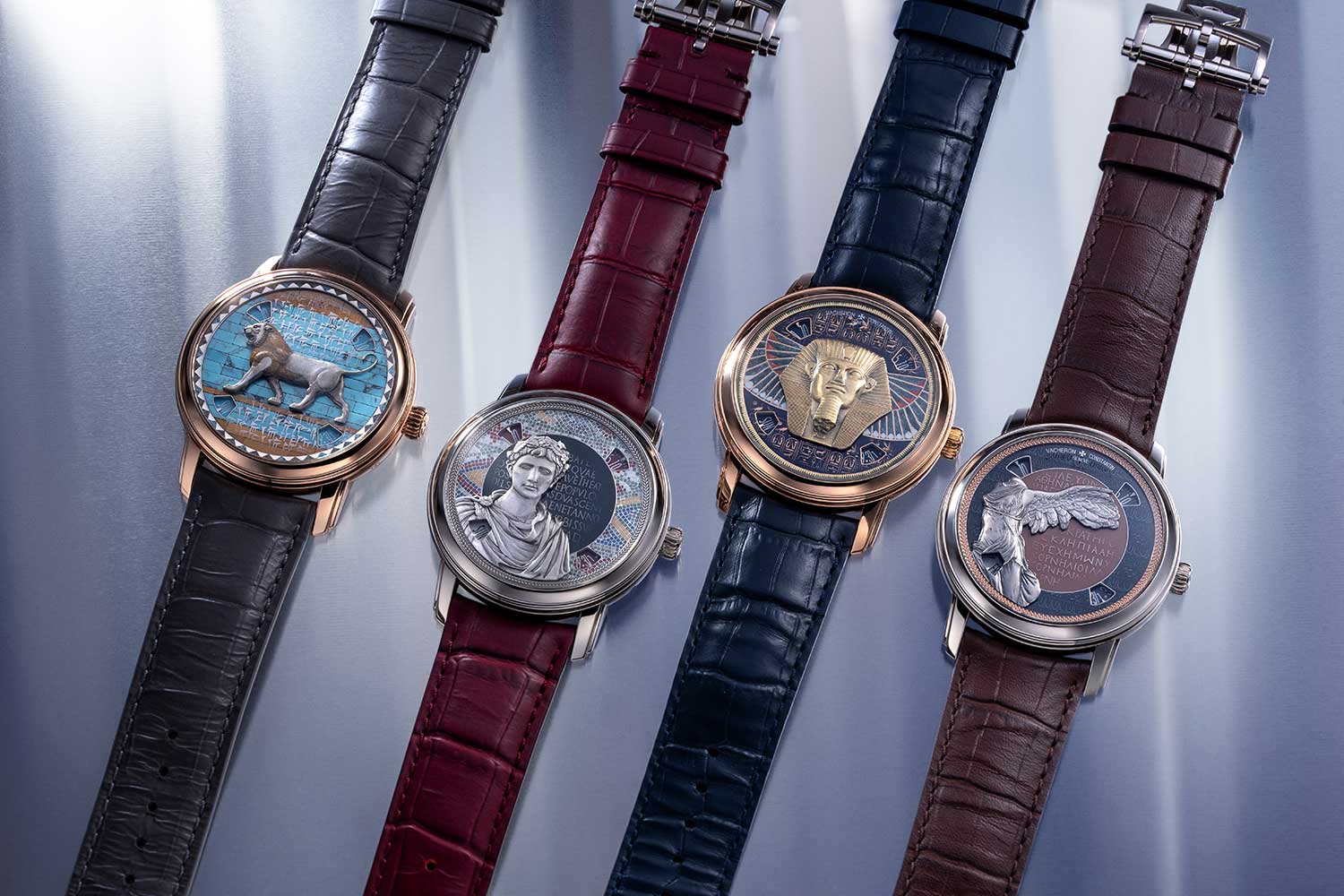
The latest Tribute to Great Civilisations quartet moves beyond decorative reference and puts stone carving at the centre of the dial, translating antiquities from Egypt, Assyria, Greece and Rome into miniature wearable reliefs.
It’s a serious exercise in scale, patience and cultural interpretation from a manufacture whose own 270-plus years of watchmaking suddenly feel almost modern beside the civilisations it’s studying.
At a glance
- Vacheron Constantin has introduced a second four-piece Métiers d’Art Tribute to Great Civilisations collection created through its Louvre partnership.
- Each watch centres on a stone-carved miniature inspired by a major antiquity from Pharaonic Egypt, the Assyrian Empire, Ancient Greece or Imperial Rome.
- The dials required up to 220 hours of work apiece, with stone, engraving, enamel and gem-set decorative techniques brought together at miniature scale.
A Louvre partnership made for the wrist
The collaboration between Vacheron Constantin and the Louvre began in 2019 around a shared interest in preserving and transmitting artistic craft.
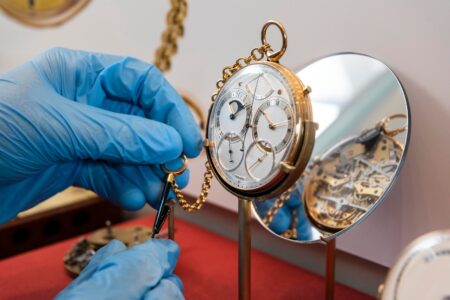
That relationship has already touched several corners of the manufacture’s world, including the restoration of La Création du Monde, an 18th-century astronomical clock gifted to Louis XV and displayed at the museum.
It also informed a Les Cabinotiers project auctioned by the Louvre, where the eventual owner could choose a dial motif from the museum’s masterpieces.

For Vacheron Constantin’s 270th anniversary, the bond took a more theatrical turn with La Quête du Temps, a 2,370-component creation featuring 23 horological complications and an automaton that tells the time.
The Métiers d’Art Tribute to Great Civilisations line sits in a different register.
It is quieter, more intimate and arguably more demanding in how it compresses monumental art into a space measured in millimetres.
Stone carving changes the dial language
The first Tribute to Great Civilisations quartet, introduced in 2022, used sculpted gold reliefs to evoke the Great Sphinx of Tanis, the Lion of Darius, the Winged Victory of Samothrace and a bust of Augustus.
This new chapter changes the material proposition entirely.
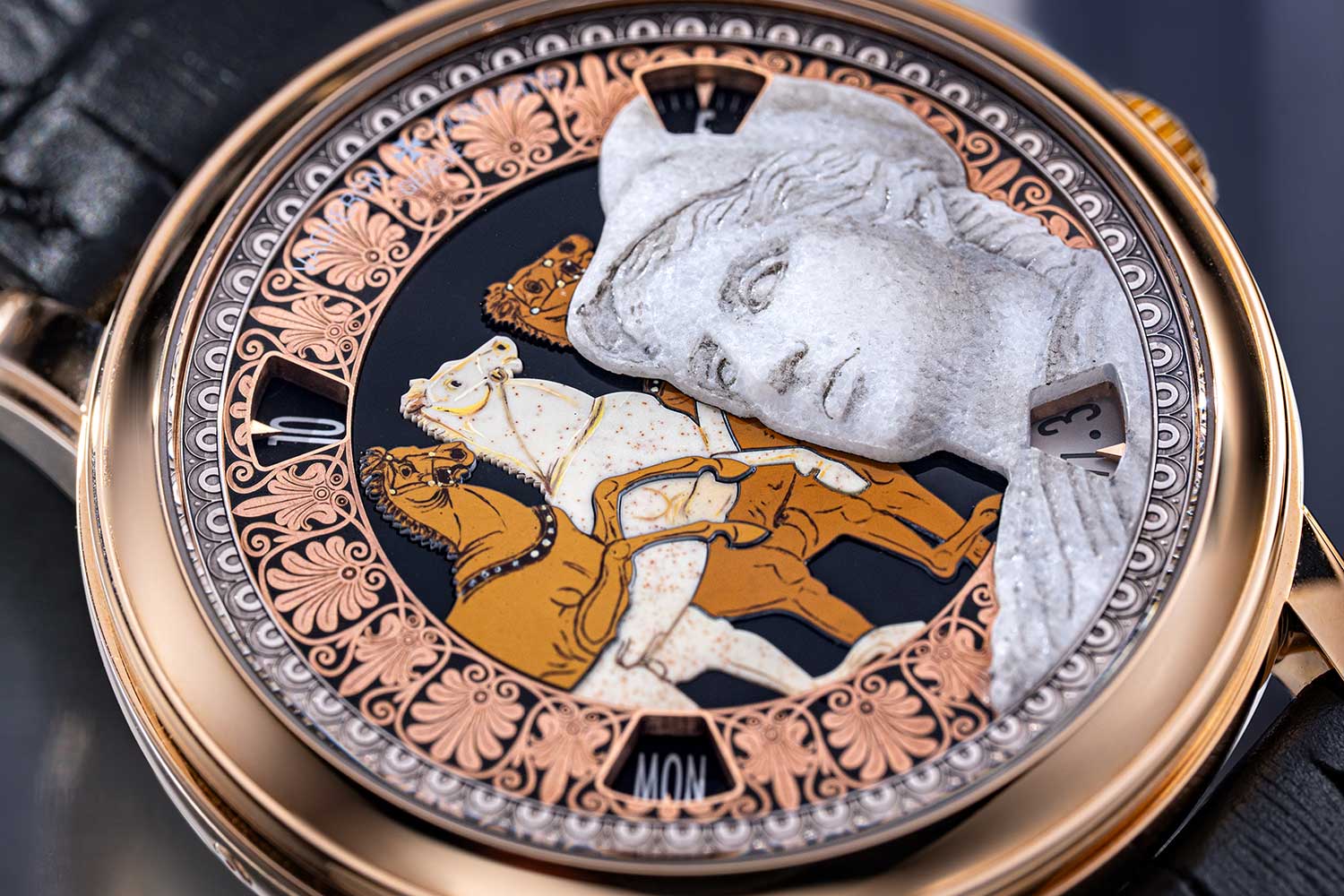
For the first time in this context, Vacheron Constantin has used stone for the central appliques, working with limestone sandstone and marble chosen to echo the material character of the ancient works.

Where possible, the maison used stone of the same type and geographic origin as the antiquities that inspired the watches.
That decision turns the dials into more than miniature images.
They become a study in texture, light absorption and hand-worked surface, with each figure shaped through abrasion rather than the cutting approach familiar to metal engraving.
Before the artisans began carving, the designs were modelled in 3D to refine proportions and understand how shadows would behave across the tiny reliefs.
Each dial is built as a layered composition, with a gold baseplate, a central stone effigy, surrounding decorative appliques and a peripheral frieze.
Different specialists handled different elements, and the completed parts had to meet with micron-level precision.
That matters because a mistake late in the process would mean losing dozens of hours of concentrated craft.
Four antiquities recast in miniature
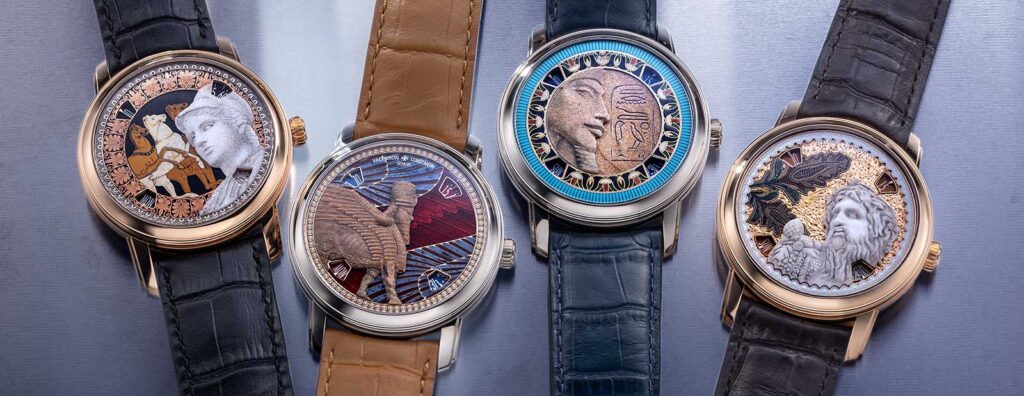
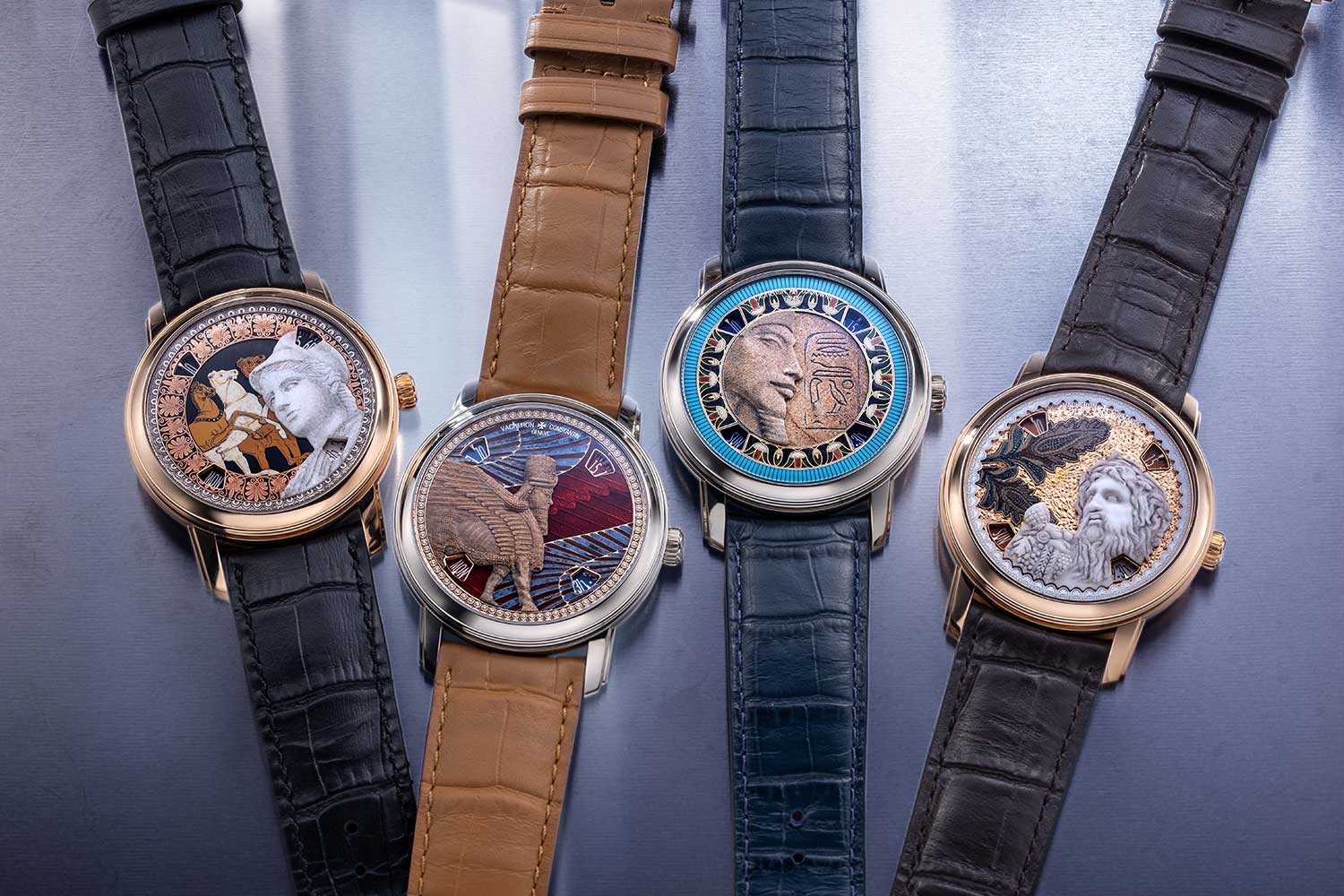
The new quartet is composed of Buste d’Akhénaton, Lamassu de Sargon II, Athéna de Velletri and Tibre de L’Iseum Campense.
Together, they trace four great strands of ancient culture through the Louvre’s antiquities collections.
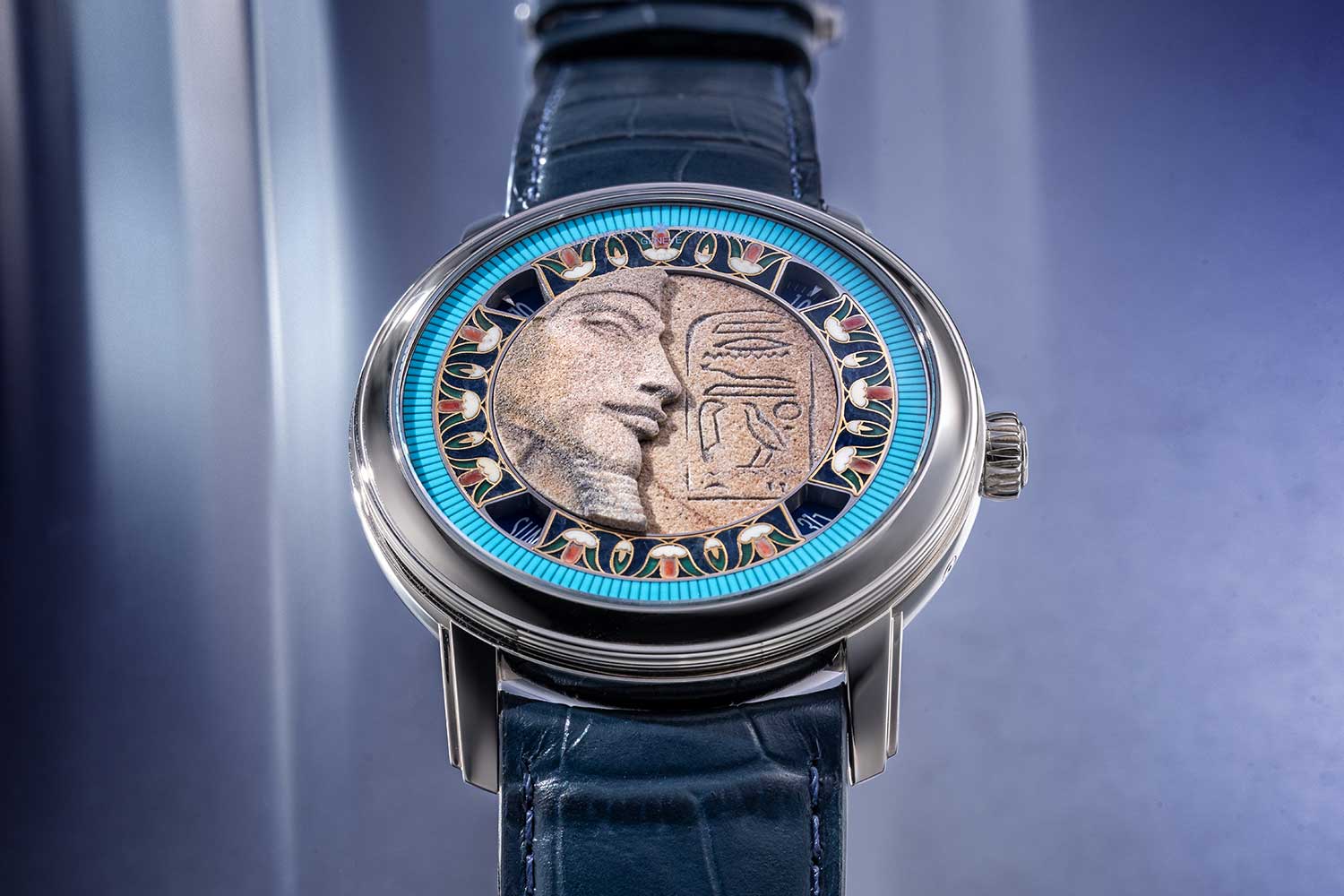
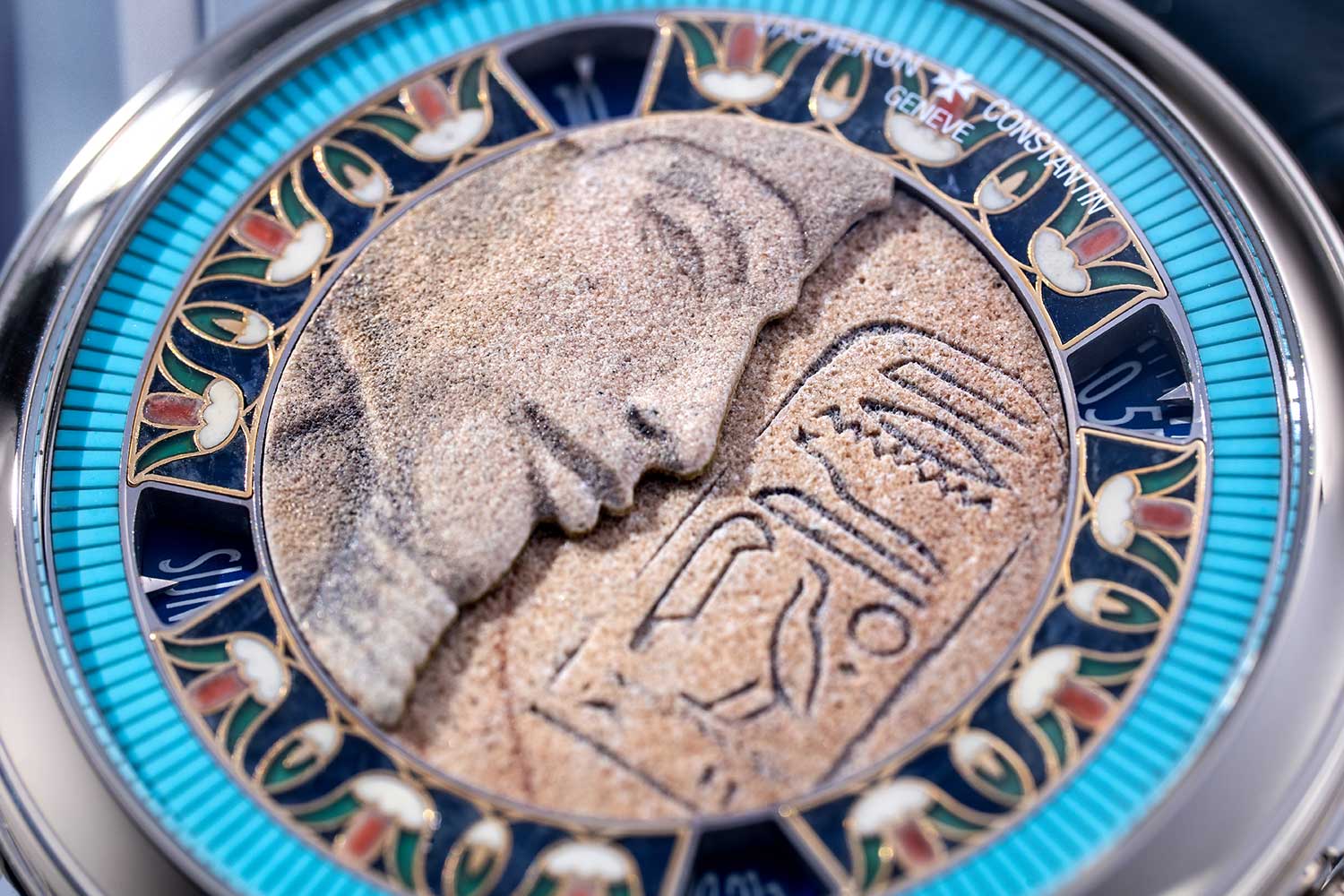
The Egyptian piece, Buste d’Akhénaton, is among the most materially direct of the four.
The pharaoh’s face is carved from Sinai limestone sandstone, the same stone associated with the museum work, then hand-patinated to bring out volume and shadow across roughly 60 hours.
The surrounding composition adds a cartouche engraved on matching sandstone, with decorative friezes including a turquoise ring inspired by the collar of Nakhti and a champlevé arrangement of red mother-of-pearl, chrysoprase, opaline and sodalite.
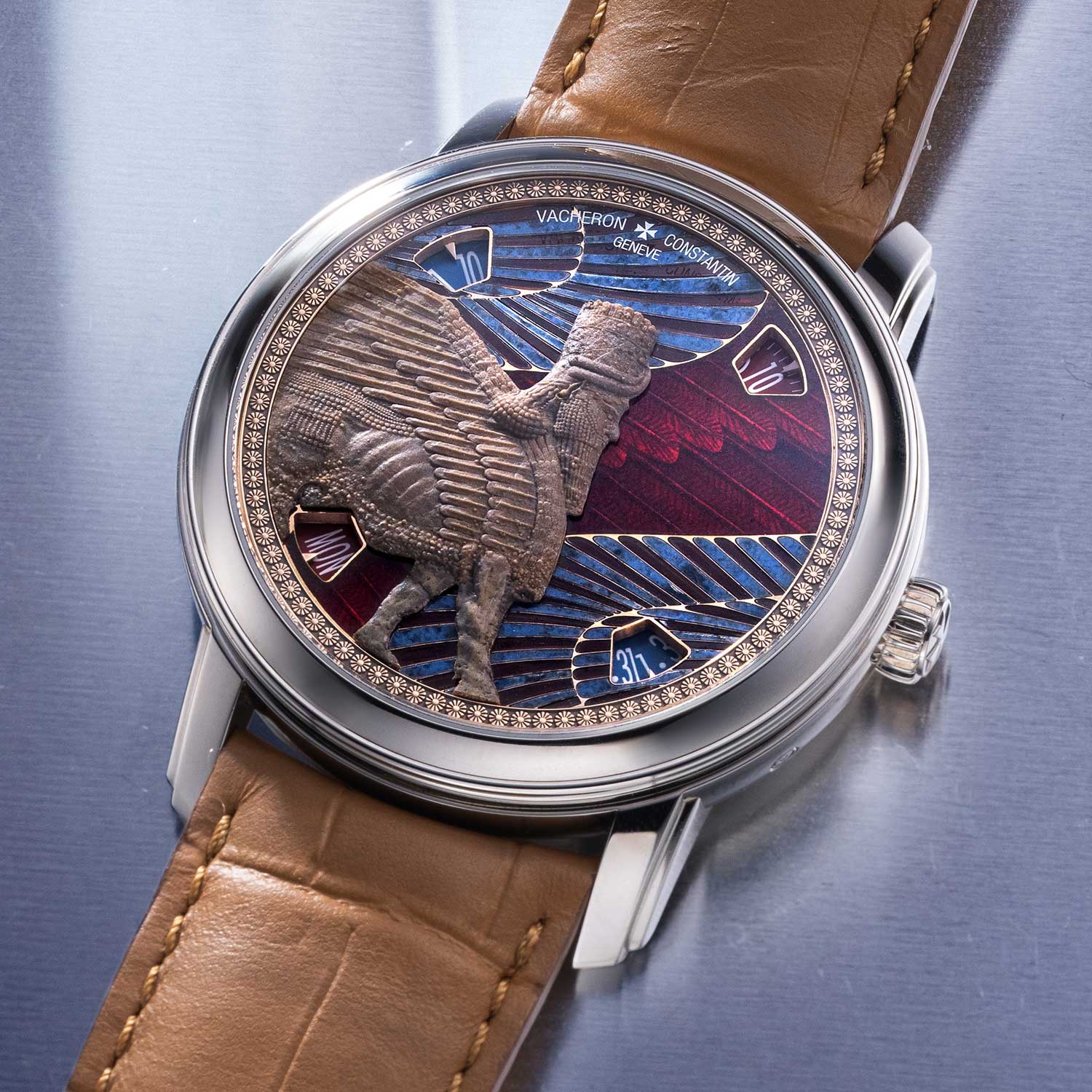
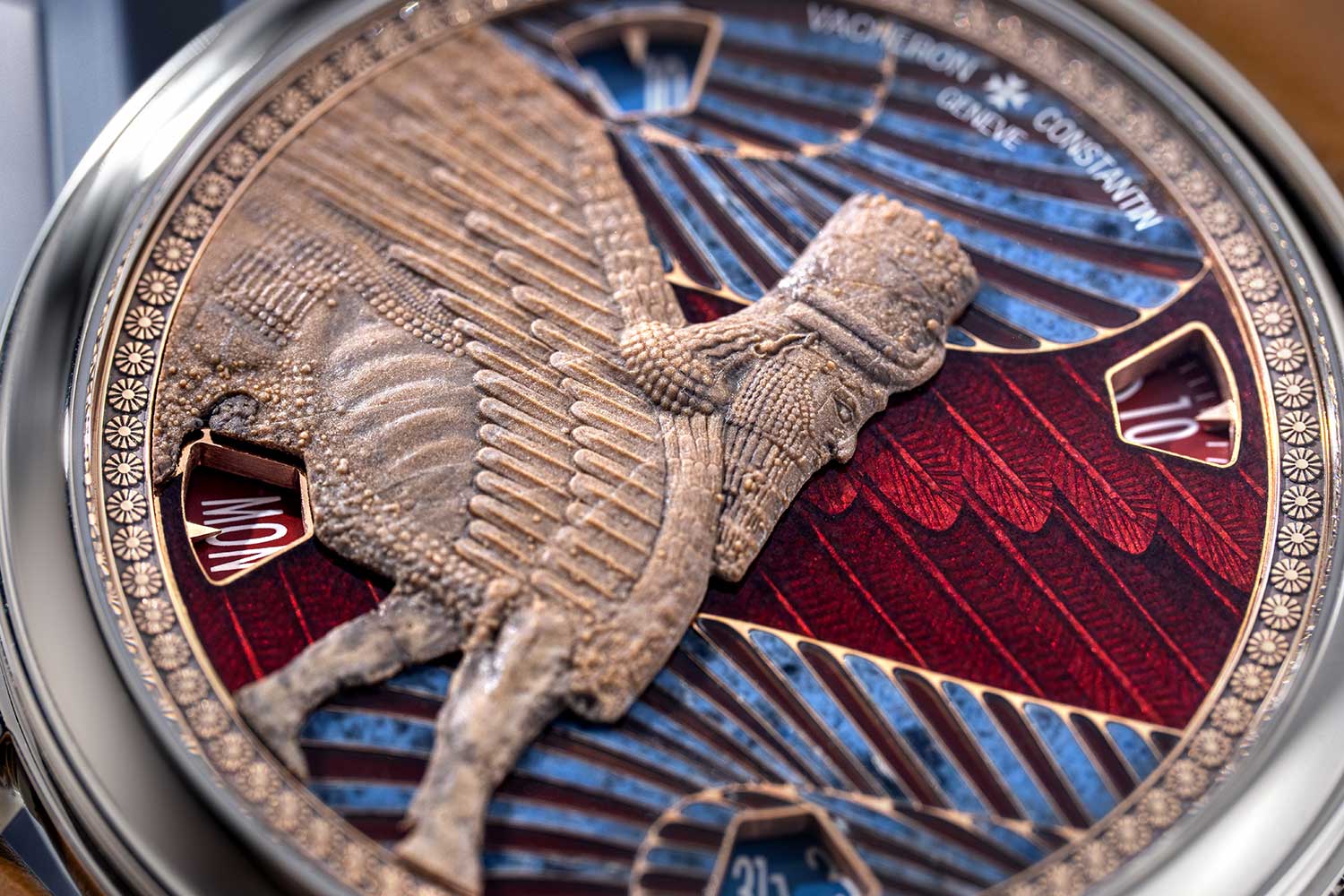
Lamassu de Sargon II takes on a different kind of challenge.
The winged, human-headed guardian from Sargon II’s palace at Khorsabad was a vast alabaster presence, yet here its beard, feathers and muscular volume are condensed into Italian limestone sandstone.
The background combines champlevé work in red agate and blue dumortierite with translucent red flinqué enamel, with roughly 152 hours of work required before the central applique was even added.
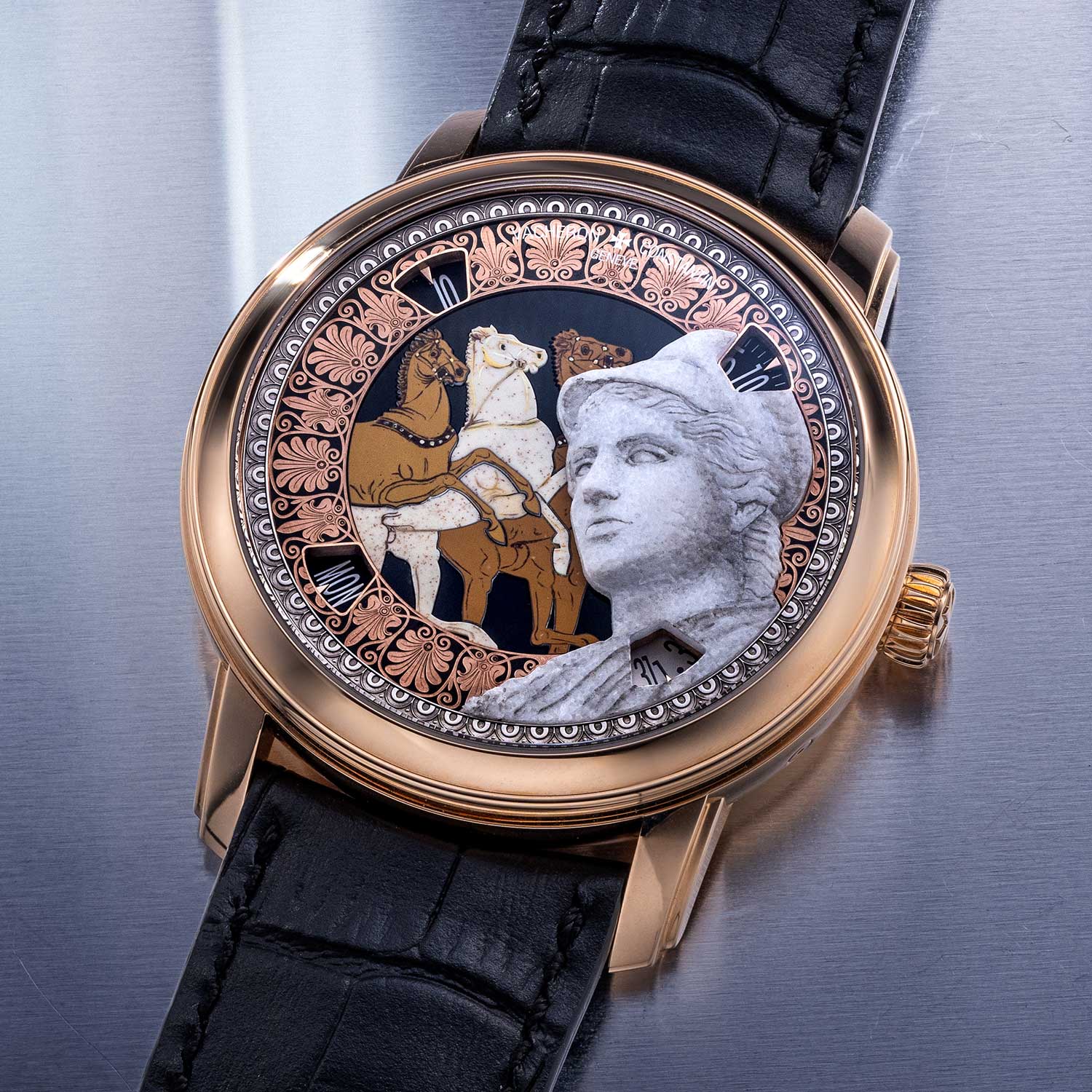
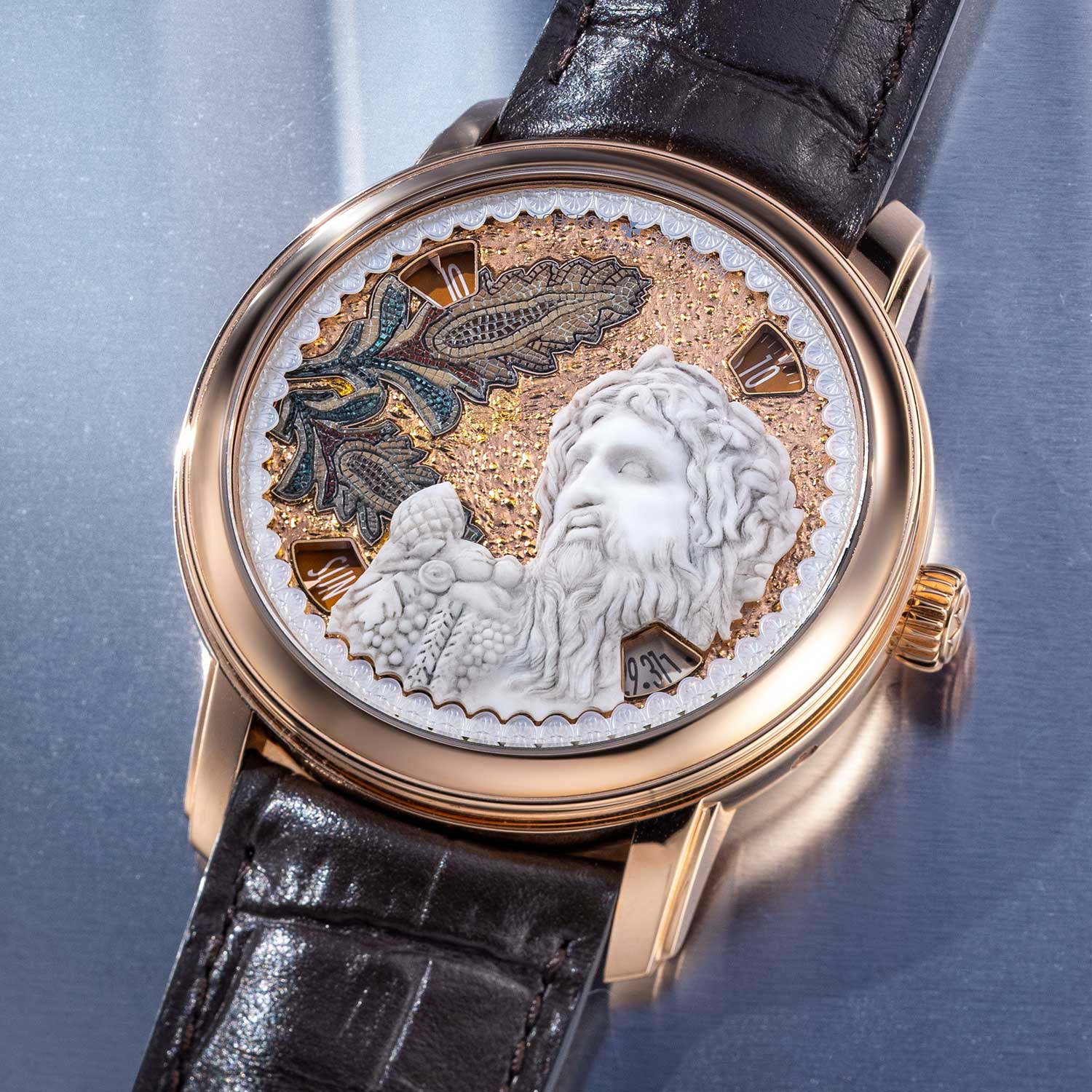
Athéna de Velletri brings Ancient Greece into the series, while Tibre de L’Iseum Campense represents Imperial Rome.
Even without shouting for attention, the grouping is ambitious because each watch needs to hold its own as an object while still belonging to a coherent four-part story.
Details & Specifications
| Brand | Vacheron Constantin |
|---|---|
| Collection | Métiers d’Art Tribute to Great Civilisations |
| Chapter | Second four-piece series within the Louvre partnership |
| Models | Buste d’Akhénaton, Lamassu de Sargon II, Athéna de Velletri, Tibre de L’Iseum Campense |
| Inspiration | Antiquities linked to Pharaonic Egypt, the Assyrian Empire, Ancient Greece and Imperial Rome |
| Central dial elements | Stone-carved appliques in limestone sandstone and marble |
| Decorative techniques | Stone carving, hand patination, engraving, champlevé work, flinqué enamel and decorative stone or mineral inlays |
| Dial work | Up to 220 hours per dial |
| Partnership | Vacheron Constantin and the Louvre, active since 2019 |
What makes these watches compelling is not simply that they borrow from museum culture, but that they treat ancient art as a technical problem as much as an aesthetic one.
For collectors drawn to métiers d’art, the appeal lies in the tension between permanence and fragility, with monumental civilisations reduced to hand-finished stone surfaces small enough to sit under sapphire crystal.