Urwerk has never treated watchmaking as a nostalgia exercise, even when the object in question is a pocket watch.
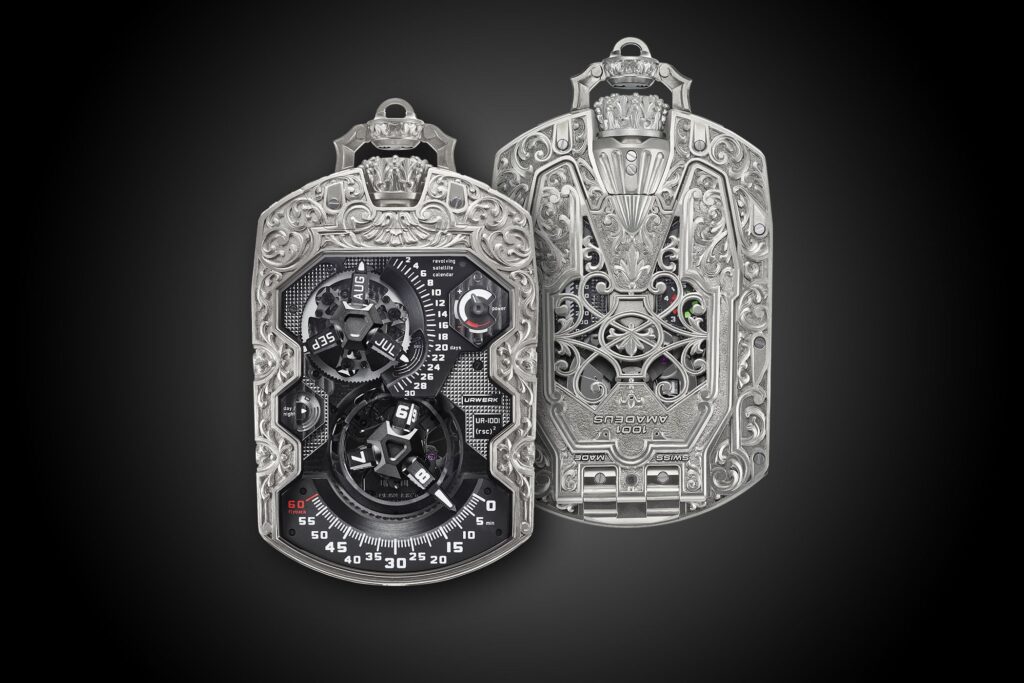
The UR-1001 Amadeus takes one of the brand’s most elaborate creations and gives it a new titanium body covered in hand engraving by Florian Güllert. It’s a unique piece, and it pushes the already unusual UR-1001 further into art-object territory without softening its mechanical weirdness.
At a glance
- Urwerk has created the UR-1001 Amadeus as a unique hand-engraved titanium version of its complex pocket watch.
- The piece combines satellite hours, retrograde minutes, a satellite calendar, running seconds, power reserve and long-term service indicators.
- The engraving work by Florian Güllert took about three months and roughly 500 hours, with pricing undisclosed.
A pocket watch with Urwerk’s space-age instincts
The UR-1001 has always been a strange proposition in the best sense.
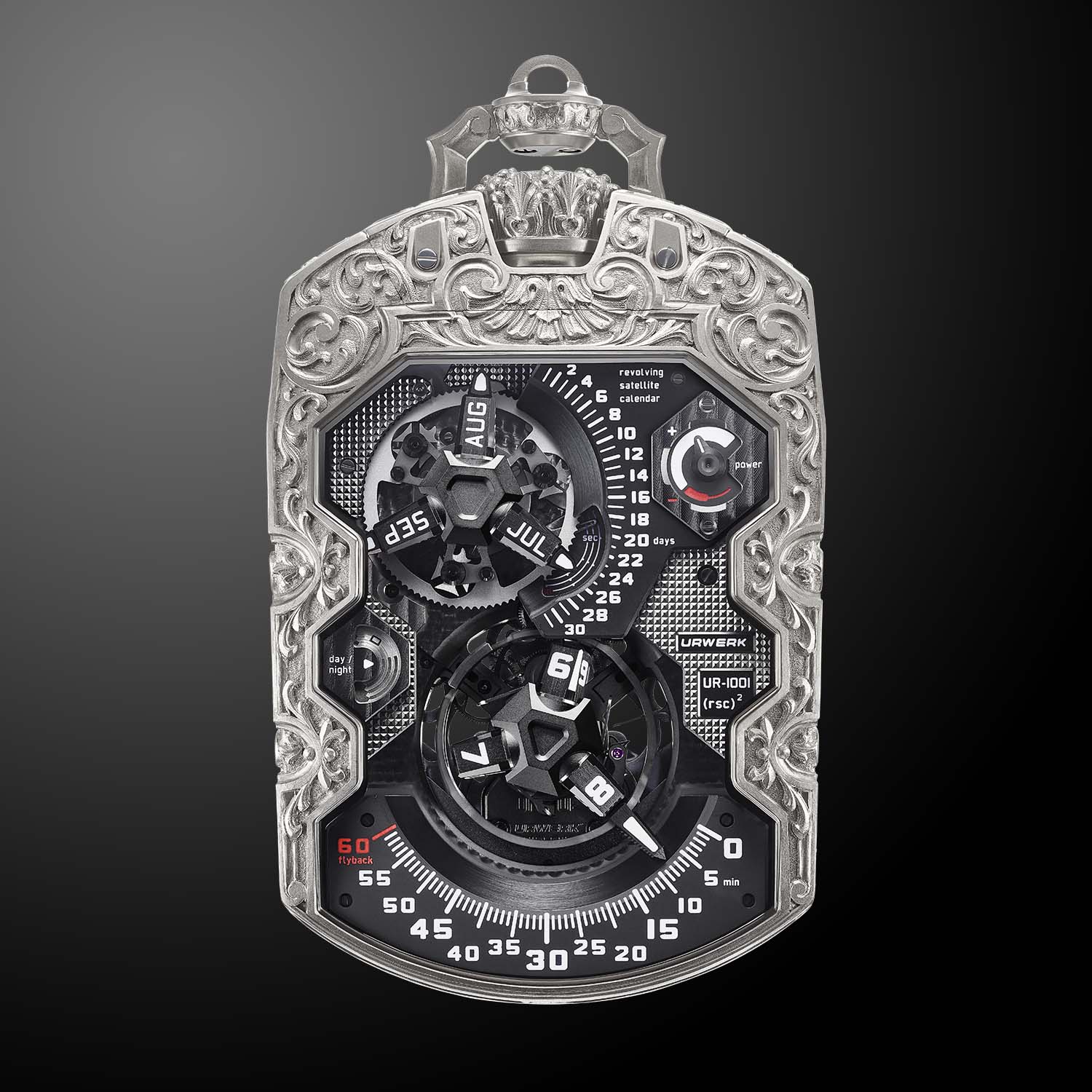
First introduced in 2011, it translated Urwerk’s wandering satellite language into a large pocket-watch format measuring 106mm by 62mm by 23mm. The shape carries a faint echo of traditional pocket watches, but almost everything else is unmistakably Urwerk.
The model is often known as the Zeit Device, a fitting name for a watch that treats time less like a dial layout and more like an engineered landscape.
Its original form used an AlTiN-treated steel case with titanium elements, making it a substantial object that sat well outside the usual conventions of portable horology.
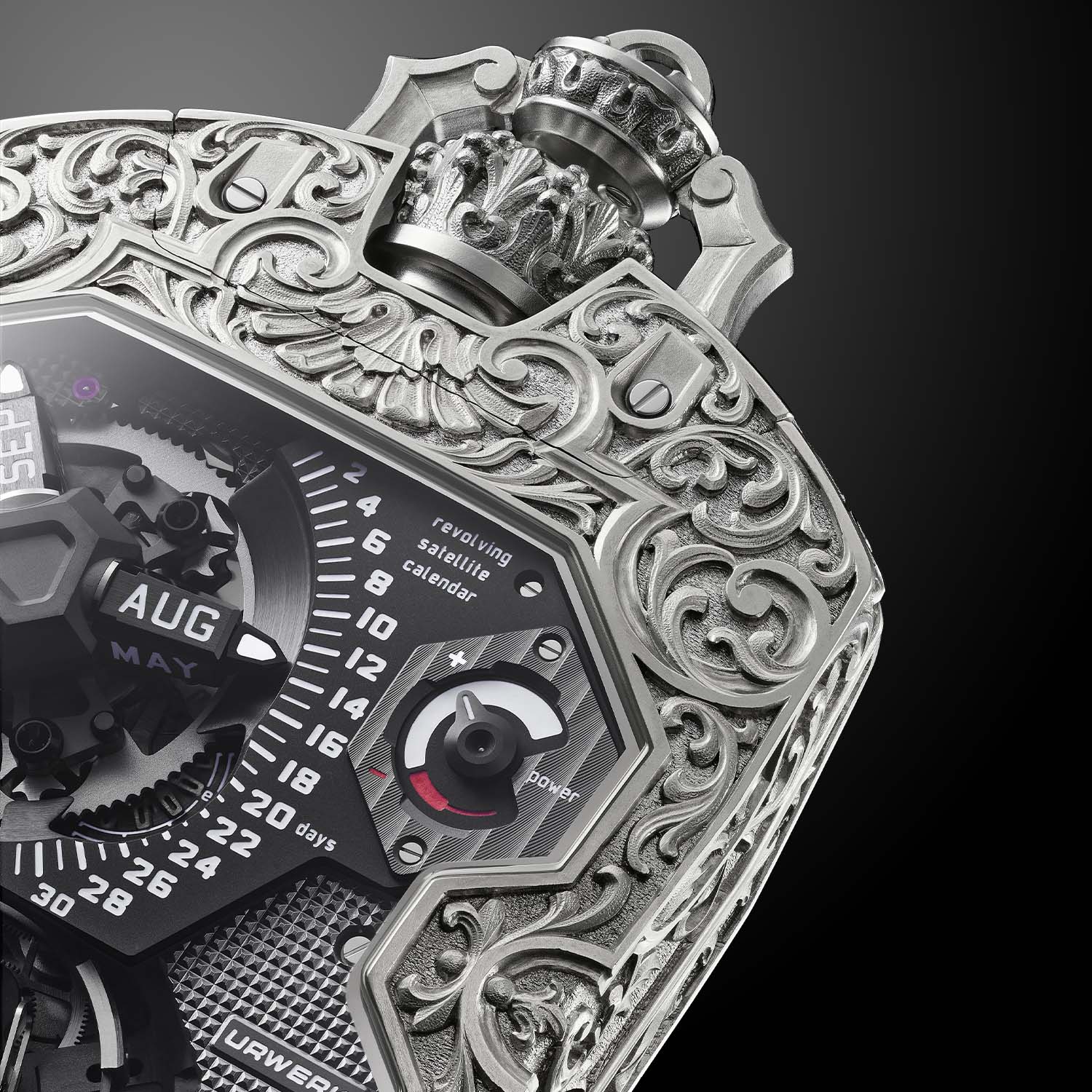
The Amadeus engraving turns titanium into ornament
For the UR-1001 Amadeus, Urwerk has moved the concept into a titanium case and given the surface to engraver Florian Güllert.
That matters because titanium isn’t the most forgiving metal for this kind of hand work. Preparing the material and executing the decoration required about three months, or around 500 hours, including the design phase.
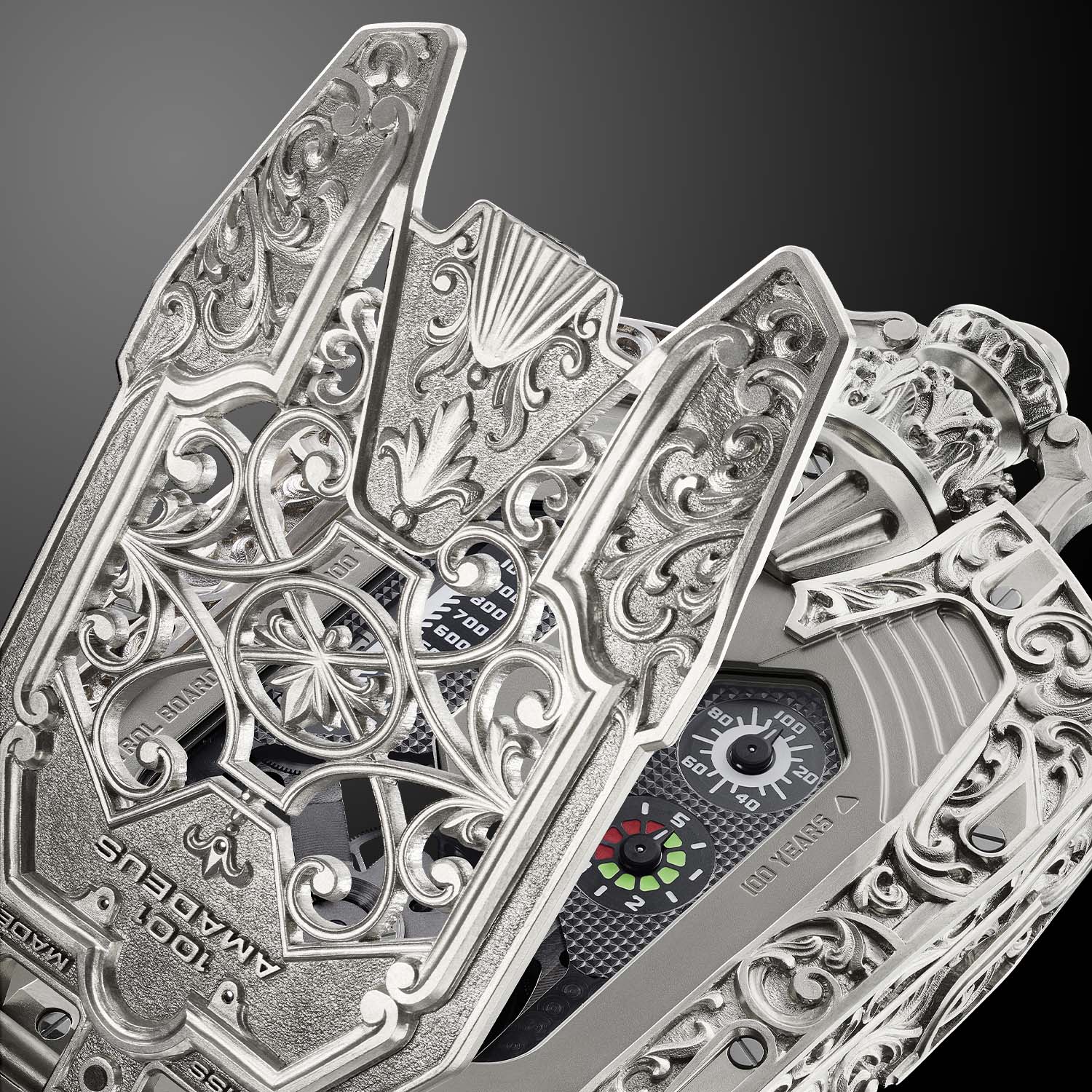
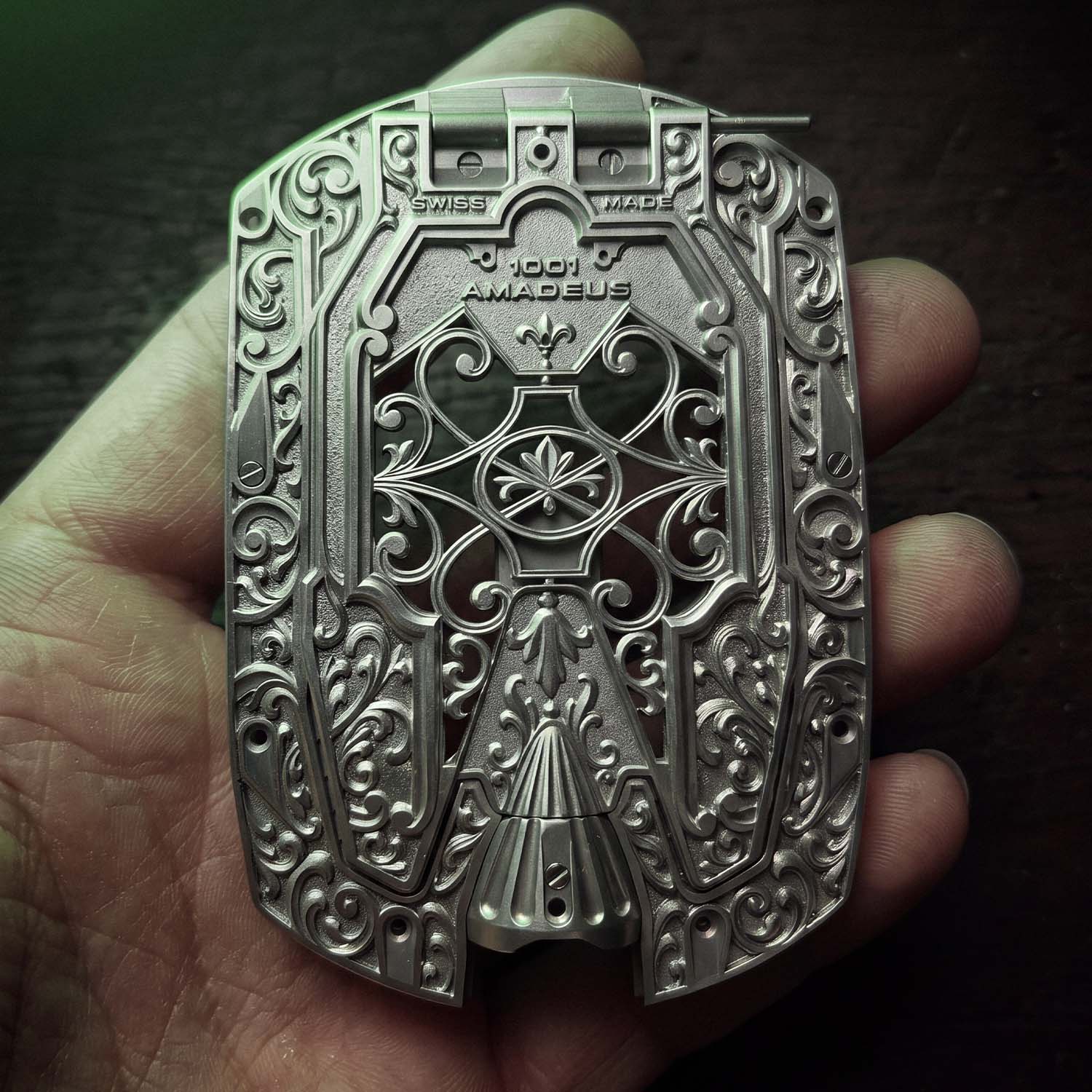
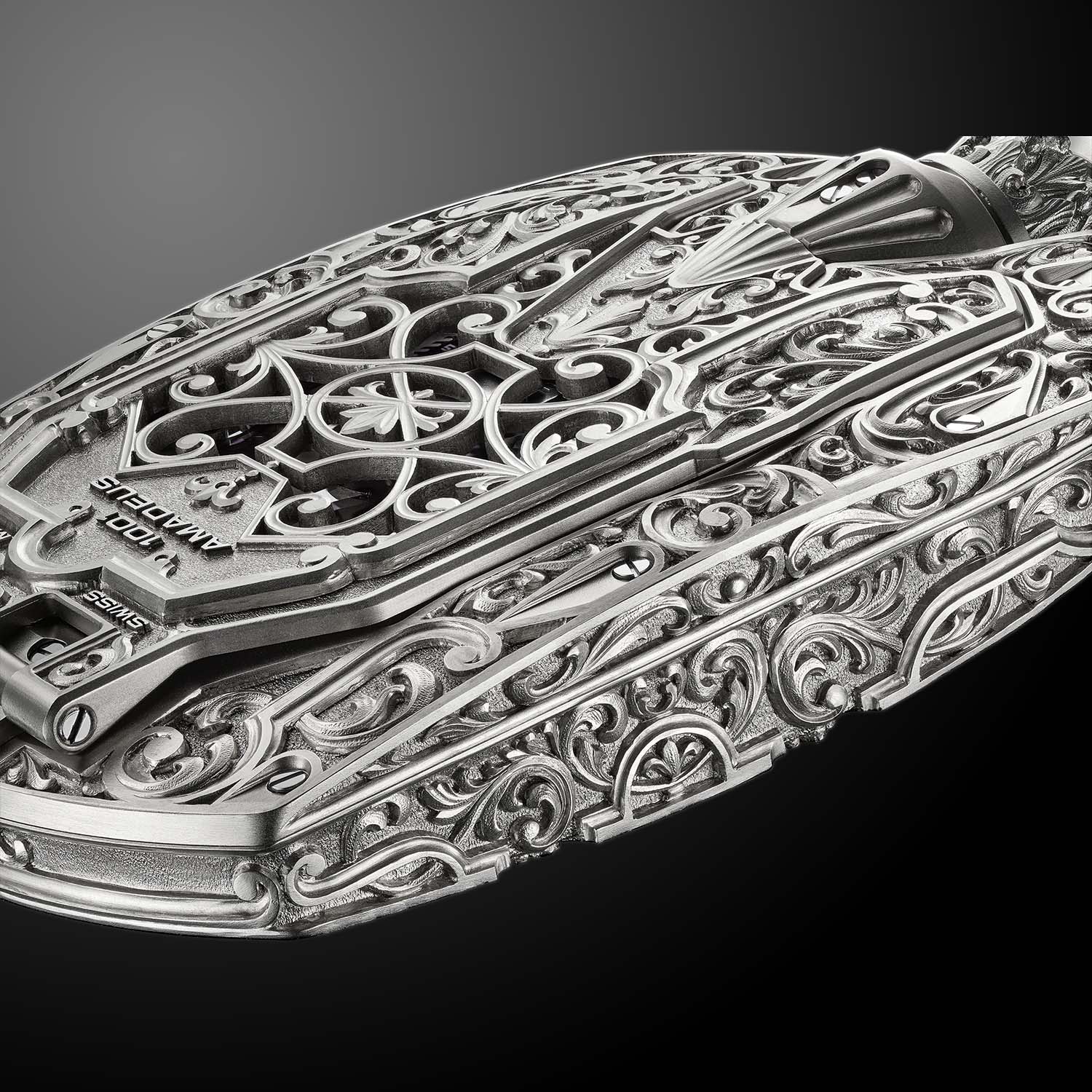
The caseback was the most demanding area, with the engraving needing to respect the mass, curves and mechanical identity of the UR-1001 rather than simply sit on top of it.

Güllert uses varied surface treatments to control how the piece catches light, with textured, dotted, satin-brushed and matte backgrounds all playing a role.
The edges are finished by hand with a file, and the details are adjusted until the decoration feels integrated with the case rather than applied after the fact.
Satellite timekeeping on a grand scale
The UR-1001’s display is dense, but it follows Urwerk’s familiar preference for mechanical choreography over conventional hands.
Hours are indicated by a revolving satellite system, while minutes are read by a retrograde hand mounted to a sprung ring around the satellite display.
As each satellite advances, it pushes the ring along a guide rail. At the 60-minute point, star cams release the minute hand, sending it back to zero to meet the next hour satellite.
The calendar side is similarly theatrical.
Months and dates are shown through an in-house revolving satellite calendar, with a mechanism that adjusts for months of 30 or 31 days through an intervening finger linked to a Maltese cross system.
Below the calendar satellites sits a three-handed running seconds display on a 120-degree scale, arranged as three 20-second arcs.
The front also includes day-night and power-reserve indications, giving the dial side a mix of immediate timekeeping and mechanical status information.
The long view is hidden on the back
Open the rear cover and the UR-1001’s obsession with time expands from minutes and months into years and centuries.
The back includes a five-year oil-change alert, a 100-year running-time indicator and a linear running-time indicator calibrated for 1,000 years.
There’s also an aperture offering a view of the UR-10.01 movement, a reminder that the spectacle is underpinned by a deeply specific mechanical architecture.

That combination is what makes the Amadeus interesting beyond the engraving itself.
It isn’t merely a decorated version of a known Urwerk design. It’s a unique execution of a watch that was already one of the brand’s most ambitious statements about how far mechanical time display can be stretched.
Details & Specifications
| Brand | Urwerk |
|---|---|
| Model | UR-1001 Amadeus |
| Collection | Special Projects |
| Format | Pocket watch |
| Case size | 106mm x 62mm x 23mm |
| Case material | Titanium |
| Decoration | Hand engraving by Florian Güllert |
| Movement | UR-10.01 |
| Time display | Revolving satellite hours and retrograde minutes |
| Calendar | Revolving satellite calendar with month and date indications |
| Additional indications | Running seconds, day-night display and power reserve |
| Back indications | Five-year oil-change alert, 100-year running-time indicator and 1,000-year linear running-time indicator |
| Production | Unique piece |
| Price | Not disclosed |
The UR-1001 Amadeus is for the collector who sees independent watchmaking as sculpture, engineering and provocation in equal measure. In a category often defined by wrist presence, Urwerk has made a pocket watch that feels even harder to ignore.