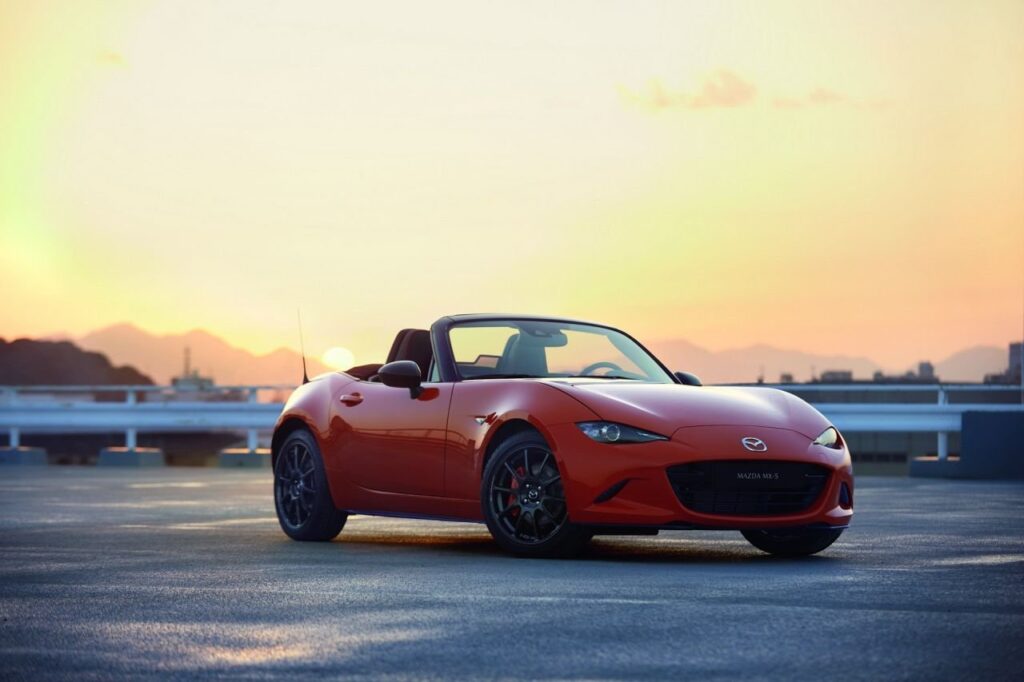
The Mazda MX-5 has always been a car defined less by numbers than by feel.
That makes its next step especially important, because Mazda CEO Masahiro Moro has confirmed that the next-generation MX-5, internally known as the NE, is being developed with electric power in mind.
The significant part isn’t just electrification, but Mazda’s intention to keep the car light, with a target under 1,200 kg.
At a glance
- Mazda CEO Masahiro Moro has confirmed that the next-generation MX-5 is being developed with an electric variant in mind.
- The company is targeting a lightweight character, with the car expected to stay under 1,200 kg through compact battery packaging and a focus on balance.
- A hybrid version has also been reported, potentially using Mazda’s new 2.5-litre Skyactiv-Z four-cylinder engine.
Keeping the MX-5 light in an electric era
Electrification is no longer a distant concern for compact sports cars, even ones with as much tradition behind them as the MX-5.
Regulations and emissions targets are pushing performance cars toward batteries, motors and hybrid systems, but the MX-5’s appeal has always depended on resisting excess.
Mazda’s challenge is clear.
The company has to modernise its most recognisable enthusiast car without dulling the delicacy that made it matter in the first place.
The stated weight target of under 1,200 kg is the detail that will matter most to many drivers, because battery-electric cars often carry a substantial mass penalty.
A compact battery and careful packaging are expected to be central to that effort, rather than chasing a large pack or headline-grabbing output.
An electric MX-5 that puts balance before power
Mazda hasn’t released detailed specifications for the next MX-5, so output, battery capacity and performance figures remain unknown.
What is clear from the direction described so far is that Mazda isn’t positioning the electric version as a straight-line numbers car.
The brief appears closer to the MX-5’s established philosophy, with emphasis on balance, steering feel and agility rather than extreme power.
There’s also a strong chance the car will retain rear-wheel drive, which would preserve one of the key traits enthusiasts associate with the MX-5.
That point isn’t a minor technical footnote.
For a light roadster, the relationship between seating position, driven wheels and chassis balance is a major part of the experience.
If Mazda can keep the electric MX-5 compact and rear-driven, it could avoid one of the common criticisms of small EVs, which is that they can feel quick but emotionally flat.
A hybrid path is still on the table
The electric variant may not be the only answer for the next-generation MX-5.
Auto Motor und Sport has also indicated that the model could take a hybrid route using Mazda’s new 2.5-litre Skyactiv-Z four-cylinder engine.
That would give Mazda more than one way to meet tightening emissions expectations while keeping the MX-5 accessible to drivers who still want a combustion engine in the mix.
For the MX-5 audience, that distinction matters.
A fully electric version would represent the clean break, while a hybrid could offer a more familiar bridge between the current formula and the next phase of lightweight sports cars.
Details & Specifications
| Brand | Mazda |
|---|---|
| Model | Next-generation MX-5 |
| Internal designation | NE |
| Body style | Roadster |
| Confirmed development focus | Electric power with lightweight construction |
| Weight target | Under 1,200 kg |
| Expected EV approach | Compact battery and packaging focused on balance |
| Possible hybrid engine | 2.5-litre Skyactiv-Z four-cylinder |
| Power figures | Not disclosed |
The next MX-5 is shaping up as a test of whether a simple, engaging sports car can survive electrification without becoming heavy or remote.
If Mazda holds to the lightness brief, the NE-generation car could become one of the more important enthusiast models of the electric transition, not because it promises to be the fastest, but because it still aims to feel like an MX-5.