Resonance sits in that rare corner of watchmaking where physics, history and audacity meet.
In Episode 2 of Masters of Chronometry, Wei Koh and Constant Kwong unpack why this elusive principle still fascinates collectors, watchmakers and anyone drawn to mechanical precision.
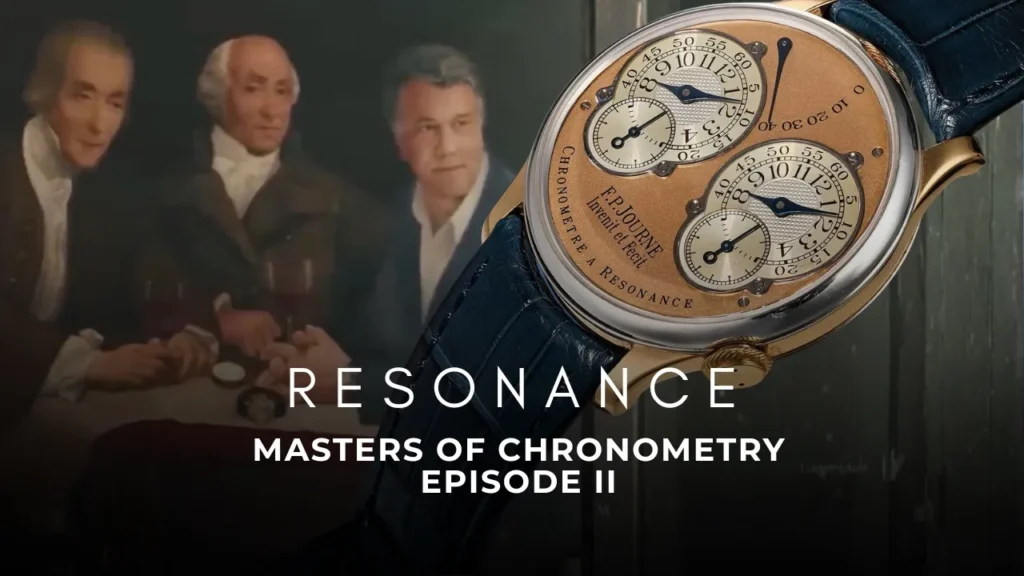
The conversation begins with the record-setting F.P. Journe Chronomètre à Résonance “Souscription, No. 007”, then opens into a broader story that stretches across more than three centuries.
At a glance
- Episode 2 of Masters of Chronometry focuses on resonance, one of high watchmaking’s most difficult precision concepts.
- The episode traces the idea from Christiaan Huygens’ 1665 pendulum clock observation to François-Paul Journe’s wristwatch execution.
- The F.P. Journe Chronomètre à Résonance “Souscription, No. 007” anchors the discussion through its rarity, auction significance and historical importance.
A 1665 observation that still echoes
The roots of resonance in horology go back to Christiaan Huygens, who observed in 1665 that two pendulum clocks mounted near one another could begin to move in sympathy.
That moment matters because it suggested that oscillators, under the right conditions, could communicate through shared vibration rather than direct mechanical command.
For precision timekeeping, the idea is beguiling.
If two regulating organs can settle into the same frequency, they may help stabilise one another, reducing deviation and improving consistency.
It’s simple to describe and exceptionally hard to execute, especially once the concept leaves the stable world of clocks and moves onto the wrist.
From Janvier and Breguet to the wristwatch
Antide Janvier explored resonance through clocks, while Abraham-Louis Breguet carried the principle into pocket watches.
Both figures understood that resonance was not merely a curiosity, but a possible route toward greater chronometric reliability.
François-Paul Journe’s achievement was to revisit that lineage for the modern wristwatch.
The Chronomètre à Résonance asked two independent oscillators to enter the same rhythm through shared vibrational energy inside a portable, wearable object.
That distinction is central to why the watch has become such a serious point of reference for contemporary independent watchmaking.
It was not simply a clever complication, but a statement about how far traditional chronometry could still be pushed.
Why the Souscription No. 007 matters
The F.P. Journe Chronomètre à Résonance “Souscription, No. 007” carries weight for more than its rarity or its record-setting auction result.
It represents an early and historically loaded chapter in Journe’s attempt to bring true resonance to a wristwatch.
For collectors, that makes it more than an important serial number.
It stands at the point where old-world chronometric theory meets the rise of the modern independent watchmaker.
The watch also reflects a particular kind of risk, because resonance is unforgiving.
A watchmaker can’t rely on the visual drama of a complex display alone, since the underlying claim lives in performance, adjustment and the behaviour of the regulating organs.
Pure resonance and mechanical coupling
One of the episode’s most useful distinctions is the difference between pure resonance and systems that rely on more direct forms of mechanical coupling.
Both approaches may involve paired oscillators, but they don’t necessarily achieve the same thing in the same way.
In a resonance watch such as Journe’s, the point is that two independent oscillators influence one another through vibrational energy.
Other modern interpretations may connect regulating systems more directly, creating coordination through mechanical architecture rather than the subtler phenomenon of resonance itself.
That difference can be easy to miss from a dial alone.
It is also exactly why resonance remains such a demanding subject for collectors, because the most important action is happening beneath the visible spectacle.
Episode 2 gives the subject the space it deserves, treating resonance not as a party trick but as one of watchmaking’s most intellectually rewarding pursuits.
For anyone interested in F.P. Journe, Breguet, historic chronometry or the outer edges of mechanical precision, this is the kind of conversation that makes a difficult idea feel alive again.