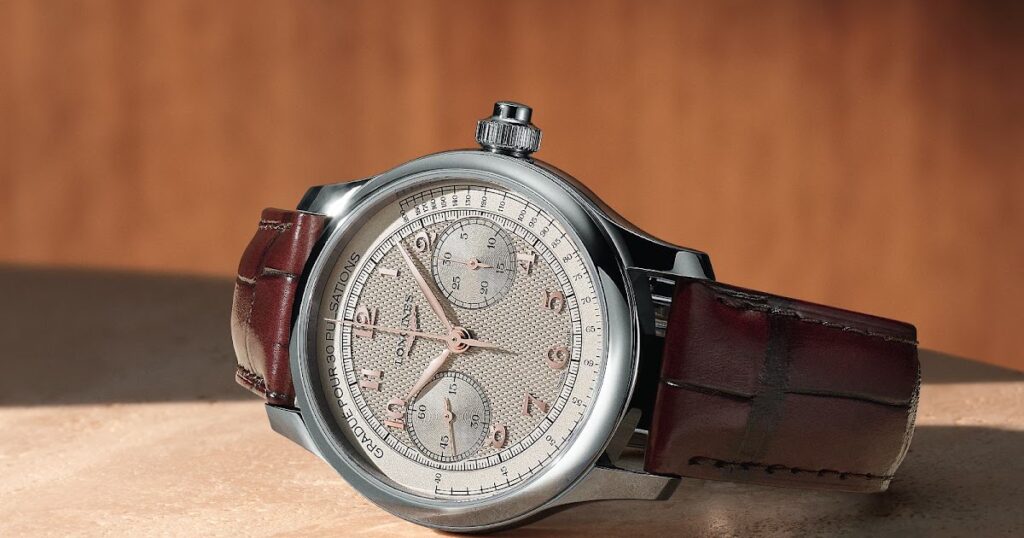
Longines has returned to one of the more characterful corners of chronograph history with the Master Collection Chrono Monopusher.
The new watch brings together two details that carry real vintage weight, a pulsometer scale and a single-pusher chronograph layout.
It’s a quieter kind of complication, but that’s exactly the appeal for collectors who prefer instrument logic over sport-watch theatre.

At a glance
- Longines has brought the pulsometer chronograph back through the Master Collection Chrono Monopusher.
- The watch combines a medical-style pulsometer scale with a single-pusher chronograph layout.
- It should appeal to collectors drawn to vintage timing instruments and restrained complicated watches.
A chronograph with medical roots
The pulsometer chronograph belongs to a period when watches were practical professional tools rather than lifestyle objects.
Instead of using a tachymeter to calculate speed, a pulsometer scale is designed for reading a pulse rate with the help of the chronograph seconds hand.
That gives the watch a different character from the racing chronographs that dominate the category today.

It’s less about velocity and more about measured observation, which makes the format feel unusually intimate for a mechanical chronograph.
Longines has often been at its best when it taps into this kind of functional heritage, and the Master Collection gives the idea a suitably formal setting.
The appeal of the monopusher layout
The monopusher chronograph is one of the cleanest ways to package a stopwatch complication.

Rather than separating start, stop and reset into two pushers, a monopusher configuration controls the chronograph sequence from a single actuator.
That small change matters visually.
It keeps the case profile cleaner and gives the watch a more classical rhythm, especially in a collection that leans toward traditional watchmaking codes.

For many enthusiasts, the format also carries a more tactile appeal.
A monopusher chronograph feels deliberately old-school, not because it lacks sophistication, but because it reduces the interface to the essentials.
Master Collection restraint
Placing this complication inside the Master Collection is a telling choice.

This isn’t positioned as a rugged sports chronograph or a retro novelty, but as a more polished interpretation of a historically purposeful timing watch.
The combination of a pulsometer scale and a monopusher mechanism gives the model enough specificity to stand apart without needing exaggerated styling.
That balance is important for Longines, a brand whose strongest modern pieces often succeed by translating archive-adjacent ideas into wearable contemporary watches.

The Master Collection Chrono Monopusher should speak to buyers who want a chronograph with a story, but not necessarily one shouting from the wrist.
Details & Specifications
| Brand | Longines |
|---|---|
| Model | Master Collection Chrono Monopusher |
| Collection | Master Collection |
| Function | Chronograph |
| Chronograph control | Single pusher |
| Scale | Pulsometer |
The return of the pulsometer chronograph gives Longines another historically fluent complicated watch with clear collector appeal.
It’s the kind of release that rewards a closer look, not because it tries to reinvent the chronograph, but because it brings back a distinctive version of it with welcome restraint.