For a brand with its mythology tied so closely to the chronograph, movement strategy is never just a technical department buried behind the dial.
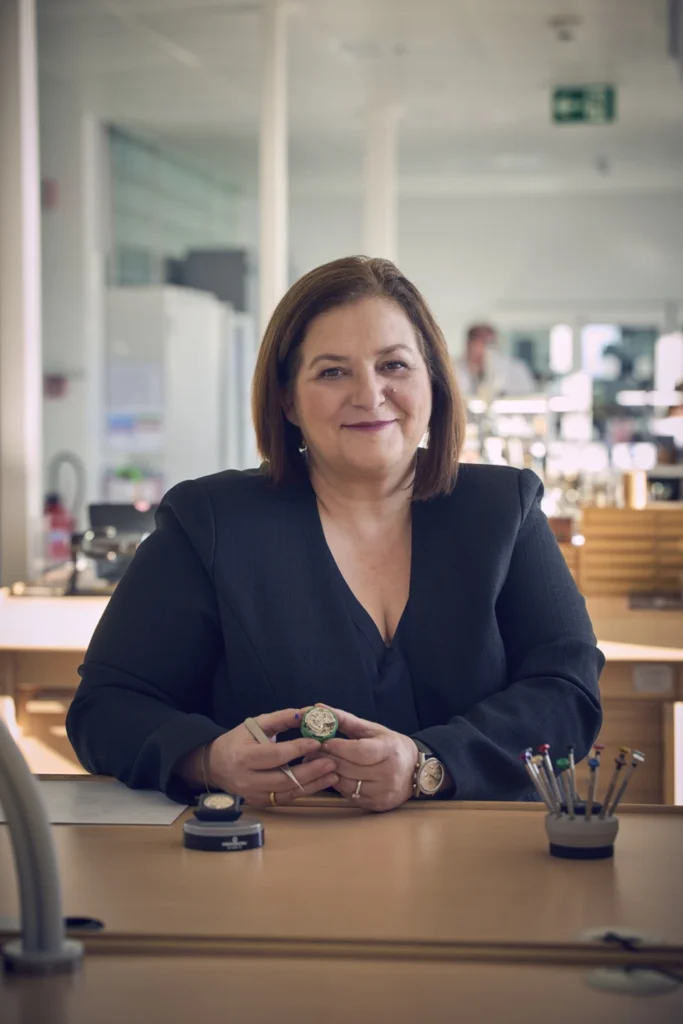
At TAG Heuer, that responsibility now sits with Carole Forestier Kasapi, one of contemporary watchmaking’s most respected movement minds and the brand’s Haute Horlogerie & Movements Strategy Director.
Her remit reaches from early research to industrialisation, which makes her role especially revealing at a moment when TAG Heuer is pairing its historic timing credentials with new materials, light-powered calibres and experimental chronograph architecture.

At a glance
- Carole Forestier Kasapi, TAG Heuer’s Haute Horlogerie & Movements Strategy Director, is guiding the brand’s movement roadmap from research to industrialisation.
- Recent projects include Solargraph, TH-Carbonspring, the Calibre TH20-11 Monaco chronographs and the compliant-mechanism Monaco Evergraph.
- Her career spans Renaud & Papi, Ulysse Nardin, Richemont and Cartier, with major honours from the GPHG and the Musée International d’Horlogerie.
A watchmaker shaped by high complications
Forestier Kasapi arrived at TAG Heuer in 2020 as Movements Director, bringing with her a career formed in some of the industry’s most demanding technical environments.
Her early years included time at Renaud & Papi in Le Locle, an atelier that became a proving ground for a generation of independent-minded watchmakers including Stephen Forsey, Bart Grönefeld, Peter Speak and Andreas Strehler.
She later worked with Ulysse Nardin and Richemont, then rose to wider prominence as Director of Movement Creation at Cartier.

Her work has been formally recognised at the highest level, including the Best Watchmaker Prize at the Grand Prix d’Horlogerie de Genève in 2012 and the Gaïa Prize for Craftsmanship-Creation from the Musée International d’Horlogerie in 2021.
Forestier Kasapi’s route into watchmaking began early, in an environment where mechanical horology was a tangible part of daily life rather than an abstract fascination.
That proximity turned into formal training, then into a career focused heavily on movement development and high complications, particularly tourbillons, where reliability and long-term performance matter as much as ingenuity.

She often returns to the importance of iteration, a fitting word for a discipline where progress can depend on tiny changes made over long periods.
TAG Heuer’s technical identity has always been restless
TAG Heuer’s current push makes more sense when viewed against the brand’s long habit of treating function and design as connected problems.
Founded in 1860, Heuer was already filing important patents in the 19th century, including a crown-operated keyless winding system in 1869 and an improvement to the oscillating pinion in 1887.

The company built much of its reputation around stopwatches and chronographs, instruments designed to measure fractions of a second at a time when timing speed was becoming culturally and technically important.
That mindset also shaped the watches people still associate with the marque.
The 1963 Carrera turned a functional component into a design advantage by marking the steel tension ring securing the crystal with a fifth-of-a-second scale, opening up the dial and improving legibility.

In 1969, Heuer helped bring the Calibre 11 self-winding chronograph to life and gave it a suitably unconventional home in the Monaco.
The Monaco’s square water-resistant case, two-register dial, angled pushers and left-side crown made it feel more like a manifesto than a conventional sports chronograph.
From Solargraph to TH-Carbonspring
The modern chapter is less about nostalgia than using recognisable TAG Heuer platforms to test new ideas at scale.

In 2025, the brand introduced new Formula 1 models with Solargraph movements, reviving the colourful energy of the 1980s designs while adding calibres powered by sunlight and artificial light.
It was an intelligent match of tone and technology, giving an accessible, sporty collection a movement story that suits everyday use.
TH-Carbonspring is a more technical proposition and potentially more consequential for the brand’s long-term autonomy.

Traditional balance springs are usually made from nickel-steel alloy, while silicium balance springs have become prized for their non-magnetic behaviour, resistance to corrosion and capacity for precise shapes.
Silicium technology remains restricted by patents and industrial access, so TAG Heuer has developed its own proprietary answer.
TH-Carbonspring is positioned to deliver similar functional advantages while being less prone to damage than silicium, a point that matters not just in the laboratory but at the workbench during servicing and repair.

The Monaco Evergraph shows where the chronograph could go next
At Watches & Wonders 2026 in Geneva, TAG Heuer introduced three new Monaco models powered by the Calibre TH20-11.
That movement is an integrated chronograph with a column wheel and vertical coupling, two details that speak directly to the tactile and mechanical expectations of serious chronograph buyers.
The more radical arrival, though, is the Monaco Evergraph.

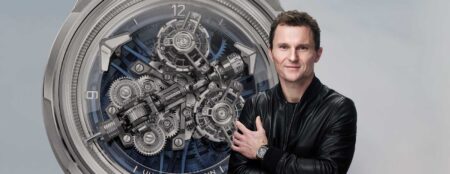
Rather than relying on many conventional chronograph components, the Evergraph uses a compliant mechanism built around flexible parts.
That may sound academic, but it goes straight to how a chronograph feels under the finger and how its architecture can be rethought after more than a century of familiar solutions.
For Forestier Kasapi, the challenge is not simply to make something novel, but to decide whether a technical idea belongs inside TAG Heuer’s identity.

Her role requires close work with engineers, watchmakers and product teams, aligning the question of what to develop with the more difficult question of why it should exist.
That distinction matters because TAG Heuer’s strongest innovations have rarely been isolated technical exercises.
They tend to work best when they make timing clearer, improve durability, change the wearing experience or sharpen the connection between the watch and the person using it.

Forestier Kasapi’s presence gives TAG Heuer a rare kind of credibility in this space, especially as the brand works across practical movements, proprietary regulating components and high-concept chronographs.
Her career has been built on the difficult middle ground between imagination and production, which is exactly where TAG Heuer’s next chapter now seems to be taking shape.