A. Lange & Söhne has returned to one of its most technically assertive chronographs with a new platinum execution of the Triple Split.
The Ref. 424.025F keeps the model’s rare defining talent intact, allowing comparative and intermediate timing not just in seconds, but across minutes and hours up to a full twelve-hour span.
It’s a serious watch for serious chronograph people, but the new grey-on-grey treatment gives the complication a quieter, more controlled presence on the wrist.

At a glance
- A. Lange & Söhne has introduced the Triple Split Ref. 424.025F in a 950 platinum case.
- The watch uses a three-level rattrapante system capable of split timing up to twelve hours.
- Production is limited to 100 individually numbered pieces, with price available on request.
A twelve-hour rattrapante returns in platinum
The Triple Split occupies a distinct place in modern high-end chronographs because its split-seconds function extends beyond the central seconds display.
Where a conventional rattrapante chronograph can compare short intervals within a 60-second window, this Lange can measure two events against each other for as long as twelve hours.
That is achieved by pairing the chronograph hands with blued-steel rattrapante hands for seconds, minutes and hours.

The pusher at 10 o’clock stops the blued hands to show an intermediate time while the rhodiumed chronograph hands continue running.
Press the same pusher again and the stopped hands catch up instantly with the live measurement.
The flyback function adds another layer of practicality, using the pusher at 4 o’clock to reset and immediately restart the active chronograph counters.

For a complication this involved, the appeal isn’t only the numerical capability; it’s the choreography of multiple hands working across the dial without the watch becoming unreadable.
Grey architecture and a disciplined dial layout
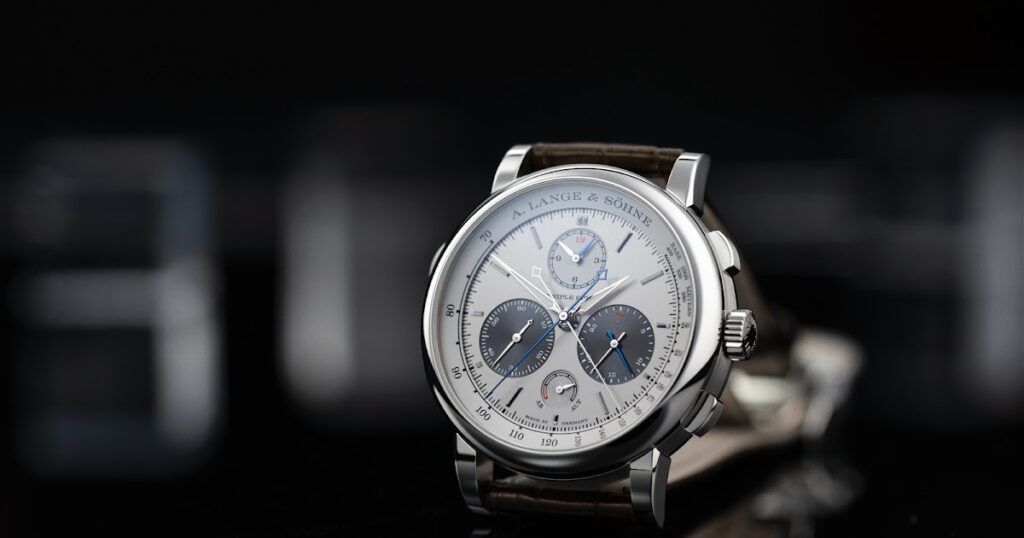
The new execution uses a 950 platinum case measuring 43.2 mm across and 15.6 mm thick.
That gives the watch the physical presence expected of Lange’s most complex chronographs, while the material choice adds density and restraint rather than visual flash.

The case mixes satin-brushed flanks with a mirror-polished bezel and lugs, a familiar Lange contrast that sharpens the architecture without overdecorating it.
On the dial, the main surface is made from 925 silver with a rhodié finish, paired with recessed auxiliary counters in a darker grey.
The layout remains highly technical, but it’s ordered with purpose.

The central hands handle the chronograph and rattrapante seconds, framed by a peripheral tachymeter scale for calculating average speed over 1,000 metres.
The instantaneous minute counter sits at 4 o’clock, the running seconds at 8 o’clock, and the hour counters occupy the upper register at 12 o’clock.
At 6 o’clock, Lange’s UP/DOWN indicator shows the remaining power reserve.

Rhodiumed-gold hour and minute hands receive luminous material, while small red accents on the totalizers and power-reserve display help separate timing information from the rest of the dial.
The result is still unmistakably an instrument, but the platinum and grey palette gives it a cooler and more formal character than earlier executions.
Calibre L132.1 and the friction problem
The hand-wound calibre L132.1 is visible through the sapphire-crystal caseback, and it remains the mechanical centrepiece of the Triple Split.

The movement comprises 567 components, including 46 jewels and five gold chatons secured by blued screws.
It runs at 21,600 vibrations per hour, or 3 Hz, and offers a power reserve of 55 hours.
The challenge in a watch like this is not simply adding more hands; it’s managing the energy demand created by several rattrapante systems and instantaneous jumping counters.

Lange addresses that with a patented disengagement mechanism designed to reduce friction losses.
When the rattrapante hands are stopped, friction-intensive components on the seconds and minute arbors are disconnected, helping the balance maintain a stable rate during an intermediate timing display.
The finishing follows the Glashütte manufacture’s traditional approach, with untreated German silver plates and bridges decorated with Glashütte ribbing.

Levers, springs and rockers are straight-grained and bevelled by hand, including internal angles that require patient manual work.
The hand-engraved balance cock is paired with a whiplash precision beat-adjustment system, giving the movement the kind of visible craft collectors expect from Lange at this level.
Details & Specifications
| Brand | A. Lange & Söhne |
|---|---|
| Model | Triple Split Ref. 424.025F |
| Case size | 43.2 mm diameter, 15.6 mm thickness |
| Case material | 950 platinum |
| Dial | 925 silver with rhodié finish and darker grey recessed counters |
| Movement | Hand-wound manufacture calibre L132.1 |
| Complication | Split-seconds chronograph with split minutes and split hours, flyback function |
| Power reserve | 55 hours |
| Frequency | 21,600 vibrations per hour, 3 Hz |
| Movement components | 567 components, 46 jewels, five gold chatons |
| Strap | Dark-brown hand-stitched alligator leather with grey stitching |
| Buckle | Quick-release deployant buckle in 950 platinum |
| Production | Limited to 100 individually numbered pieces |
| Price | Available on request |
The Triple Split in platinum is unlikely to be anyone’s casual chronograph purchase, and that’s exactly the point.

It’s a highly specific expression of Lange’s chronograph expertise, aimed at collectors who value mechanical depth, architectural finishing and a complication that still feels genuinely rare in contemporary watchmaking.