Urwerk has built much of its identity on making time move in unexpected ways.
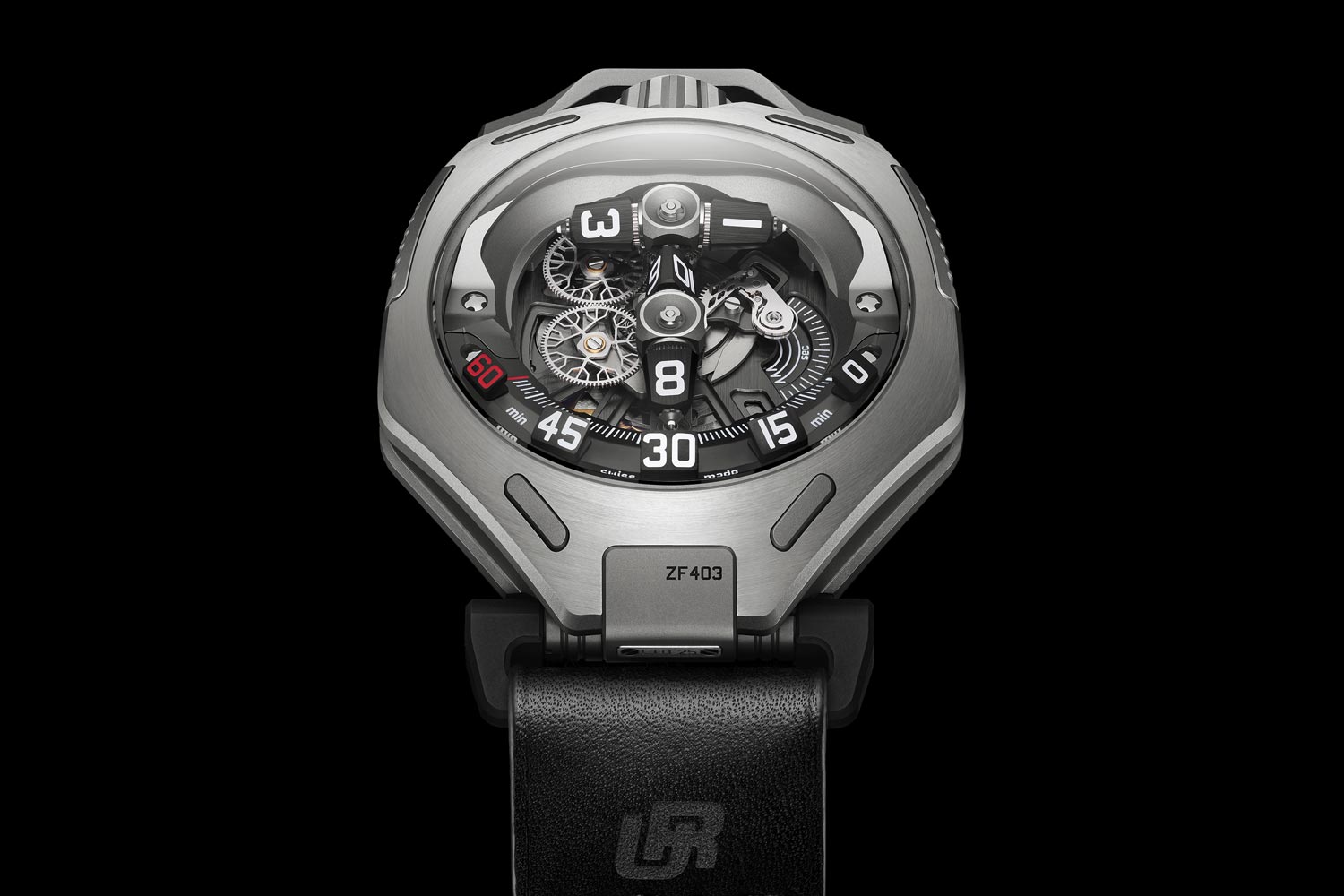
The UR-300 Time Quantum does more than put the brand’s satellite-hours language into a new case. It changes the architecture that carries the hours across the dial.
For a watchmaker that has spent nearly three decades developing wandering discs and rotating cubes, this is a meaningful shift.
At a glance
- Urwerk’s UR-300 Time Quantum introduces a new jumping T-frame approach to wandering hours.
- The display uses four three-sided prisms mounted on two bars that swap roles every hour.
- The watch is limited to 50 pieces in total, priced at CHF 168,000 excluding taxes.
A T-frame replaces the familiar satellite arms
Urwerk’s wandering-hours story goes back to 1997, when the brand began building around a complication with roots in the mid-17th century.
Until now, the essential layout has stayed relatively consistent, with symmetrical rotating arms carrying discs or cubes.
The UR-300 Time Quantum changes that foundation with what Urwerk calls a T-frame.
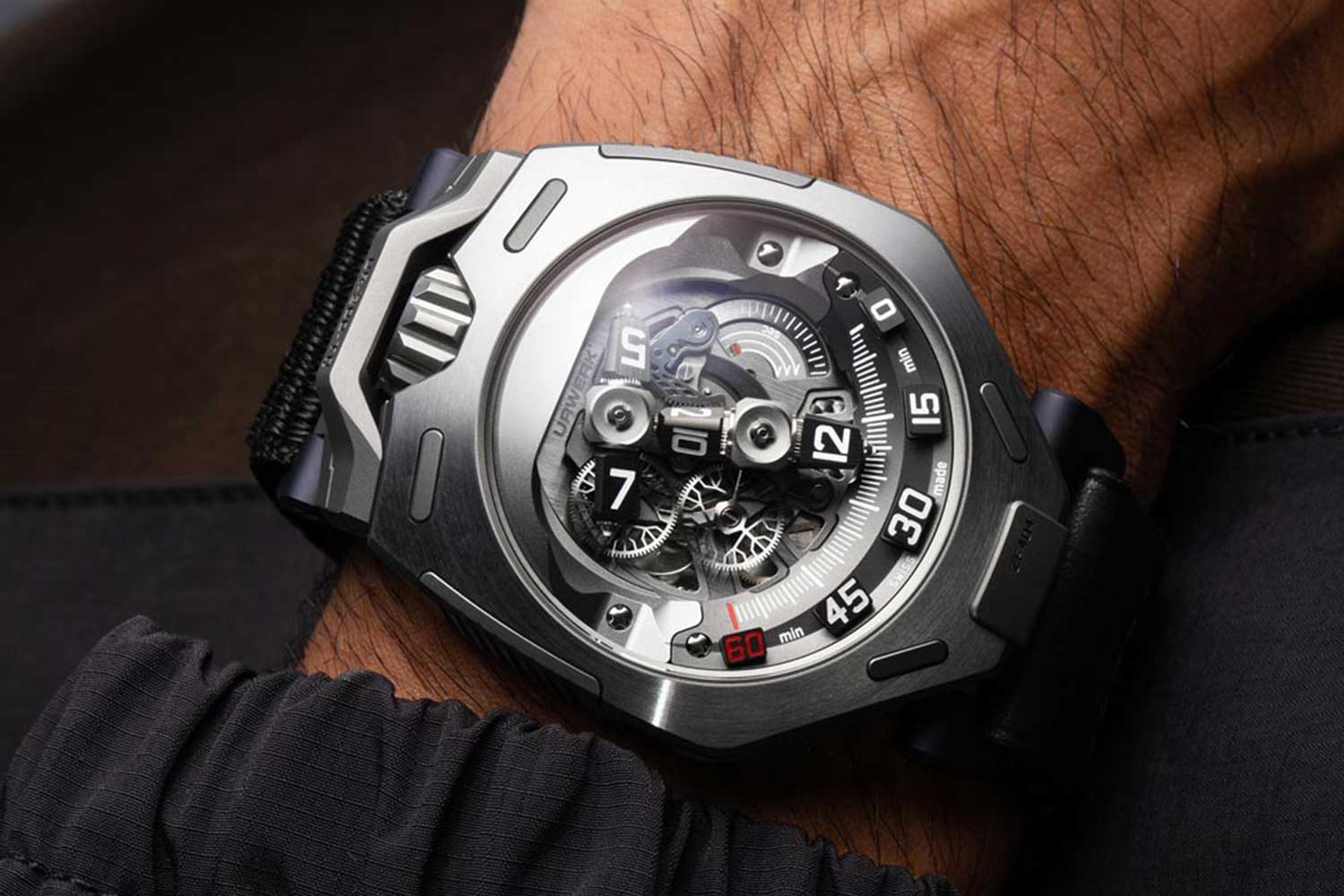
Rather than using cubes, the watch has four three-sided prisms, with the 12 hour numerals divided across them.
The T-shape appears to be a single fixed structure, but it is actually made from two separate bars.
One bar sits vertically and points down toward the minute track, while the other lies horizontally across the top.
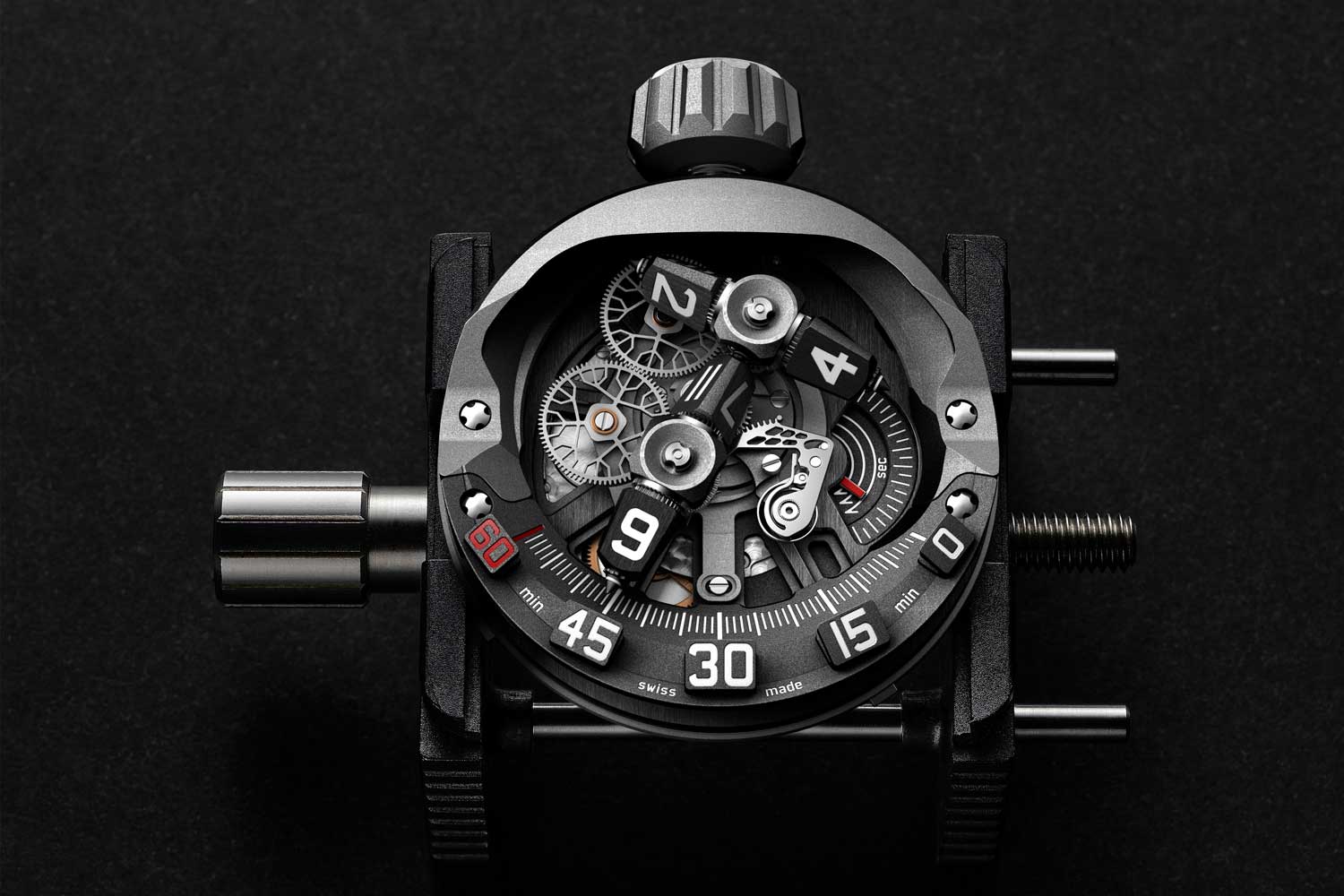
Each bar carries a prism at both ends, and the two bars continually exchange roles as the hours advance.
The basic reading remains familiar for Urwerk. The active hour numeral still travels across a 108-degree minute arc positioned at six o’clock, with the hour itself serving as the pointer.
The hourly jump carries the drama
During the hour, the prism at the bottom of the vertical bar moves slowly across the minute scale.
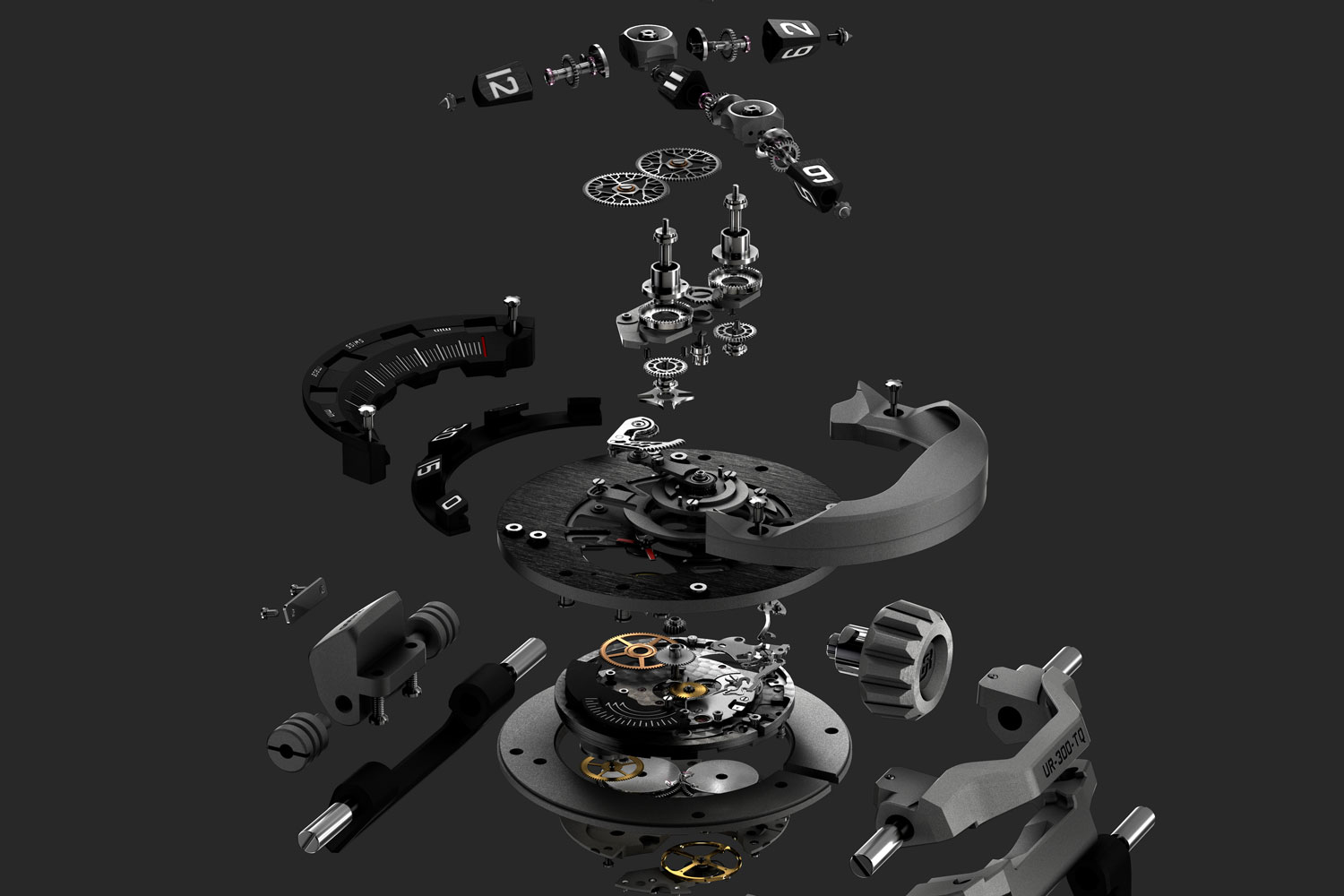
When it reaches the 60-minute mark, the display rearranges itself in a single coordinated jump.
The two bars pivot on their own centres, so the vertical bar moves into a horizontal position while the former horizontal bar becomes the new vertical bar.
At the same moment, the carousel carrying both bars jumps forward by 72 degrees, placing the next hour at the start of the minute track.
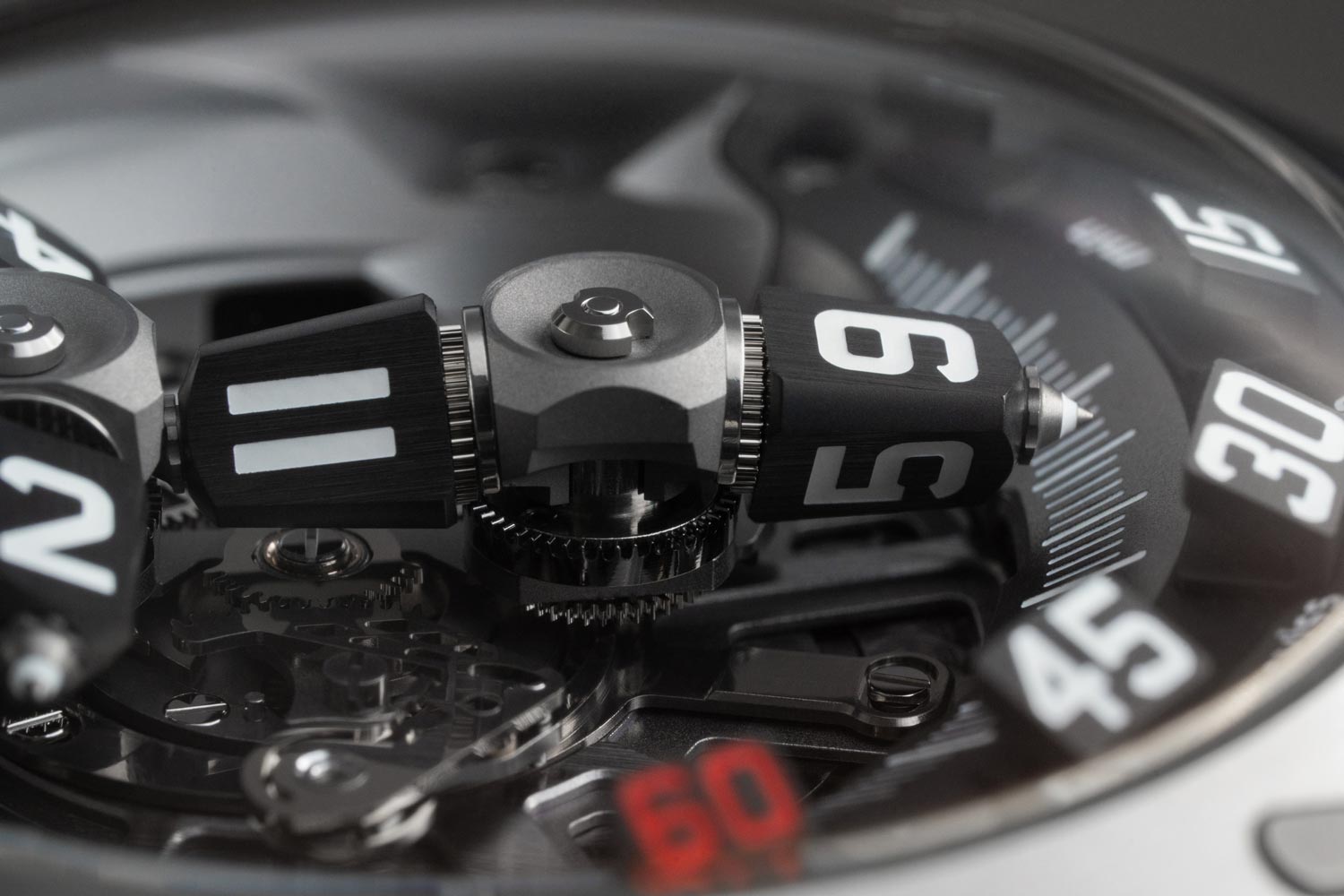
All four prisms also turn to their next face, setting up the correct numeral for the new hour.
The numbering is arranged with a neat mechanical logic.
Each prism appears at the bottom of the T once every four hours, so the numerals are grouped in intervals of four.

One prism carries 1, 5 and 9, another carries 2, 6 and 10, and the remaining prisms follow the same pattern.
Because every prism turns at each hourly jump, a prism has advanced four times by the time it returns to the bottom position.
With three faces, the first three turns bring it back to its starting face, and the fourth turn advances it to the next relevant hour.
That means the system can turn every prism together and still land on the correct display at the bottom of the T.
It is a more active choreography than on earlier Urwerk satellite-hour watches, where only the incoming disc or cube needed to turn.
Here, the prisms on each bar are geared to a shared central wheel, forcing all four to rotate when the mechanism advances.
Case, movement and production
The UR-300 is not one of Urwerk’s more compact recent satellite-hour watches.
Its Grade 5 titanium case measures 45.2 mm by 58.8 mm and stands 18.25 mm thick, giving the jumping T-frame space to perform.
The case design is new for Urwerk and is offered in two finishes.
Buyers can choose bare titanium or a black version finished using plasma-enhanced chemical vapour deposition, known as PECVD.
Inside is the automatic UR-30.01V movement, topped by Urwerk’s own module for the T-frame display.
The movement runs at 28,800 vibrations per hour and has a 44-hour power reserve.
A discreet seconds display sits beside the minute track, using three hands that each cover 20 seconds across a 120-degree arc.
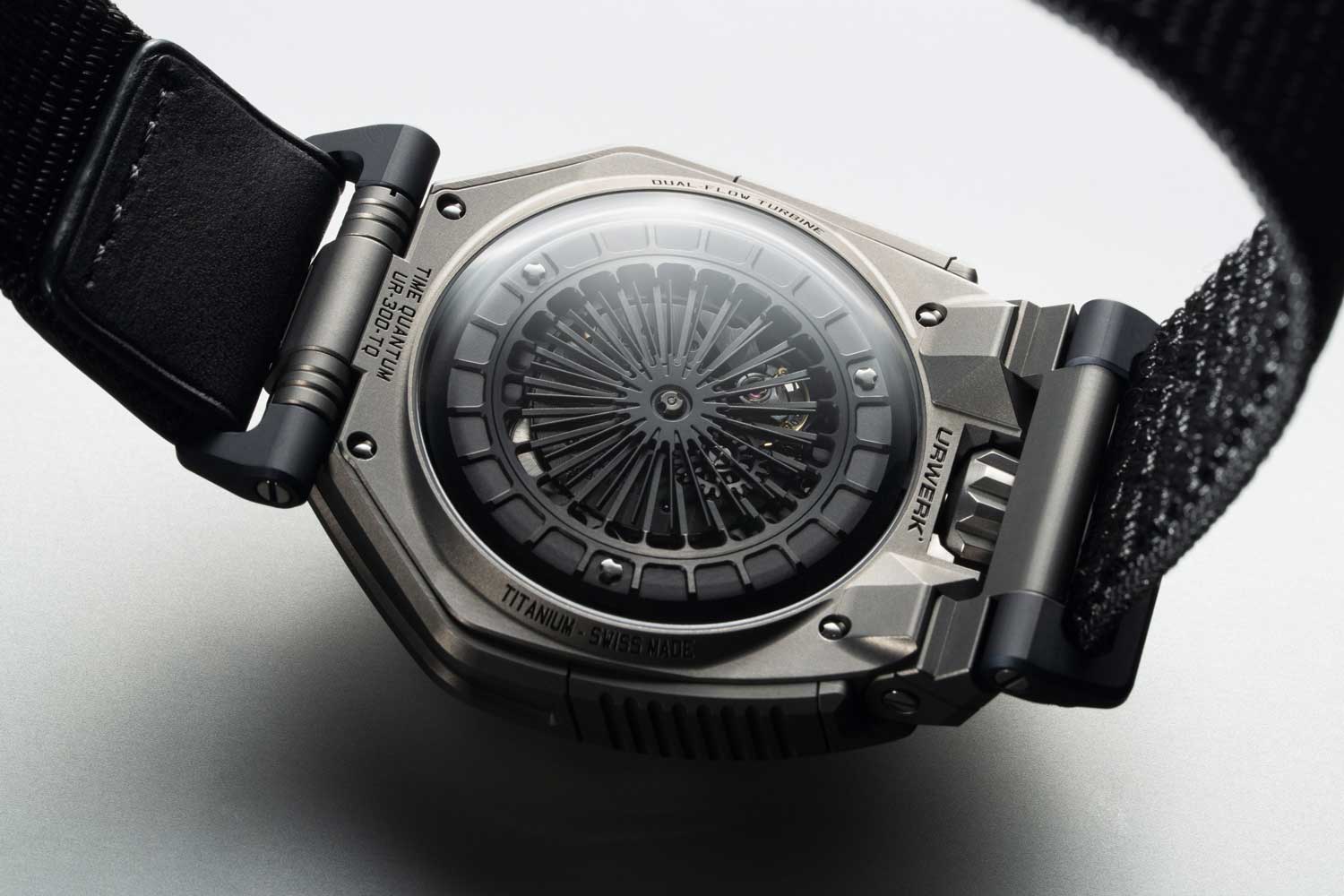
The movement also incorporates Urwerk’s patented Dual Flow Turbine, which regulates the speed of the automatic rotor to reduce wear and tear.
The watch is fitted to a Nato strap and is water resistant to 30 metres.
Production is limited to 25 pieces in titanium and 25 pieces in black-coated titanium, making 50 pieces in total.
Details & Specifications
| Brand | Urwerk |
|---|---|
| Model | UR-300 Time Quantum |
| Reference | UR-300-TQ |
| Case size | 45.2 mm x 58.8 mm x 18.25 mm |
| Case material | Grade 5 titanium, bare or black PECVD-coated titanium |
| Movement | UR-30.01V automatic |
| Functions | Wandering hours with jumping T-frame, minutes and seconds |
| Power reserve | 44 hours |
| Frequency | 28,800 vibrations per hour, 4 Hz |
| Water resistance | 30 m |
| Strap | Nato strap |
| Limited edition | 25 pieces in titanium and 25 pieces in black-coated titanium, 50 pieces total |
| Price | CHF 168,000 excluding taxes |
The UR-300 Time Quantum is unmistakably an Urwerk, but its appeal lies in how decisively it rethinks one of the brand’s core ideas.
For collectors drawn to mechanical display systems rather than conventional dial layouts, this is a familiar language made strange again.