Watchmaking loves a birthday.
Every year brings another anniversary, another commemorative dial and another reminder that some maisons have been around for a very long time. But a founding date, however impressive, only tells part of the story.
For collectors, the more interesting question isn’t simply how old a watch brand is. It’s whether that age reflects continuity, reinvention, survival or a clever second act.
At a glance
- A founding date can signal heritage, but it rarely tells the whole story of a watchmaker.
- The quartz crisis created a major divide between uninterrupted maisons, revived names and post-1980s independents.
- Collectors should read age as context, not proof of quality, innovation or relevance.
The problem with founding dates
In traditional Swiss watchmaking, age is often used as shorthand for authority.
It’s easy to understand why. If a house has been producing watches for centuries, that longevity suggests accumulated skill, institutional memory and a certain resistance to fashion.
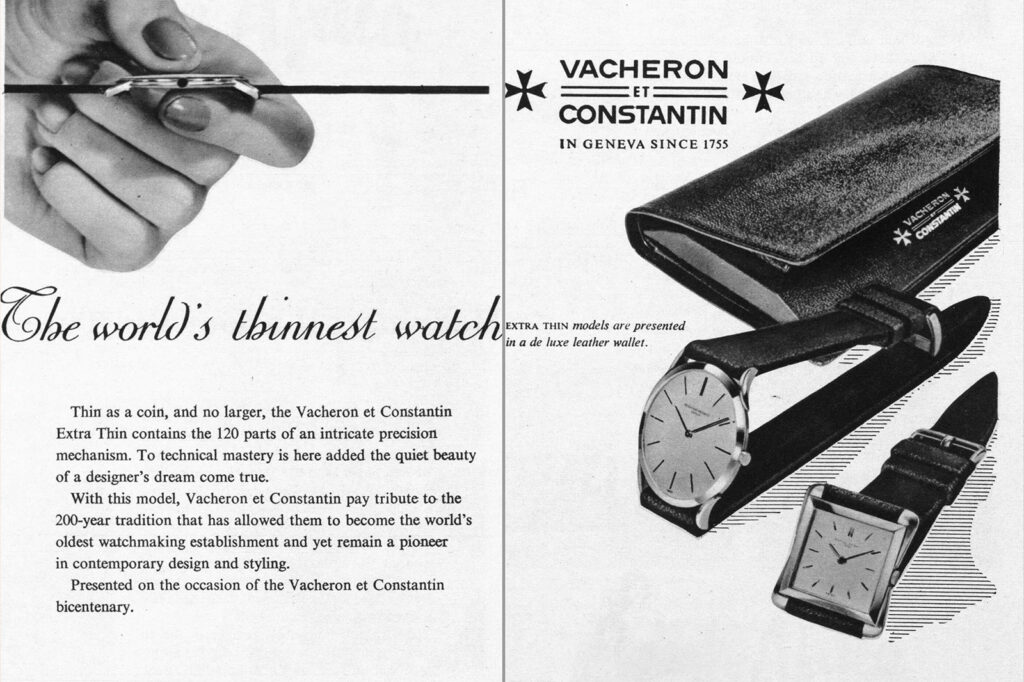
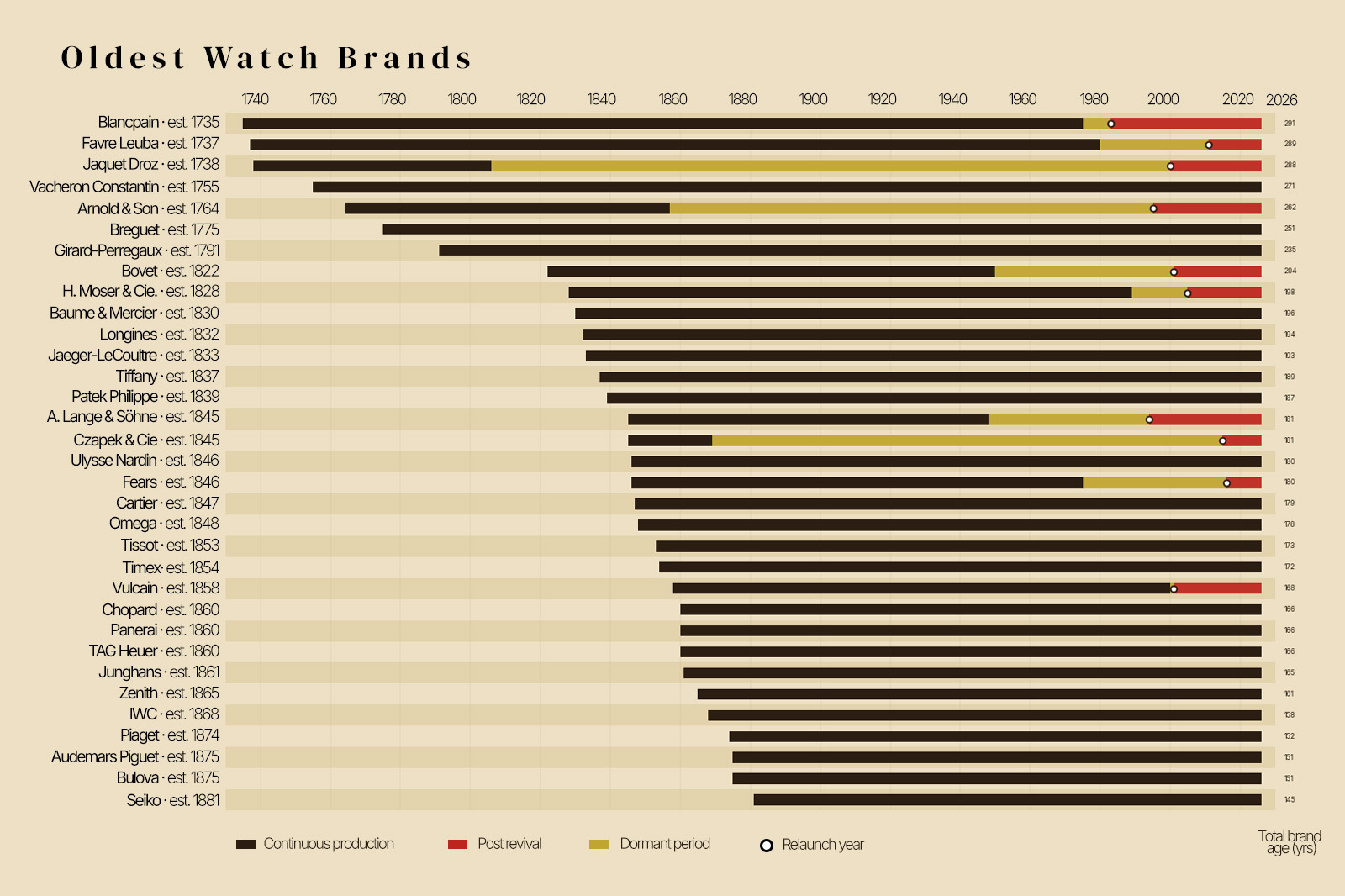
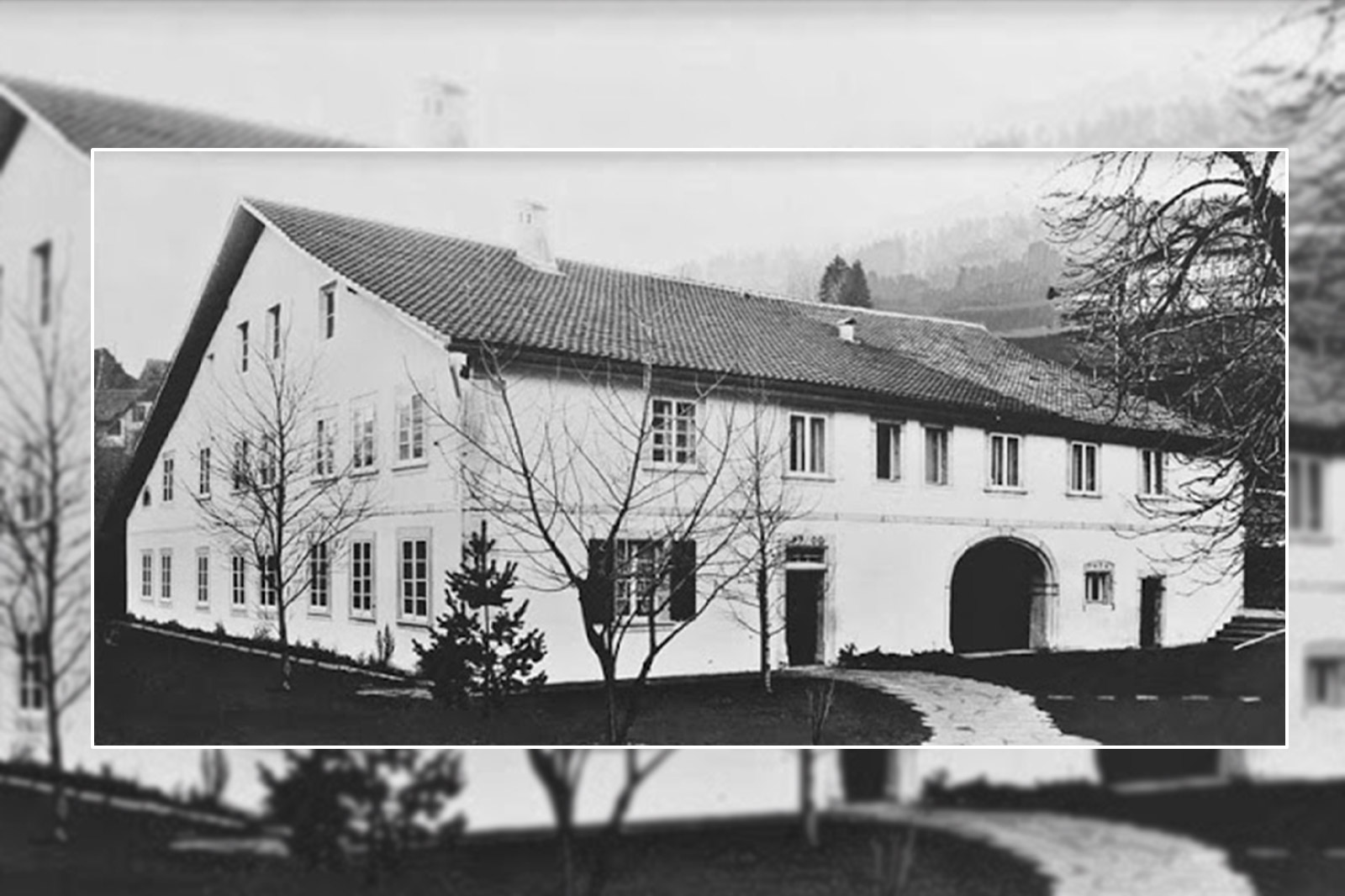
Vacheron Constantin is the cleanest example. Founded in 1755, it has a rare claim to uninterrupted watchmaking history and marked its 270th anniversary in 2025.
That word uninterrupted does a lot of work.
Blancpain, founded in 1735, offers a more complicated case. Its name reaches further back than Vacheron Constantin’s, yet the company ceased operating between 1975 and 1983 before being revived under Jean-Claude Biver.
The revived Blancpain placed high complications at the centre of its identity, with the Fifty Fathoms returning to production much later.
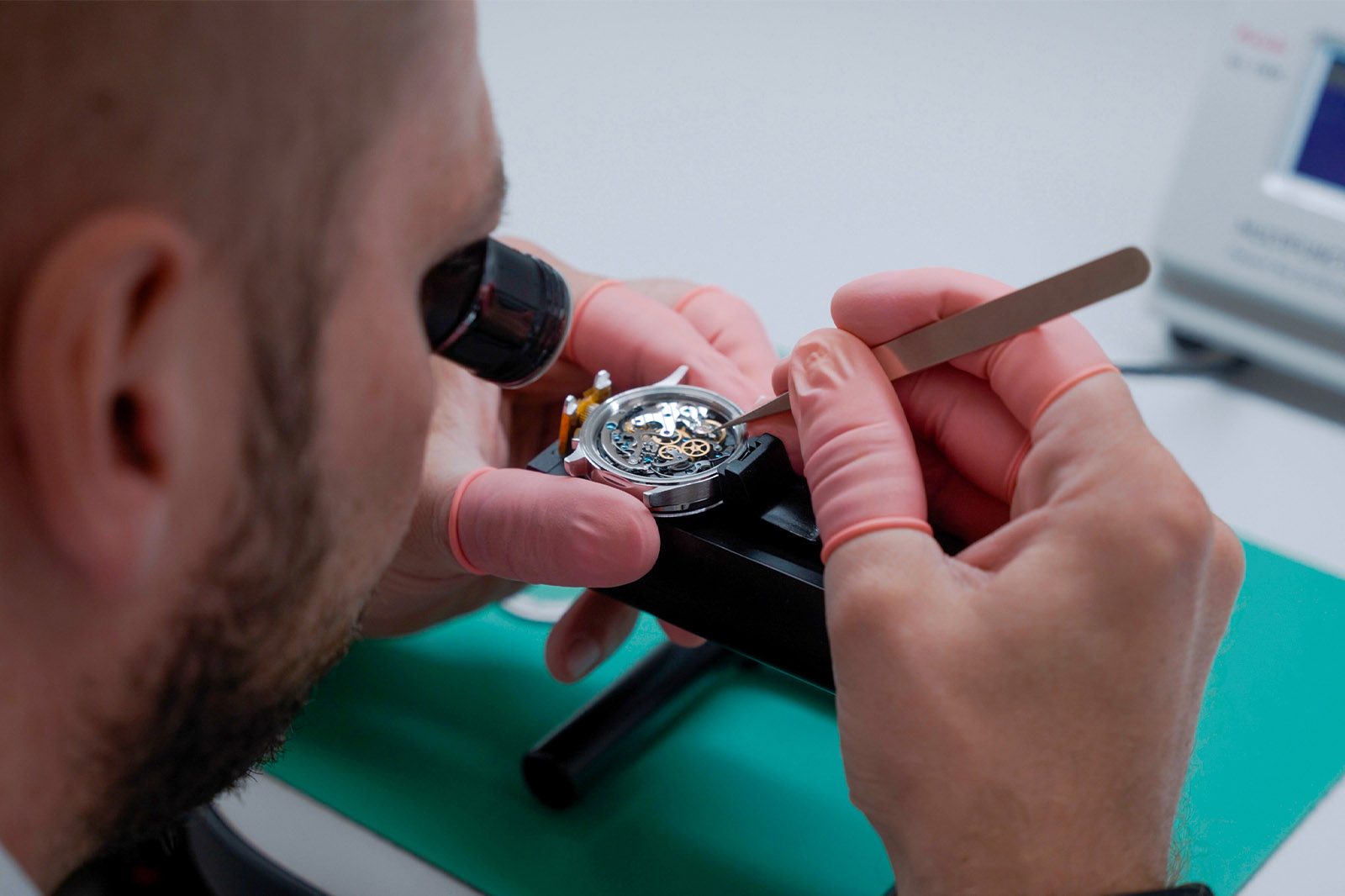
That doesn’t make modern Blancpain less interesting. If anything, its rebirth is one of the defining stories of contemporary mechanical watchmaking.
It does, however, show why a date printed in a catalogue can flatten a brand’s real history.
The quartz crisis changed the meaning of heritage
The reason this distinction matters is the quartz crisis.
When quartz technology arrived in wristwatches, most famously with the Seiko Astron in 1969, it challenged the entire economic logic of mechanical watchmaking.
A battery-powered watch could be cheaper, more accurate and easier to live with than a traditional mechanical watch. For many buyers, that was the end of the argument.
The impact on the Swiss industry was brutal. Established names disappeared, factories closed and skills that had seemed permanent suddenly looked fragile.
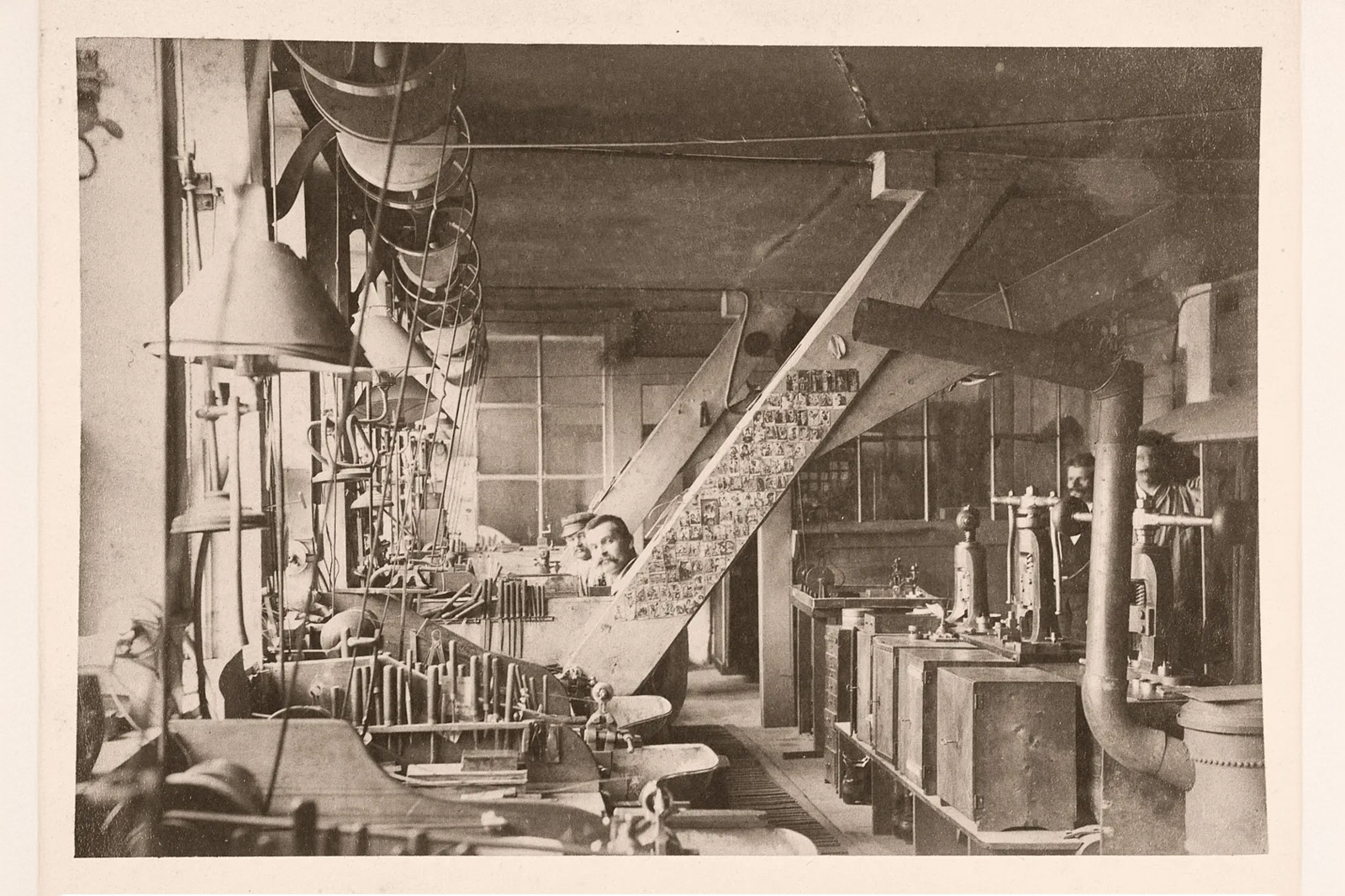
For today’s collector, that era creates a useful dividing line.
Some brands passed through the crisis without breaking their historical thread. Others went quiet, changed hands or returned decades later with a new identity wrapped around an old name.
Neither path is automatically superior.
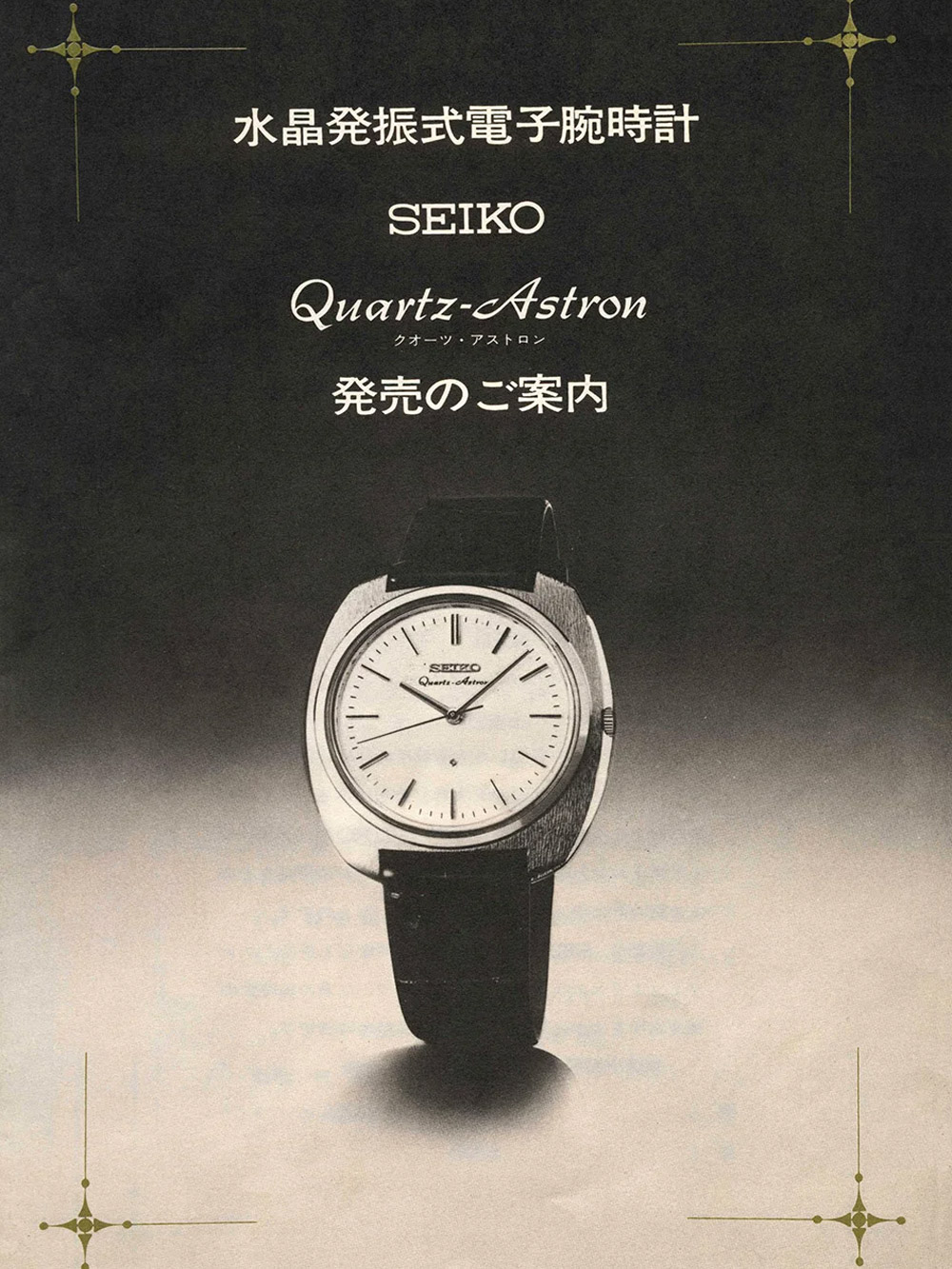
A continuous history can be remarkable, but survival alone doesn’t guarantee creative vitality. A revived marque can be commercially polished, but it may also become a platform for serious modern craft.
Modern independents were born into a different world
After the crisis, mechanical watchmaking had to justify itself in a new way.
It was no longer enough to argue that a mechanical watch was the best tool for telling time. The mechanical watch had to become an object of culture, engineering, taste and identity.
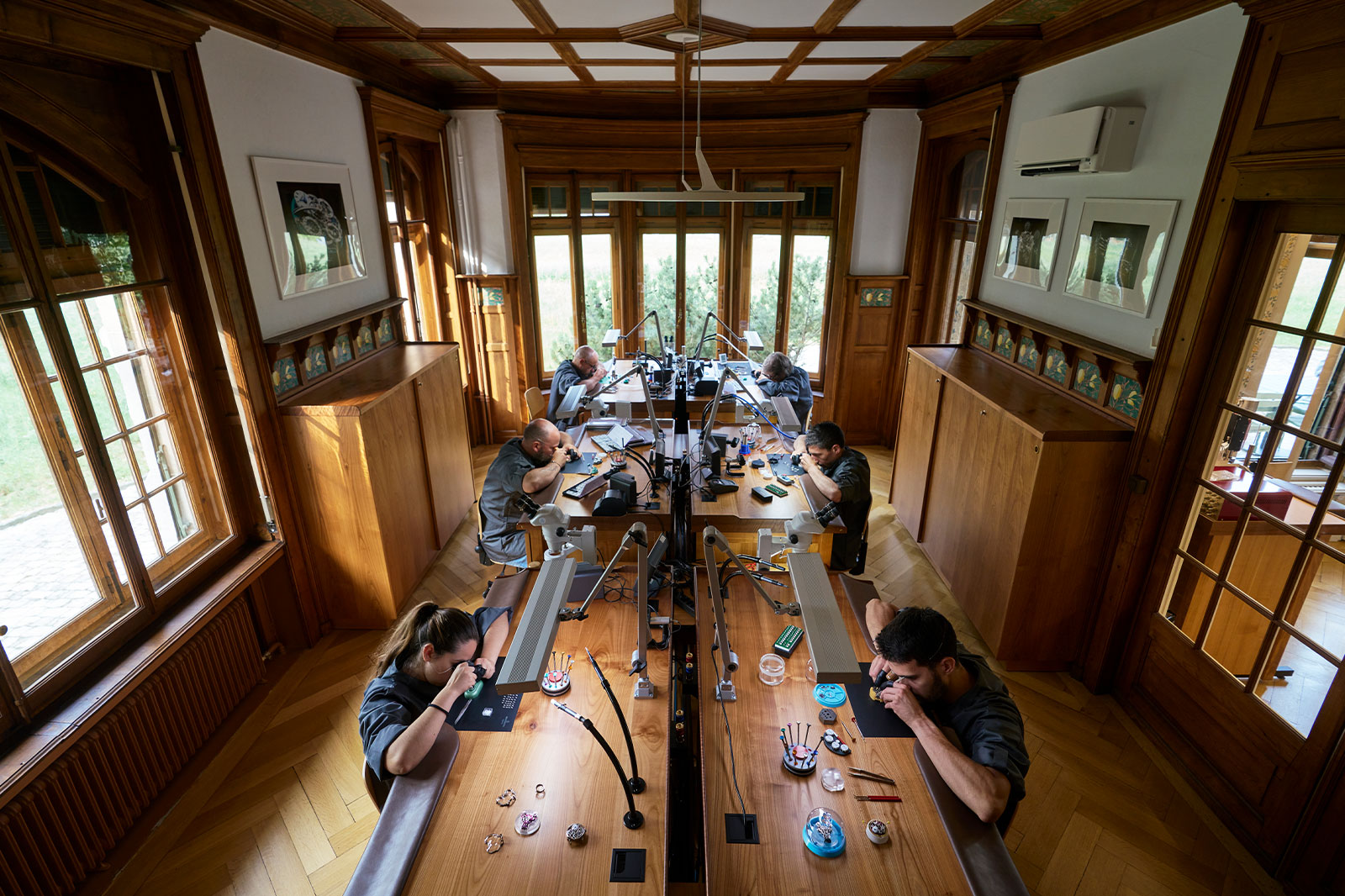
That shift opened space for brands that could never have existed in the same way during the old industrial order.
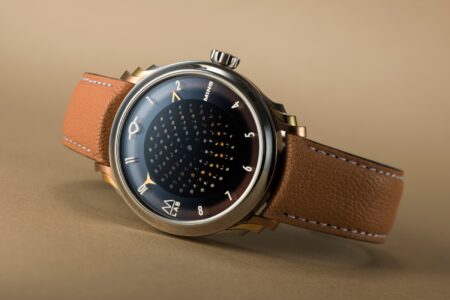
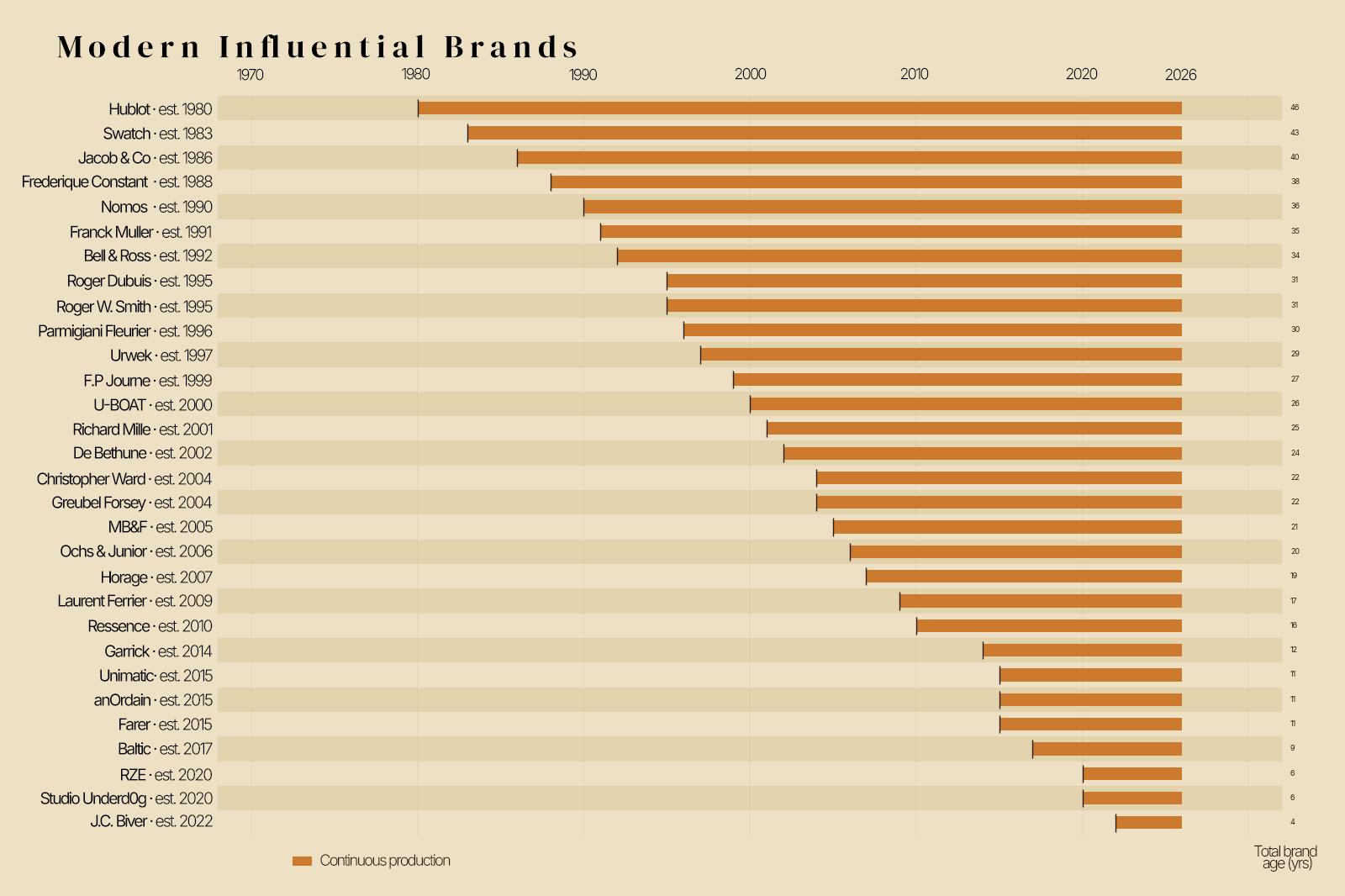
MB&F is a perfect example of youth as an advantage. Its horological machines are shaped by science fiction, sculpture and a willingness to ignore the conventions of round cases and classical dial layouts.
Urwerk, Richard Mille, Roger Dubuis and Greubel Forsey also show how modernity can become a brand identity in itself.
These watchmakers don’t carry centuries of archive material, and they don’t need to. Their credibility comes from distinct ideas, technical confidence and a clear sense of the collector they’re speaking to.
The rise of smaller contemporary names also reflects the way collectors now discover watches.
A niche independent no longer needs a global network of boutiques to find an audience. A strong design language, small production and a recognisable point of view can travel quickly in the internet era.
What age actually tells a collector
Age matters, but not in the simplistic way it’s often presented.
A centuries-old name can suggest deep craft, cultural weight and a lineage of complicated watchmaking. It can also bring conservatism, expectation and the risk of being trapped by its own archive.
A young brand can feel agile, inventive and free from inherited rules. It can also lack the patience, finishing depth or after-sales infrastructure that established collectors value.
The useful question is not whether old is better than new.
It’s whether a brand’s age matches its character.
Vacheron Constantin’s appeal is inseparable from continuity, refinement and the long arc of Genevan watchmaking. Blancpain’s modern identity is tied to resurrection, traditional complications and a deliberate return to mechanical seriousness after the industry’s darkest period.
MB&F’s appeal lies elsewhere entirely. Its youth isn’t a gap to be excused, but part of the proposition.
The same applies to the broader independent scene, from radical high-end makers to playful smaller labels such as Studio Underd0g.
Collectors are better served by reading age as context rather than credential.
A founding date can add emotional weight, but it shouldn’t do the work of judgment. The watch still has to stand on its design, movement, finishing, wearability and the coherence of the brand behind it.
In the end, the most meaningful age in watchmaking isn’t counted only in years. It’s measured in generations, disruptions and the choices a brand makes when history stops being enough.