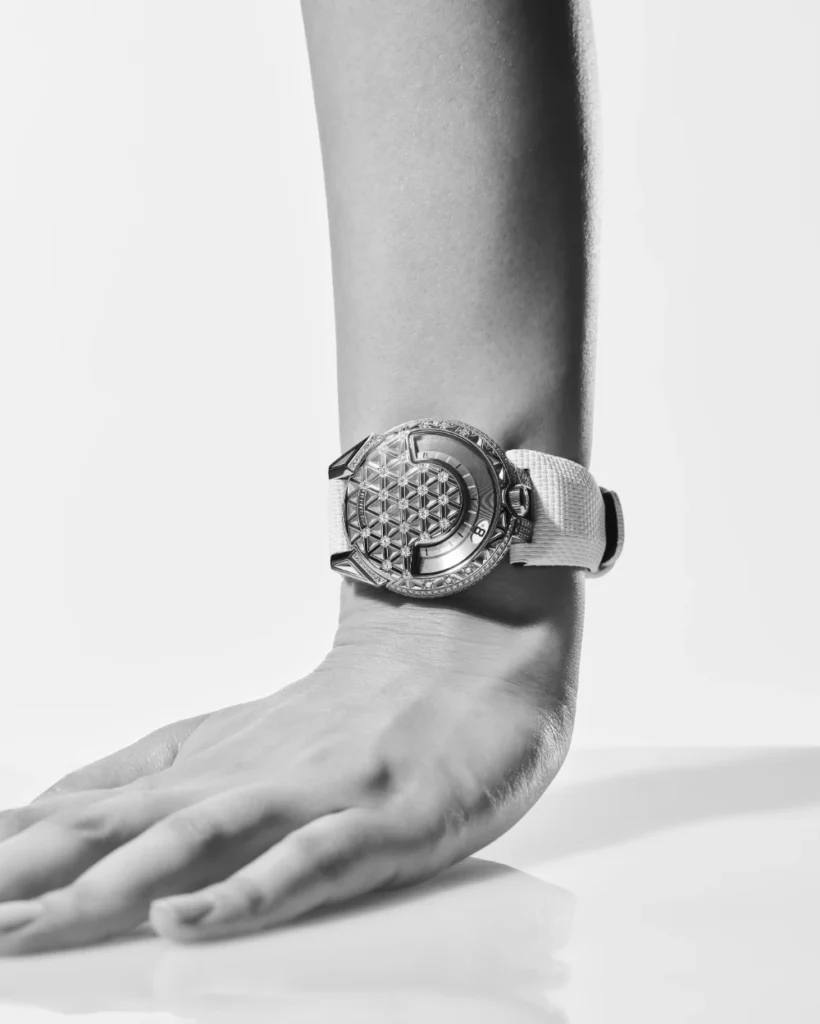
The URWERK UR-101 Diamond Sky takes one of the brand’s earliest ideas and gives it an unexpectedly architectural diamond treatment.
This is not a conventional gem-set watch dressed for evening wear, but a compact 41 mm URWERK with its wandering-hours display framed by a steel case that has been engraved and set to read like a geometric constellation.
The UR-101 returns with a sharper celestial language
The UR-101 matters because it sits close to the beginning of URWERK’s story.
When Felix Baumgartner, Thomas Baumgartner and Martin Frei introduced the UR-101 and UR-102 in 1997, independent watchmaking had not yet become the playground of kinetic displays and radical case architecture that collectors know today.
The idea was already clear at the start, with hours shown as moving bodies rather than hands fixed to the centre of a dial.
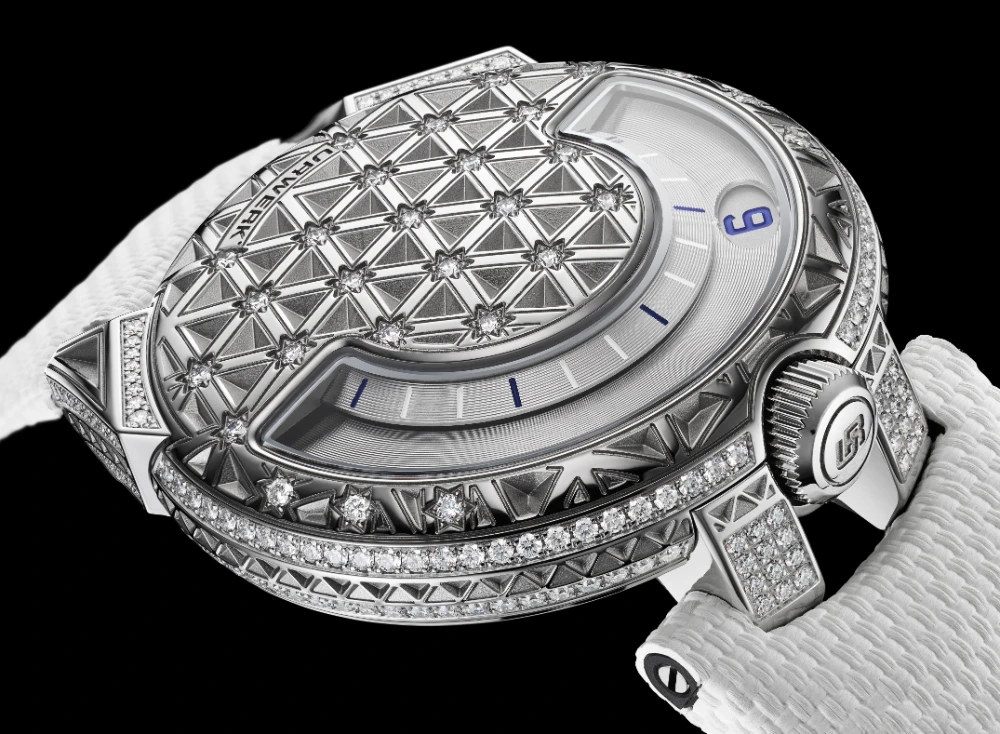
The Diamond Sky keeps that same essential grammar, including the satellite time display, the crown at 12 o’clock, angular lugs and the compact saucer-like case silhouette that has long been associated with the first URWERK watches.
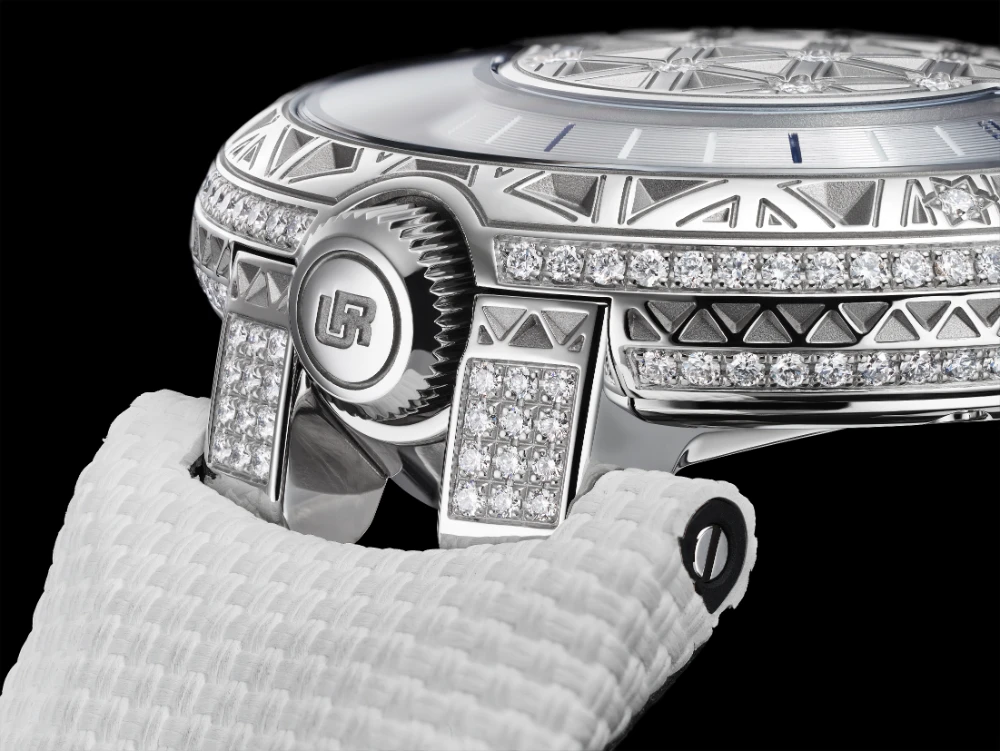
A steel case set like a mapped constellation
The visual shift comes from the case, which is steel and measures 41 mm across with a slim 9.33 mm profile.
Across its surface, URWERK uses an engraved geometric network with 214 D-E-F VVS+ diamonds placed at the intersections, totalling 1.63 carats.
The result is more restrained than a fully pavéd jewellery watch and more deliberate than a bezel-set flourish.
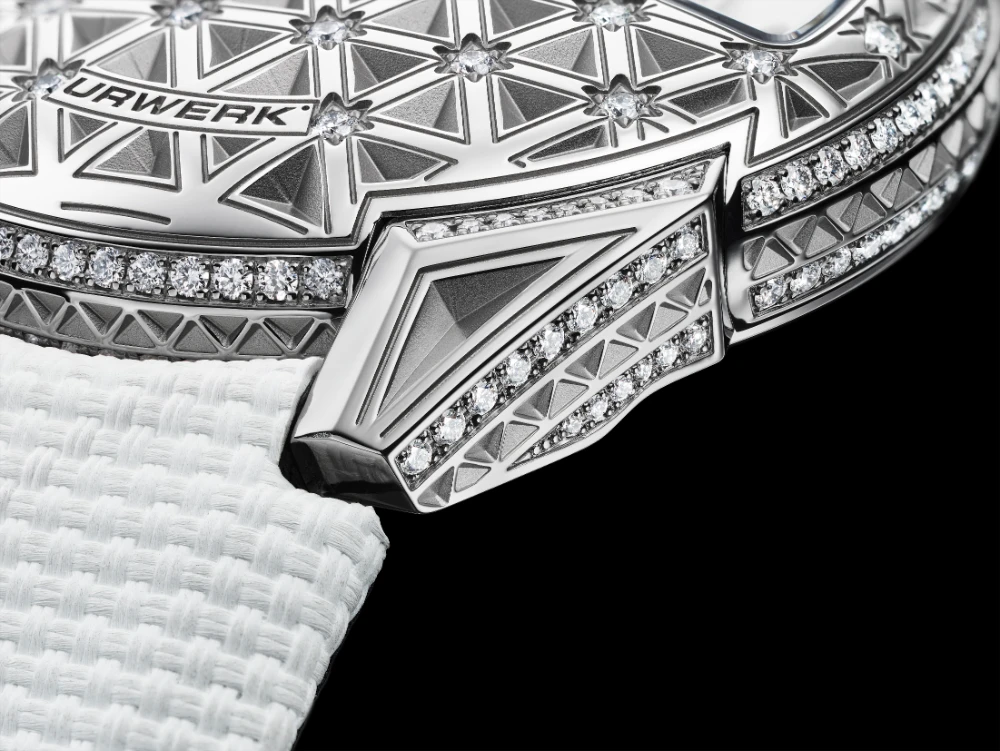
The stones work with the case architecture, giving the watch a fixed-star effect that changes as the wrist moves without overwhelming the underlying UR-101 shape.
Martin Frei’s design language has always leaned into spacecraft, science fiction and imagined instruments, and here the diamond layout feels closer to an orbital chart than traditional decoration.
Wandering hours with luminous clarity
The UR-101 Diamond Sky displays time through two satellites that carry the wandering hours across a minute scale.
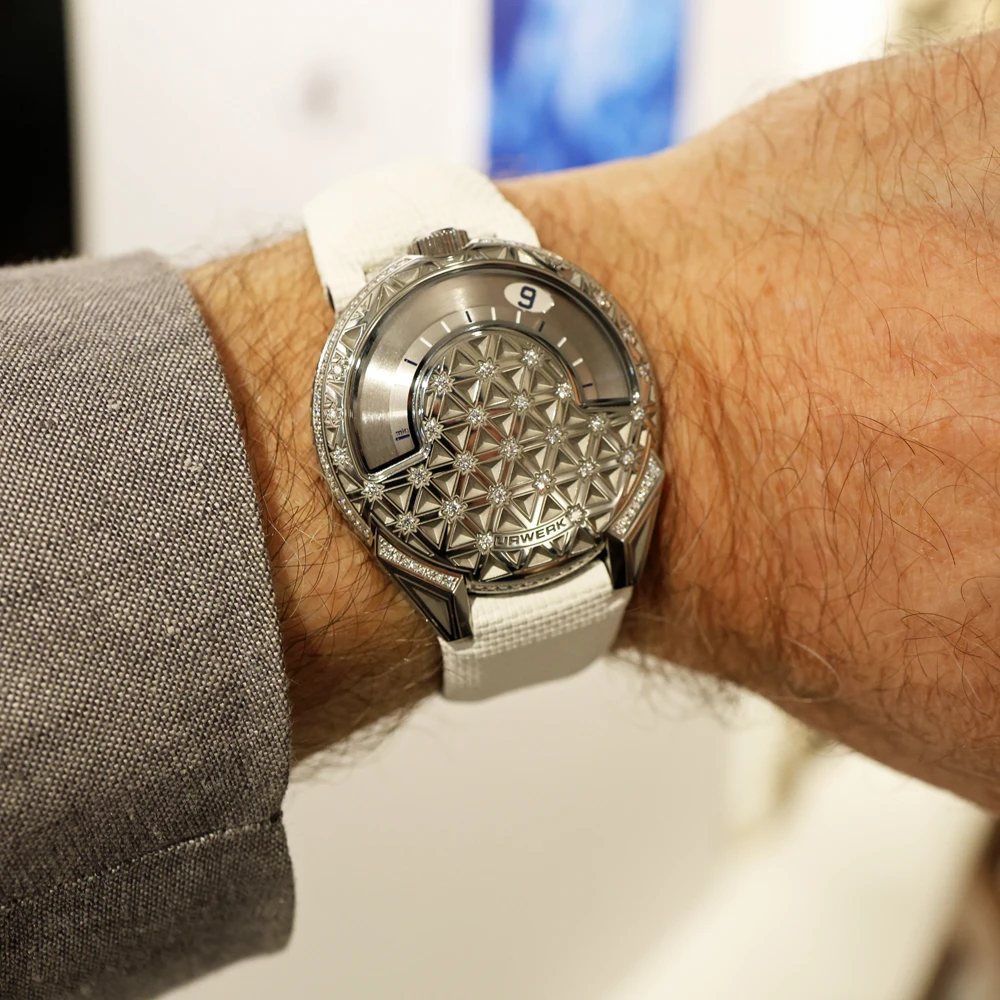
It is a poetic way of reading time, but it also has real historical depth, echoing early night clocks that used moving hour numerals and an illuminated arc to make time legible in darkness.
URWERK’s modern version is cleaner, smaller and more mechanical in its expression.
Super-LumiNova on the wandering hours and minute markers helps preserve the practical side of the display, an important detail on a watch whose case already draws plenty of light.
The UR-1.01V calibre and key specifications
Inside is the automatic UR-1.01V calibre, running at 28,800 vibrations per hour with 28 jewels and a 48-hour power reserve.
The movement finishing includes snailing, sandblasting, satin brushing and chamfered screw heads, which fits the brand’s usual mix of contemporary mechanics and traditional hand-finishing cues.
- Model is the URWERK UR-101 Diamond Sky
- Case is 41 mm stainless steel and 9.33 mm thick
- Gem setting uses 214 D-E-F VVS+ diamonds totalling 1.63 carats
- Display shows wandering hours on two satellites with minutes
- Movement is the automatic UR-1.01V with a 48-hour power reserve
- Strap is textured white rubber with black calfskin lining and a steel pin buckle
- Price is CHF 85,000 excluding taxes
The white rubber strap is an interesting choice, keeping the watch in URWERK’s world rather than pulling it toward formal jewellery-watch territory.
With black calfskin lining and a steel pin buckle, it reinforces the contrast between technical object and celestial surface.
Who the Diamond Sky is really for
The UR-101 Diamond Sky will appeal most to collectors who understand the importance of URWERK’s earliest case language but want something more unusual than a straight archival revival.
It also suits buyers who are open to diamonds when they are used as part of the structure of a design rather than as a simple signifier of luxury.
At CHF 85,000 before taxes, it sits firmly in serious independent watchmaking territory, but the interest here is not only the gem count or the movement.
The appeal is the way URWERK has taken a foundational watch and made it feel newly strange, turning the UR-101 into a small steel sky chart for the wrist.