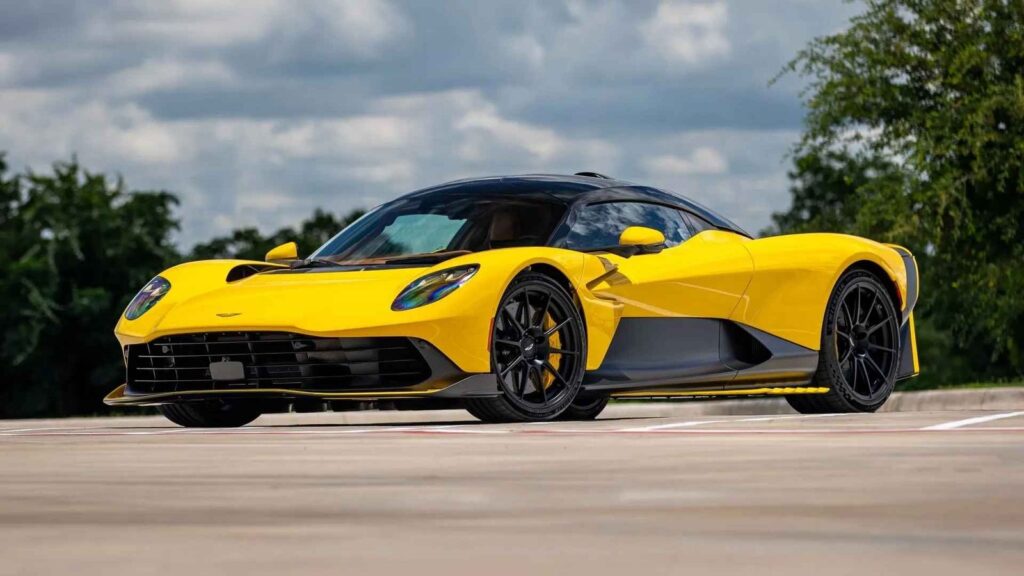
The Aston Martin Valhalla is still a rare sight in customer hands, which makes this Monterey Car Week pairing unusually interesting.
A single collector is bringing two 2026 examples to market in the US, and both are showing just 196 miles. For a car that has only recently begun reaching owners, this is an unusually early glimpse at how the Valhalla may behave on the secondary market.
At a glance
- A single owner is offering two 2026 Aston Martin Valhalla hypercars during Monterey Car Week.
- Both cars show just 196 miles, with one finished in Ultra Yellow and the other in Speedway White.
- The Ultra Yellow car carried an original price above $1.27 million, including more than $217,000 in options.
A rare early resale for Aston Martin’s Valhalla
Seeing one Valhalla appear for resale this early would be enough to catch attention.

Seeing two from the same collection gives the sale a different character, particularly because the cars appear to have been used sparingly rather than treated as regular road companions.
Both are 2026 model-year examples and both show identical mileage at 196 miles, a figure that suggests careful storage, brief demonstration use or limited delivery-to-display movement rather than meaningful driving.
That low mileage matters because the Valhalla is still close to the beginning of its life with customers.

Early cars often carry extra weight among collectors, especially when they appear in strong specifications and have barely had time to establish a public market rhythm.
The Ultra Yellow car is the extrovert of the pair
The more dramatic of the two cars is finished in Ultra Yellow, paired with a black roof and extensive exposed carbon fibre.
It’s the kind of configuration that leans into the Valhalla’s visual aggression rather than trying to quiet it down.
The cabin continues that approach, combining Oxford Tan leather with yellow accents and carbon trim.
That interior choice gives the car a warmer, more tailored feel than a simple black cabin would, while still keeping a link to the exterior colour.
This example also carries the clearest pricing context of the two.
Its original price was more than $1.27 million, with over $217,000 of that coming from optional equipment.
That option spend is significant even in this corner of the market, and it reinforces how personal these early Valhalla configurations can be.
The Speedway White car takes a cleaner route
The second Valhalla is finished in Speedway White and presents a more restrained personality.
Rather than leaning as heavily on exposed carbon, it uses more body-coloured panels, giving the shape a cleaner and slightly less confrontational look.
The interior brings more colour than the exterior might suggest, with California Poppy orange paired with Onyx Black leather.
It’s a vivid combination, but not an untidy one.
Against the white exterior, the orange cabin gives the car a sharper identity without turning it into the louder of the two.
Details & Specifications
| Brand | Aston Martin |
|---|---|
| Model | Valhalla |
| Model year | 2026 |
| Number offered | Two |
| Seller context | Single owner collection |
| Mileage | 196 miles on each car |
| Sale location | United States, during Monterey Car Week |
| Ultra Yellow example | Ultra Yellow exterior, black roof, exposed carbon fibre, Oxford Tan leather interior with yellow accents and carbon trim |
| Ultra Yellow original price | Over $1.27 million, including more than $217,000 in options |
| Speedway White example | Speedway White exterior with more body-coloured panels, California Poppy orange and Onyx Black leather interior |
Monterey Car Week has always been a natural stage for unusual consignments, but this pair has a particular appeal because it sits at the intersection of new-car scarcity and collector-market curiosity.
For Aston Martin clients who missed an allocation, or collectors who prefer a car already configured and effectively unused, the opportunity is straightforward.
The harder question is which personality suits the garage better.
The Ultra Yellow car has presence from across a lawn, while the Speedway White example feels more measured and graphic.
Together, they make an unusually neat snapshot of how differently the same hypercar can be expressed before it has even had time to become familiar.