The tourbillon is one of watchmaking’s most familiar complications, yet one of its most interesting chapters is still not widely understood.
Episode 3 of Masters of Chronometry follows the inclined tourbillon, a deceptively simple idea that asks what happens when Breguet’s rotating regulator is no longer set flat inside the movement.
It’s a story that moves from Boston to Glashütte and into the modern era of Greubel Forsey, Jaeger-LeCoultre, HYT and ArtyA.
At a glance
- Episode 3 of Masters of Chronometry traces more than 165 years of inclined tourbillon development.
- The episode focuses on how tilting the regulating organ can help address positional errors beyond the vertical pocket-watch problem.
- Key names include Andrew Holden Potter, Walter Prendel, Robert Greubel, Stephen Forsey, Éric Coudray, Jaeger-LeCoultre, HYT and ArtyA.
Breguet’s invention meets a different problem
Abraham-Louis Breguet’s tourbillon was created for a world of pocket watches.
The basic principle was elegant: place the escapement and balance inside a rotating cage so gravity’s effect on timing errors could be averaged out while the watch spent long periods in a vertical position.
That logic made sense for a watch kept in a waistcoat pocket, but real life is rarely so tidy.
A watch may be placed dial-up on a table, held at an angle, carried in motion or strapped to a wrist that constantly changes position.
The inclined tourbillon grows from that complication within the complication.
Rather than accepting the regulating organ in one conventional plane, watchmakers began to ask whether angling it could create a more effective averaging of gravity’s influence across multiple positions.
The overlooked American beginning
The story begins in 19th-century America with Andrew Holden Potter, a Boston watchmaker whose work has often been overshadowed by confusion with Albert Henry Potter.
Andrew Holden Potter’s inclined-balance tourbillon stands as an early and remarkable answer to the limits of a conventional tourbillon architecture.
Its importance lies not simply in being unusual, but in identifying a practical weakness in how a rotating regulator behaves outside a single expected orientation.
That makes it one of the more intriguing pieces in the broader tourbillon lineage.
For collectors and historians, the distinction between the two Potters matters.
It restores attention to a watchmaker whose contribution sits at the beginning of an idea that would take more than a century to become central to some of contemporary independent watchmaking’s most serious experiments.
Walter Prendel and the Glashütte leap
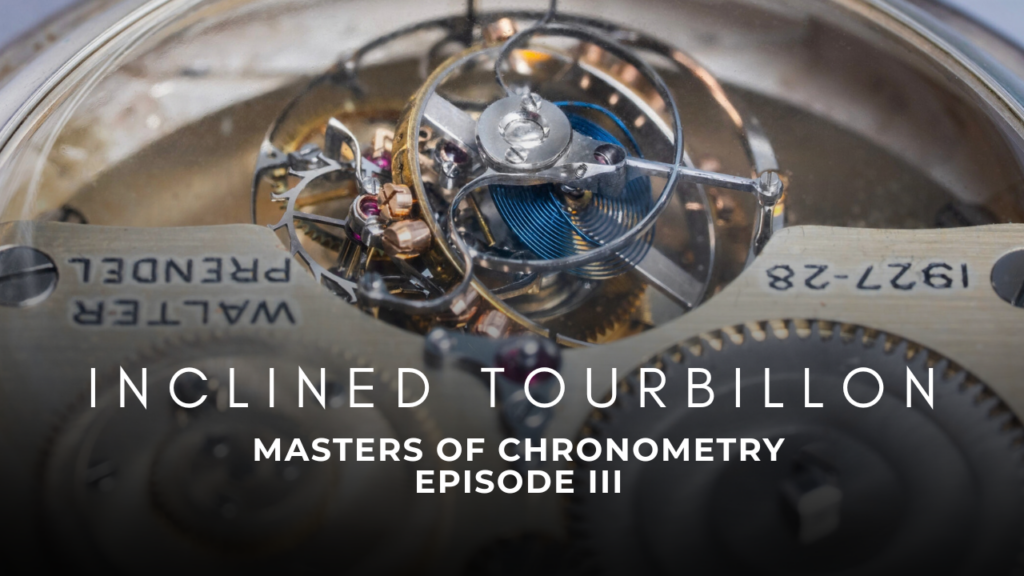
Around seven decades after Potter’s work, Walter Prendel pushed the idea much further.
Trained at the German Watchmaking School in Glashütte under Alfred Helwig, Prendel created a six-minute tourbillon of remarkable complexity.
Its architecture went beyond a single tilted balance.
The escape wheel, pallet fork and balance were progressively inclined at different angles, creating a layered mechanical arrangement that treated inclination as a system rather than a visual flourish.
That detail is crucial.
In lesser hands, an angled tourbillon can become a spectacle first and a timing device second.
Prendel’s construction belongs to the more serious tradition, where the visual drama comes from a technical proposition.
It also shows how Glashütte’s educational and workshop culture could take an earlier idea and turn it into something more architecturally ambitious.
Greubel Forsey and the modern wristwatch argument
The modern chapter is inseparable from Robert Greubel and Stephen Forsey.
Their Double Tourbillon 30° translated the principle of inclination into the wristwatch with a level of focus that helped make the angled tourbillon newly relevant.
In 2011, the Double Tourbillon 30° scored 915 out of 1,000 points at the Concours International de Chronométrie.
That result gave the concept something more valuable than visual credibility.
It gave it chronometric evidence in a competitive setting.
Greubel Forsey continued to explore the idea through watches including the Tourbillon 24 Secondes and Tourbillon Cardan, each taking a different approach to how a regulating organ can move through space.
The appeal is not just the motion itself, but the controlled complexity behind it.
The inclined tourbillon is difficult because every gain in theoretical performance arrives with mechanical trade-offs in energy, geometry, adjustment and construction.
The inclined tourbillon today
One reason the inclined tourbillon remains compelling is that it has not settled into a single formula.
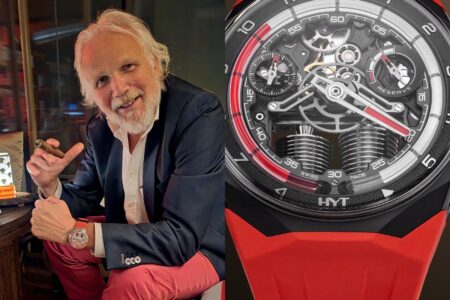
Éric Coudray’s work, the HYT Conical Tourbillon and Jaeger-LeCoultre’s Heliotourbillon all show how the idea can be interpreted through different mechanical languages.
ArtyA’s Complexity adds a more recent expression, using two inclined Cônillon tourbillons connected by a differential.
That arrangement turns the question of inclination into a conversation between two regulators rather than a single rotating assembly.
At this level, the inclined tourbillon sits between science, sculpture and watchmaking philosophy.
It appeals to collectors who care about more than rarity or decoration, because it reveals how far watchmakers are willing to go in pursuit of a better answer to gravity.
The most interesting part is that the question remains open.
From Andrew Holden Potter’s Boston pocket watch to today’s multi-axis wristwatch constructions, the inclined tourbillon continues to ask whether changing the angle can change the outcome.
That persistence is what makes it more than a niche within haute horlogerie.
It is one of watchmaking’s longest-running arguments with gravity, and Episode 3 of Masters of Chronometry gives that argument the historical depth it deserves.