Some watches do not need a rare complication or an exotic dial to feel important.
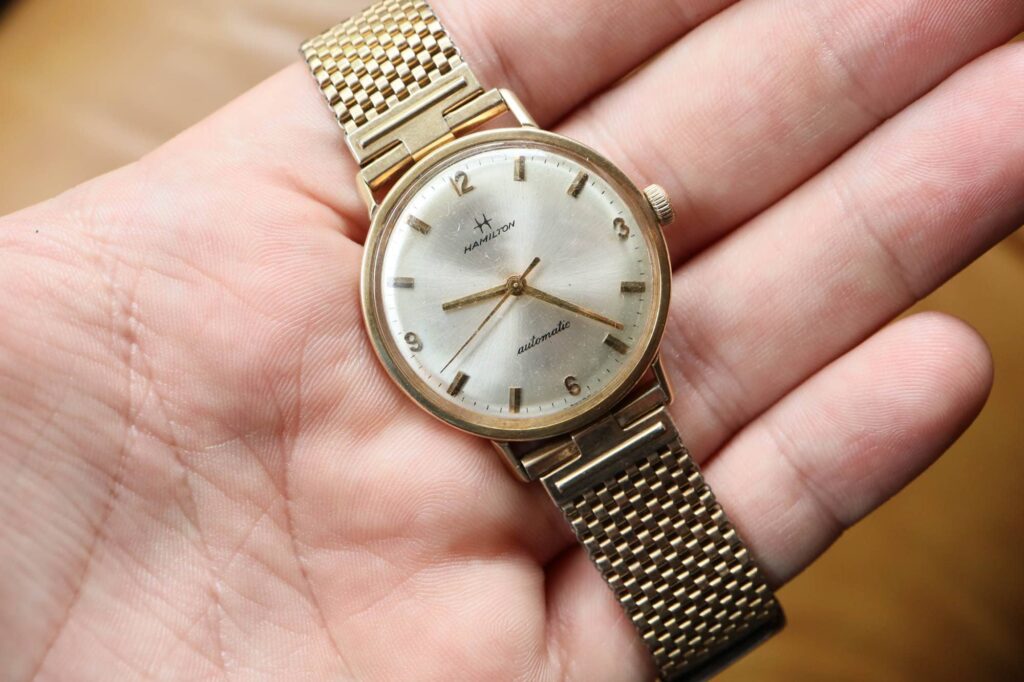
The 1968 Hamilton Accumatic A-203 makes its case in solid 14K gold, with mid-century restraint, dependable automatic engineering and the unmistakable gravity of a watch built to outlive its first owner.
A solid-gold standout from Hamilton’s Accumatic years
Hamilton produced the Accumatic line from 1956 into the early 1970s, making it one of the brand’s familiar automatic families during a period of broad change in American watchmaking.

Most Accumatic models were straightforward three-hand watches, sometimes with a date, and many used Swiss ETA calibers finished and identified under Hamilton’s own movement system.
The A-203 arrived in 1968 and stood apart because of its solid 14K gold case, made by DiVincenzo & Arienti, a respected case manufacturer of the era.
At $140 when new, it was not an insignificant purchase, with that figure landing around $1,328 in 2026 dollars.

That puts the A-203 in an interesting place, not as a flamboyant dress watch, but as a serious gold automatic that could mark a milestone and then remain in a family for decades.
The 35mm case and champagne dial get the proportions right
The A-203 measures 35mm across with an 18mm lug width, giving it the balanced proportions that make many vintage Hamilton watches so wearable today.
Its light champagne dial keeps the gold case from feeling heavy, while the mix of applied markers and numerals adds enough texture without disturbing the clean layout.

One especially charming detail is the cursive automatic text above 6 o’clock, which softens the otherwise formal Hamilton signature at the top of the dial.
The case uses a monobloc construction, meaning the movement is reached from the front after the crystal is removed.
Hamilton paired that construction with a water-resistant crown and gasket setup, though any surviving example should be treated as a nearly 60-year-old dress watch rather than something ready for moisture.

Hamilton’s 689A automatic movement inside
Power comes from the Hamilton 689A, a 17-jewel automatic movement closely related to the ETA 2451.
The 689A is rated for roughly 47 hours of power reserve, a touch longer than the standard ETA 2451’s commonly cited 42-hour figure.
Hamilton also gave the movement black rhodium plating and a signed balance, small details that help distinguish it from a plain off-the-shelf ETA execution.
For ownership, that ETA connection is a practical advantage because the movement architecture is familiar to many watchmakers.
The monobloc case, however, means servicing is not quite as casual as popping off a conventional caseback.
What collectors should check before buying an A-203
Finding an A-203 can be harder than the model’s simple design suggests.
Many sellers may list one only as a 14K gold Hamilton rather than by the Accumatic or A-203 name, so broader searches are often more effective.
Condition matters sharply with this watch because the gold case is central to its appeal.
Look closely for over-polishing, softened edges, deep case marks and signs that the original finishing has been erased.
The crystal also deserves attention, since cracks or heavy scratches can suggest rough handling during past access to the movement.
A recently serviced example may be worth paying more for, particularly because front-loading cases can add complexity and cost when maintenance is needed.
The lasting appeal of a restrained gold Hamilton
The Accumatic A-203 is not the loudest vintage Hamilton, and that is exactly its strength.
It offers precious-metal construction, sensible automatic mechanics and a design language that works with a suit, a sweater or a quiet dinner without demanding attention.
For collectors, it sits at the intersection of accessible vintage scholarship and genuine heirloom value.
For families, it is the sort of watch that can carry stories even when no one remembers every detail of where it has been.
The 1968 Hamilton Accumatic A-203 remains a compelling reminder that legacy watches are not always the rarest or most complicated pieces in the box.
Sometimes they are simply well-made, quietly beautiful and still ticking long after the moments they witnessed have become memory.