The Swiss watch industry isn’t dealing with one clean problem. It’s being squeezed from several directions at once, with tariffs, currency pressure, uneven demand and a changing customer base all arriving in the same cycle.
For microbrands, that creates a more complicated picture than the headlines suggest. The big Swiss houses are under pressure, but the same market forces that hurt established mid-tier names can give smaller, sharper brands room to move.
Deloitte’s 2025 Swiss Watch Industry Study and the early 2026 export figures from the Federation of the Swiss Watch Industry show a market that’s not collapsing, but clearly reorganising.

At a glance
- Swiss watch exports peaked in value in 2023, weakened in 2024 and entered 2026 with uneven momentum across key markets.
- The hardest pressure is falling on the entry-to-mid Swiss segment, while the highest price tiers have remained more resilient.
- For microbrands, 2026 looks less like a broad boom and more like a test of pricing, product discipline and market focus.
Swiss watchmaking has moved from record value to harder math
In 2023, Swiss watch exports reached a record CHF 26.7 billion, marking the high point of the post-pandemic luxury surge.
By 2024, the picture had changed. Export value slipped by nearly 3%, while volume fell by 10%, equal to roughly 1.5 million fewer watches sold globally.
That distinction matters because the value decline was mild compared with the drop in units. Swiss watchmaking was still extracting high prices, but it was selling fewer watches.

The strain was especially visible below CHF 3,000 in export price, a bracket that roughly translates to watches retailing around CHF 6,000 to CHF 8,000. That segment saw export earnings fall 16%.
At the upper end, watches in higher price categories performed better, with value up 1% even as volumes fell 4%.
That split confirms the industry’s long-running premiumisation problem. Brands have moved upmarket because the top end has been more profitable and more resilient, but the middle has become increasingly exposed when demand softens.

For microbrands, this is the first important distinction. A small independent selling mechanical watches at $300 to $1,500 isn’t fighting the same battle as a large Swiss group brand trying to defend volume at several thousand francs.
The overlap is emotional and aesthetic, not always commercial. A buyer comparing a microbrand diver with a mainstream Swiss watch may care about mechanical credibility, design and value, but the business models behind those watches are very different.
The US tariff shock has made 2026 difficult to read
The United States has been the largest export market for Swiss watches since 2021, accounting for CHF 4.4 billion in 2024, or 16.8% of all Swiss watch exports.

That made the 2025 tariff escalation especially disruptive. After an initial 10% tariff period in April, the rate on Swiss goods rose to 39% in August.
Brands and retailers responded by moving inventory early. Swiss watch exports to the US surged 150% in April 2025 compared with the same month in 2023, then rose again by 45% in July as companies tried to get ahead of the full tariff impact.
That front-loading makes the 2026 data look sharper than it would in a normal year.

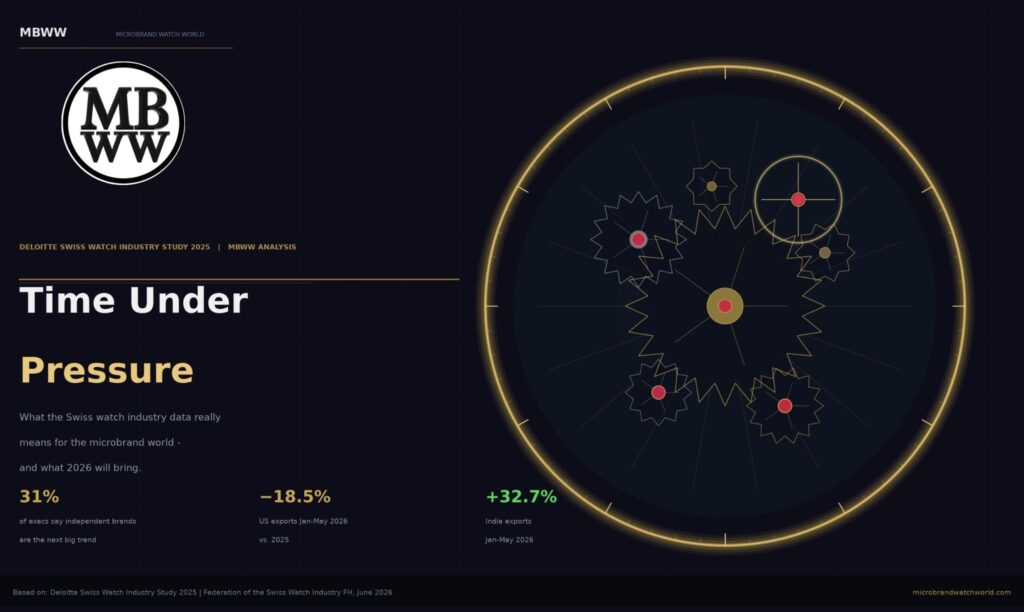
In the first five months of 2026, Swiss watch exports to the US totalled CHF 1.83 billion, down 18.5% from the same period in 2025. Compared with January to May 2024, however, the US was still up 4.7%.
In other words, 2026 is correcting an inflated 2025, not simply falling off a cliff.
| Market | Jan-May 2026 movement |
|---|---|
| United States | Down 18.5% versus 2025, up 4.7% versus 2024 |
| France | Up 53.9% versus 2025 |
| India | Up 32.7% versus 2025 |
| Mexico | Up 21.0% versus 2025 |
France’s dramatic increase is likely tied to a mix of European tourist demand and changes in how brands move inventory through markets as the US tariff environment becomes more expensive.

India and Mexico are more interesting for the longer term. Both are growing from smaller bases than the US, but their momentum shows that the next phase of watch demand won’t be concentrated only in the familiar luxury capitals.
Microbrands should pay attention here, even if they don’t have the distribution budgets of large Swiss groups. A direct-to-consumer brand can test demand in emerging collector markets more quickly than a traditional company tied to wholesale networks and retail doors.
The Swiss mid-market is where the pressure is most visible
Deloitte’s executive survey, conducted among 111 senior industry figures, captured a cautious industry before the full 39% US tariff was confirmed.

At that point, 43% of executives viewed the outlook for their main export markets negatively, while only 23% were positive.
The mood changes dramatically by price point. For watches above CHF 50,000, 64% of executives saw the outlook as positive.
In the CHF 10,000 to CHF 50,000 luxury band, sentiment was more mixed, with 38% neutral and 32% positive.

For entry-level and mid-range Swiss watches, the view was far darker. Around 60% of executives rated the outlook as negative in both the under CHF 1,500 and CHF 1,500 to CHF 10,000 export-price categories.
That is the part of the market most exposed to a value challenge. When a watch is expensive enough to demand serious consideration but not rare enough to feel insulated, buyers become more selective.
This is where microbrands can be credible, but only if they understand what they’re offering.

The advantage isn’t simply being cheaper. Plenty of inexpensive watches feel anonymous.
The advantage is being specific. A microbrand can win with a strong case profile, a clear design point of view, transparent pricing, community trust and a product that doesn’t feel like a diluted version of something else.
That’s particularly important as established brands push prices upward. Every price increase creates a question in the buyer’s mind, and independent brands can answer that question when they offer a sharper proposition.

What 2026 asks of microbrands
The strategic priorities inside the Swiss industry are revealing. Among brand executives, 82% said new product introductions were a priority, followed by organic growth at 61%, expansion into new markets at 52% and cost reduction at 46%.
That last figure is telling because cost reduction was only 11% in 2023.
Component manufacturers are even more defensive, with 74% focused on cost reduction and 70% cutting capital expenditure. By June 2025, more than 100 watchmaking-related companies in Switzerland were using short-time working compensation.

For small brands, the lesson is plain. The supply side is under pressure, and that can affect timelines, minimum orders, component access and pricing.
Microbrands that depend on predictable production windows need to be more disciplined than ever. The brands most likely to navigate 2026 well will be the ones that avoid overextending themselves on too many variants, too many pre-orders or too much speculative inventory.
Product planning also needs to become less reactive. If every brand responds to uncertainty by launching more watches, collectors will become harder to impress and quicker to ignore weak releases.

A tighter catalogue may be more powerful than a crowded one.
Market focus matters too. The early 2026 numbers show that demand is moving unevenly, with the US distorted by tariffs and markets such as India and Mexico growing quickly.
That doesn’t mean every microbrand needs an India strategy or a Mexico strategy overnight. It does mean small brands should look beyond the usual English-speaking collector bubble when they think about community, shipping, customer service and launch timing.
The strongest microbrands in 2026 won’t just be the ones with the nicest dials. They’ll be the ones that understand where their buyers are, what those buyers can justify spending and how to deliver without behaving like a miniature version of a luxury conglomerate.
There’s still room for independent watchmaking to grow, but the easy assumptions are gone. In a market under pressure, microbrands need to be lean, precise and honest about value, because collectors have more choices and less patience for vague promises.