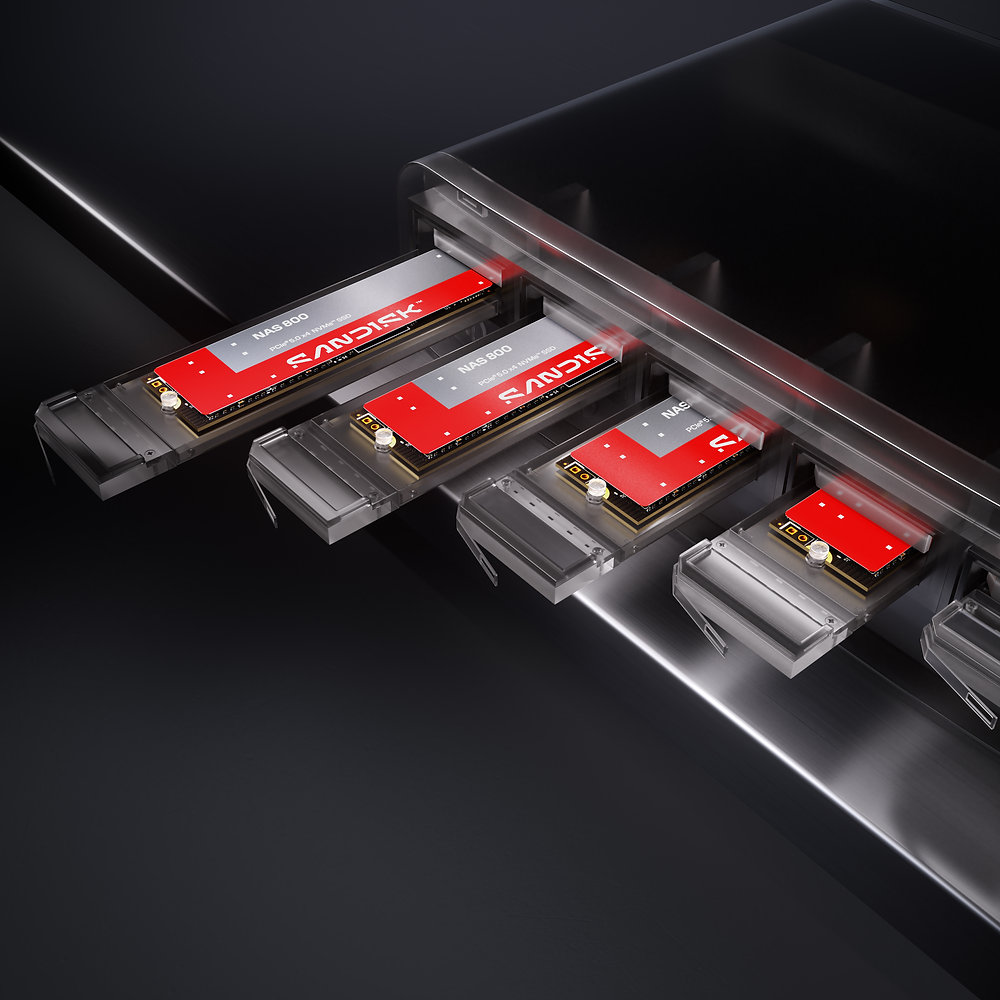
NAS storage has moved well beyond the backup closet.
For creative studios, small businesses and power users, it’s now a working private cloud, a collaboration hub and, increasingly, a place where AI-ready datasets need to live close to the people using them.
Sandisk’s new SANDISK NAS SSD family is aimed squarely at that shift, with one drive for accessible SATA upgrades and another for high-speed PCIe 5.0 deployments.

At a glance
- Sandisk has introduced the SANDISK NAS 600 SATA SSD and SANDISK NAS 800 NVMe SSD for modern network-attached storage systems.
- The NAS 600 focuses on high-endurance SATA upgrades, while the NAS 800 targets PCIe 5.0 all-flash and hybrid NAS workloads.
- Capacities run from 500GB to 4TB for the NAS 600 and from 960GB to 7.68TB for the NAS 800.
A SATA route away from spinning drives
The SANDISK NAS 600 SATA SSD is the more familiar of the two, designed for users who want to modernise existing NAS systems without rethinking the entire enclosure.
It uses a 2.5-inch, 7mm SATA form factor and is intended to fit into 3.5-inch NAS drive bays that support 2.5-inch SSDs.
That matters for small offices and home studios where a NAS may already be central to daily work, but where hard drives can become the bottleneck in shared projects, media libraries and backup routines.

The NAS 600 is rated for sequential reads up to 560MB/s, which places it at the practical ceiling of SATA rather than chasing headline-grabbing numbers.
Its advantage is the combination of solid-state response, no mechanical noise and endurance figures suited to heavier collaborative use.
Sandisk quotes up to 2,500TBW on the 4TB model and up to 2.25 million hours MTTF, positioning the drive for multi-drive NAS and RAID configurations rather than casual desktop storage.

Capacities range from 500GB to 4TB, giving smaller teams a realistic path into SSD-based NAS storage, caching or tiering without moving directly to a full NVMe platform.
PCIe 5.0 performance for demanding shared workflows
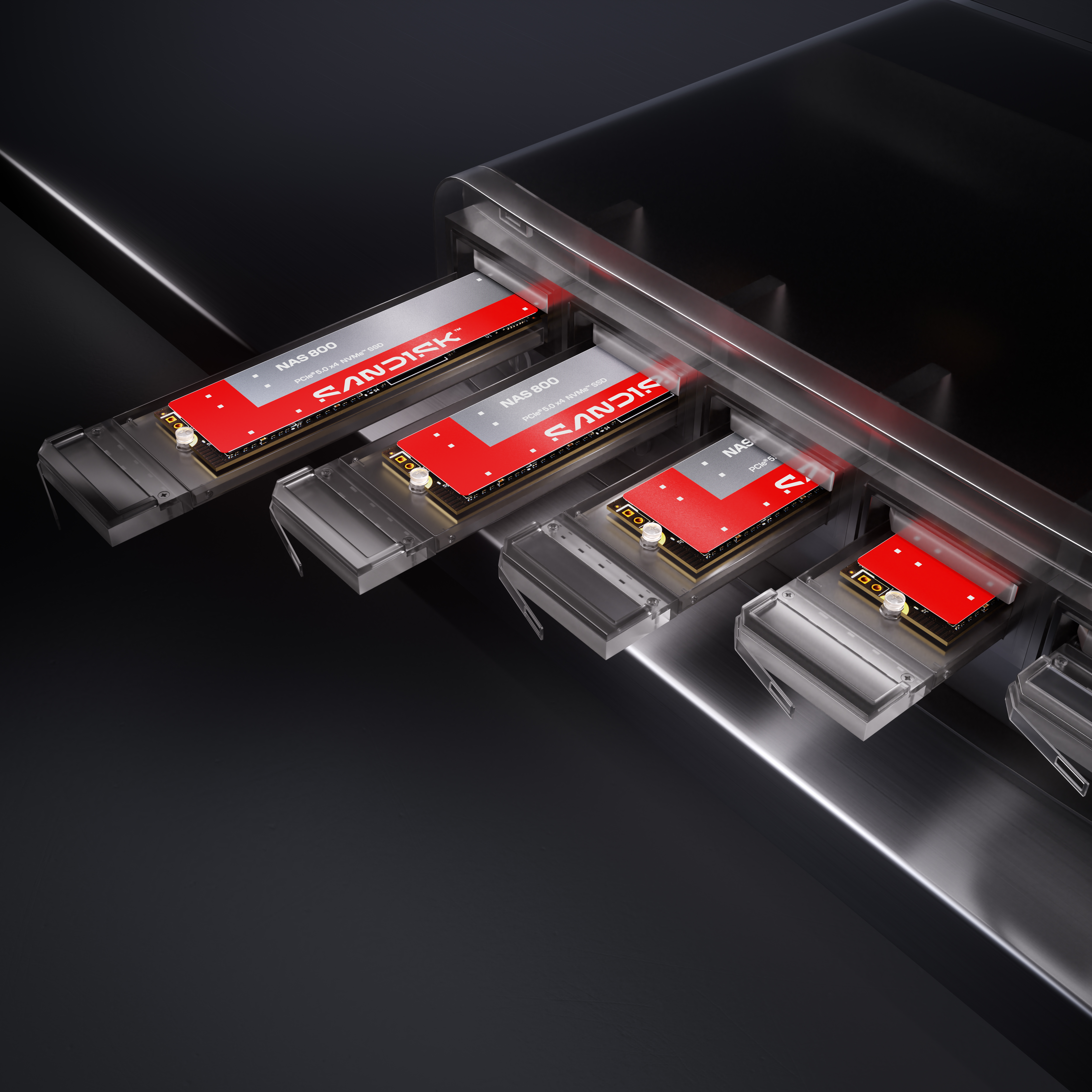
The SANDISK NAS 800 NVMe SSD is the higher-performance option, built around PCIe 5.0 and aimed at all-flash or hybrid NAS systems.
It’s intended for roles such as caching, storage tiering or primary storage in environments where multiple users and applications are pulling from the system at once.
The performance numbers are substantial.
Sandisk lists up to 2.3 million random read IOPS and up to 2 million random write IOPS on the 3.84TB model, alongside sequential read and write speeds of up to 14,900MB/s and 13,200MB/s on the 1.92TB version.
Those figures make the NAS 800 relevant for database work, virtualization, collaborative content production and data-heavy local workflows.
Sandisk also identifies agentic AI as a target use case, reflecting the broader move toward keeping sensitive or high-volume datasets on local infrastructure instead of sending everything to public cloud platforms.
The endurance ceiling is also much higher than the SATA model, with the 7.68TB version rated up to 14PBW.
It uses SANDISK TLC 3D NAND and is tested with many leading NAS systems for M.2 2280 compatibility, which is important because high-speed NAS upgrades often depend as much on enclosure support as on the drive itself.
Built for the new role of NAS
The timing is easy to understand.
Small businesses and independent studios are generating more data, but they’re also becoming more cautious about where that data lives and how quickly it can be accessed.
A well-configured NAS can offer fast local access, user-level control and centralised storage without requiring every workflow to move through a remote cloud service.
SSDs strengthen that proposition by reducing noise, improving responsiveness and helping shared systems cope with heavier multitasking.
Anil Moolchandani, vice president of product management at Sandisk, framed the launch around changing NAS behaviour among prosumers, creative professionals and small businesses.
The practical takeaway is clear enough: Sandisk wants to cover both ends of the upgrade curve, from replacing hard drives in existing NAS hardware to building out high-performance flash storage for more demanding teams.
Details & Specifications
| Brand | Sandisk | Sandisk |
|---|---|---|
| Model | SANDISK NAS 600 SATA SSD | SANDISK NAS 800 NVMe SSD |
| Storage interface | SATA | PCIe 5.0 NVMe |
| Form factor | 2.5-inch, 7mm | M.2 2280 |
| Capacities | 500GB to 4TB | 960GB to 7.68TB |
| Endurance | Up to 2,500TBW on 4TB model | Up to 14PBW on 7.68TB model |
| MTTF | Up to 2.25 million hours | Not stated |
| Sequential read | Up to 560MB/s | Up to 14,900MB/s on 1.92TB model |
| Sequential write | Not stated | Up to 13,200MB/s on 1.92TB model |
| Random read/write | Not stated | Up to 2.3M/2M IOPS on 3.84TB model |
| NAND | Not stated | SANDISK TLC 3D NAND |
| Intended use | HDD replacement, SSD cache or storage tier in NAS systems | All-flash and hybrid NAS, caching, tiering or primary storage |
For buyers, the distinction is straightforward.
The NAS 600 is the quieter, simpler upgrade for systems still living in the SATA world, while the NAS 800 is for users building a faster NAS around NVMe performance and heavier workloads.
Both point to the same larger trend, with private cloud storage becoming less of a passive archive and more of an active production platform.