Xiaomi’s performance car story is moving quickly, and the SU7 Ultra now appears to be getting a more serious track-focused development push.
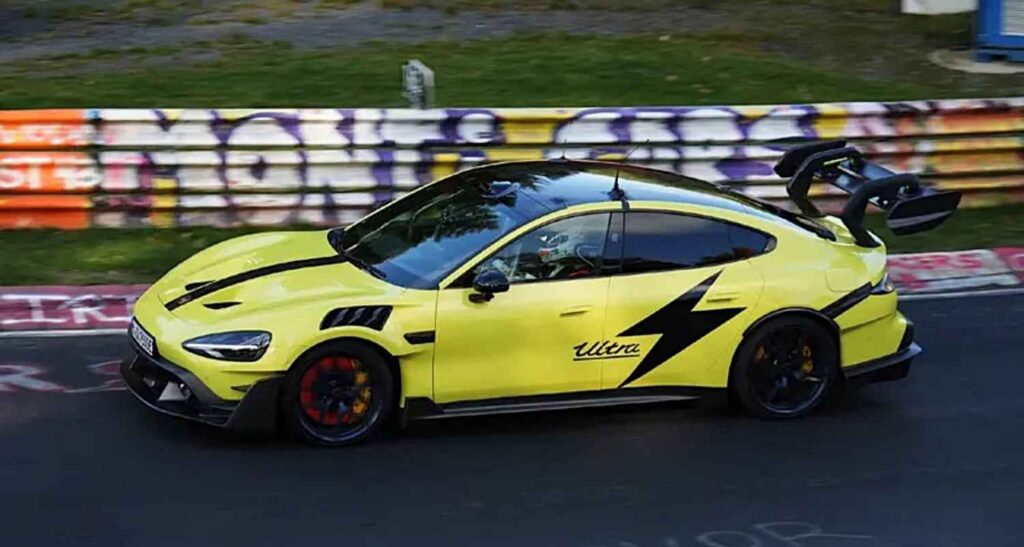
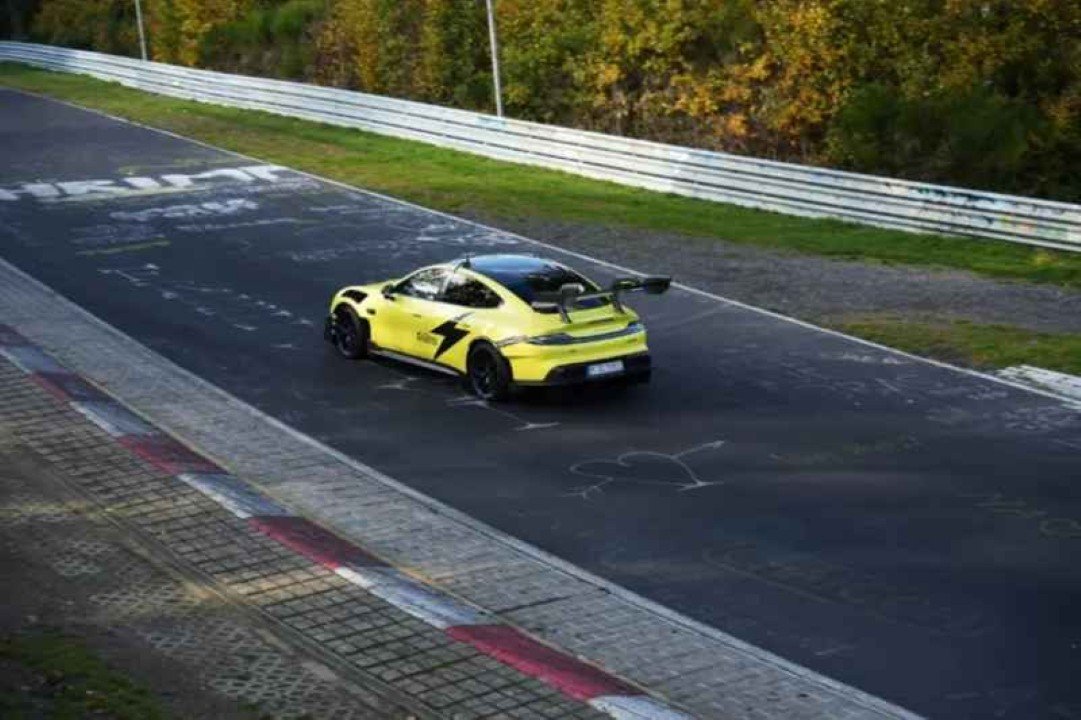
An undisguised prototype has been seen testing at the Nürburgring Nordschleife with a noticeably more aggressive aero package, suggesting the electric saloon’s next evolution could be aimed at higher-speed circuit work.
The car was identified by Car News China, with images attributed to Weibo.
At a glance
- An updated Xiaomi SU7 Ultra prototype has been spotted testing at the Nürburgring Nordschleife.
- The most notable change is a swan-neck rear wing with a movable section, potentially allowing an active drag-reduction function.
- Munich registration plates have been linked to testing for a possible 2027 update, though Xiaomi hasn’t confirmed timing.
A Nürburgring prototype with harder-edged aero
The prototype keeps the broad SU7 Ultra silhouette but wears several pieces that make the current production car look comparatively restrained.
At the front, there’s a larger splitter, additional bumper-mounted aerodynamic elements and louvred vents above the front wheels.
Those vents are a familiar piece of serious performance-car language, used to relieve pressure in the wheel wells and manage airflow around the front axle.
The side skirts have also been revised, giving the car a lower, more planted visual stance.
None of these changes has been formally detailed by Xiaomi, so for now they should be read as visible prototype hardware rather than confirmed production specification.
The rear wing is the key change
The biggest talking point is at the back.
Where the current SU7 Ultra uses a fixed carbon-fibre spoiler, this prototype carries a wing mounted on swan-neck supports with a movable section.
That layout raises the possibility of an active DRS-style function, allowing the wing to reduce drag on straights before returning to a higher-downforce setting for braking and cornering.
It’s a logical area of development for an electric performance car chasing lap time, where managing drag, cooling and downforce can matter as much as headline power.
The Nordschleife setting also matters, because it exposes aero balance, thermal consistency and high-speed stability in a way few circuits can.
What appears to carry over
Not everything on the car is new.
The prototype still has the roof-mounted LiDAR sensor seen on the SU7 Ultra, and the yellow brake callipers remain visible behind the wheels.
Its pale yellow body colour is different from the production car’s Lightning Yellow finish, which may simply reflect prototype specification.
Munich registration plates suggest the car is being evaluated in Europe, and they have been linked to development work for a possible 2027 update.
That timing remains unconfirmed, but it would fit the kind of mid-cycle technical refinement often seen when a carmaker wants to sharpen an already high-output performance model.
Details & Specifications
| Brand | Xiaomi |
|---|---|
| Model | SU7 Ultra prototype |
| Test location | Nürburgring Nordschleife |
| Drivetrain | Three-motor all-wheel drive on the current SU7 Ultra |
| Power | 1,526 hp on the current SU7 Ultra |
| Notable prototype aero | Swan-neck rear wing with movable section, larger front splitter, revised side skirts, bumper aero elements and louvred front-wheel vents |
| Carry-over visible details | Roof-mounted LiDAR sensor and yellow brake callipers |
If the package reaches production, the updated SU7 Ultra could become a more convincing circuit-focused flagship rather than simply a very powerful electric saloon.
For now, the Nürburgring prototype points to a carmaker still pushing the edges of its first high-performance EV platform.