Richemont has started fiscal 2026 with the kind of momentum the wider luxury sector has been looking for.
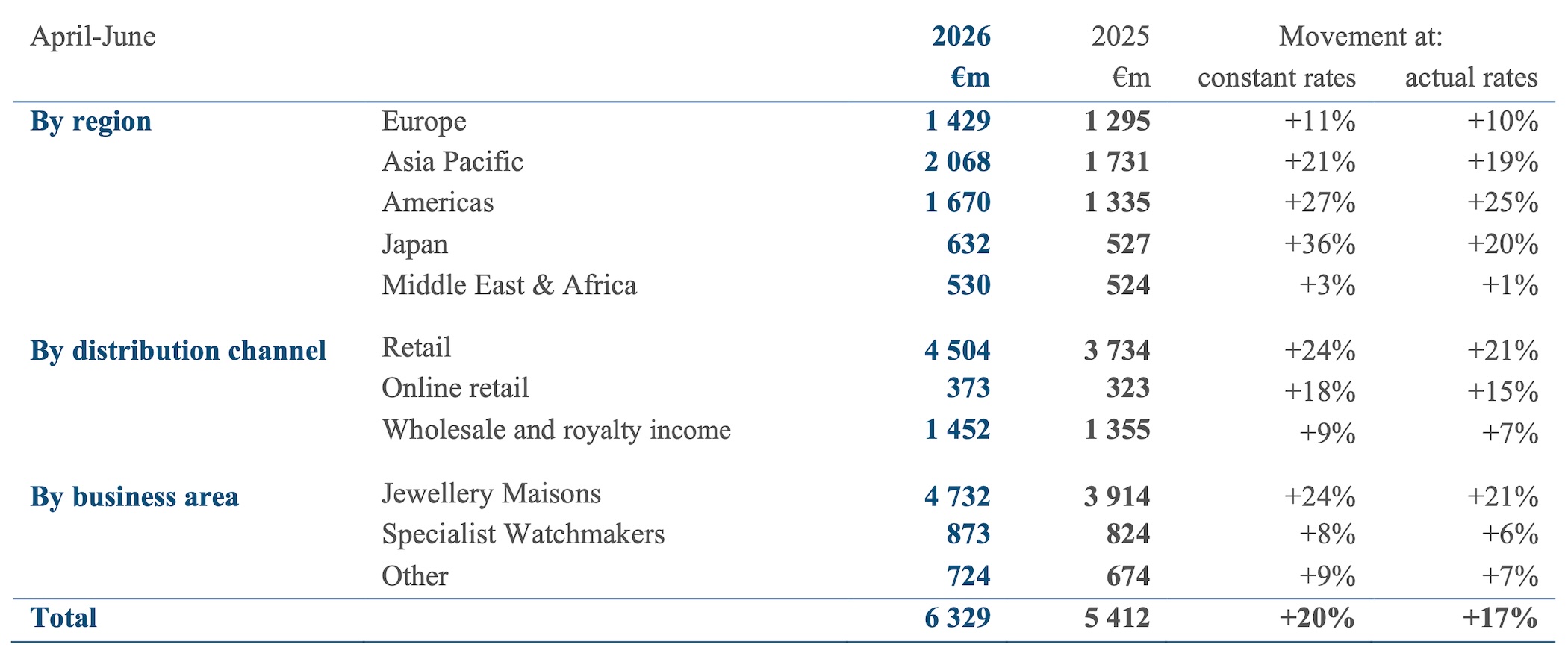
For the quarter ended 30 June 2026, the Swiss group recorded sales of €6.3 billion, up 20 percent at constant exchange rates and 17 percent at actual exchange rates versus the same period last year.
The figures matter because they show strength in high jewellery, resilience in watches and broad regional demand at a time when luxury growth has been uneven.
At a glance
- Richemont recorded first-quarter fiscal 2026 sales of €6.3 billion, up 20 percent at constant exchange rates.
- Jewellery maisons remained the group’s main growth engine, while specialist watchmakers returned to positive momentum.
- The Americas, Japan, Asia Pacific and Europe all delivered double-digit growth, with retail now representing 71 percent of group sales.
Jewellery remains Richemont’s power base
Richemont’s jewellery maisons delivered the clearest statement of strength, with sales rising 24 percent at constant exchange rates to €4.732 billion.
Cartier and Van Cleef & Arpels remain central to that performance, underlining how branded jewellery continues to anchor the group’s growth profile.
The result also reinforces a structural shift that has been visible across the top end of luxury, where iconic jewellery collections and high jewellery clientele have helped soften volatility elsewhere.

Specialist watchmakers show healthier momentum
The group’s specialist watchmakers posted sales of €873 million, an 8 percent rise at constant exchange rates.
That’s a notable improvement for a category that has faced a tougher environment across parts of the Swiss watch industry.
Richemont highlighted broad improvement across most maisons, with Vacheron Constantin, Jaeger-LeCoultre and A. Lange & Söhne standing out during the quarter.
For collectors, the signal is less about runaway growth and more about stability at the higher end of watchmaking, where product depth, heritage and controlled distribution remain important advantages.
Growth was broad across major regions
The Americas led Richemont’s regional performance with a 27 percent increase at constant exchange rates.
Japan was even stronger at 36 percent, while Asia Pacific rose 21 percent and Europe grew 11 percent.

The Middle East and Africa also returned to growth, rising 3 percent despite a more complicated geopolitical backdrop in the region.
That geographic spread gives the quarter more weight, as growth wasn’t dependent on a single market or tourist flow.
Retail continues to reshape the business
Direct-to-client sales remain a defining part of Richemont’s model.
Retail sales increased 24 percent at constant exchange rates and accounted for 71 percent of group sales during the quarter.
Online retail grew 18 percent, while wholesale and royalty income rose 9 percent.
The balance is important because it gives Richemont more control over pricing, client relationships and brand presentation, particularly for maisons where scarcity and experience are part of the proposition.
For the luxury watch and jewellery industry, Richemont’s first quarter offers a useful read on where demand is holding firm. Jewellery remains the clear driver, but the improving watch performance suggests the group’s leading maisons still have room to move in a more selective market.