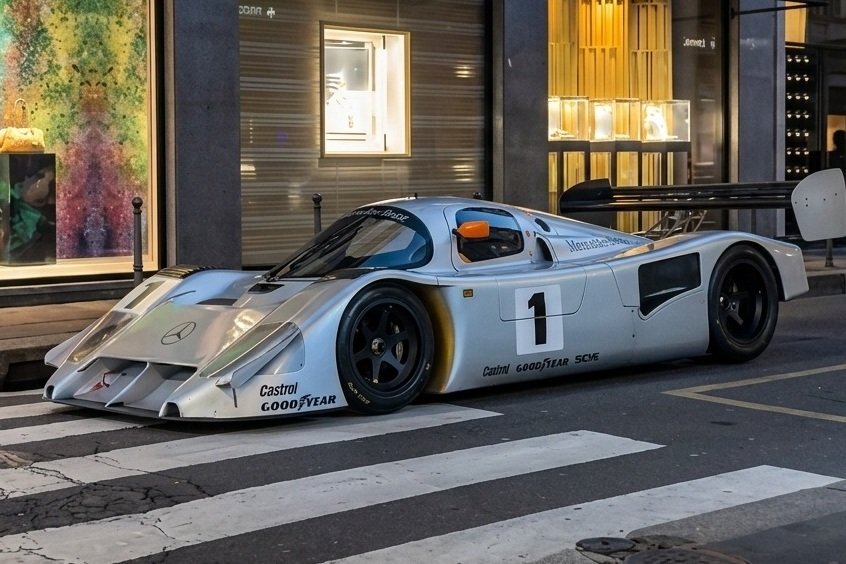
Milan is used to dramatic machinery, but a Mercedes-Benz C291 on public streets is a different order of sighting.
The silver prototype was built for the 1991 World Sportscar Championship, where Mercedes-Benz and Sauber developed it around the demanding new 3.5-litre regulations.
A 1991 prototype with Formula 1 energy
The C291 was not conceived as a road-going exotic or a museum-friendly showpiece, but as a top-level sports prototype from one of endurance racing’s most technically adventurous periods.
At its heart is a 3.5-litre flat-12 engine, a high-revving unit capable of spinning to 13,200 rpm and delivering the kind of hard-edged soundtrack more commonly associated with contemporary Formula 1 machinery.
Sauber-Mercedes engineering in its sharpest form
The move away from larger, more traditional racing engines made the C291 a radical machine, with Mercedes and Sauber chasing response, revs and aerodynamic efficiency under the new rulebook.
Its low canopy, silver bodywork and tightly managed surfacing give it the look of a land-bound aircraft, while the large rear wing makes clear that the shape was dictated by downforce rather than theatre.
Why a Milan street sighting matters
Cars like the C291 are normally encountered at historic race meetings, private collections or factory events, not moving through an urban backdrop among taxis, scooters and traffic lights.
That contrast is what makes the Milan appearance so striking, because the car’s proportions, noise and purpose are all calibrated for speed rather than city life.
For collectors and motorsport enthusiasts, the C291 represents a narrow and fascinating moment when endurance prototypes briefly converged with Formula 1-style engine thinking.
Seeing one outside the paddock is rare enough; hearing a flat-12 Mercedes prototype echo through Milan makes it the sort of encounter that lingers long after the car has disappeared.