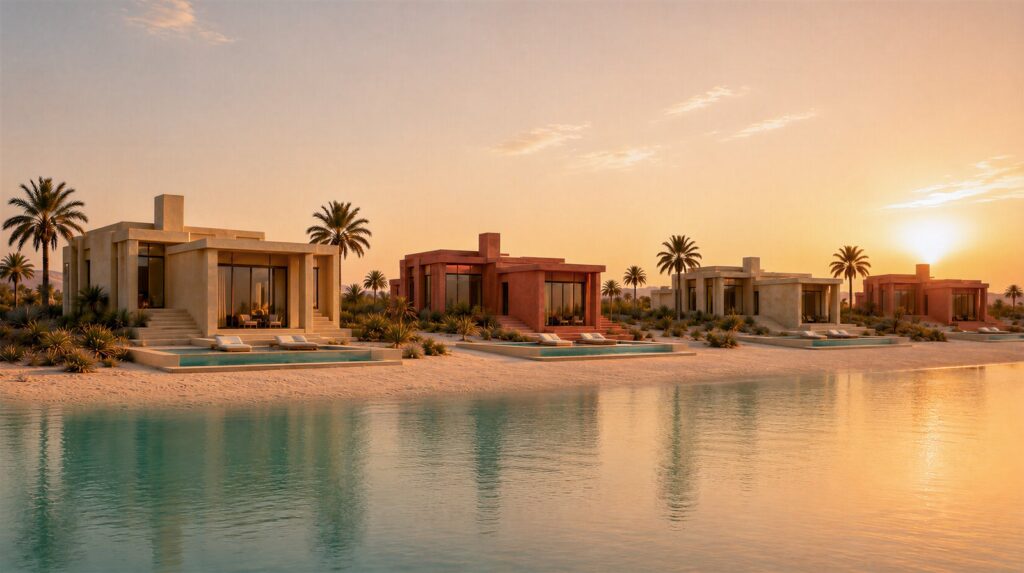
El Gouna has never quite fitted the usual Red Sea resort template.
For 36 years, the town has built its appeal around walkable districts, low-rise waterfront living and a residential rhythm that works beyond the holiday season.
Now, Marina Island by Tuban and SIBA El Gouna are pushing that story forward, pairing marina-led coastal living with a more authored, architecturally varied vision of the modern Red Sea home.
At a glance
- El Gouna Red Sea has unveiled Marina Island by Tuban and SIBA El Gouna as two new residential developments in the coastal town.
- Marina Island centres on a working marina and open-to-sea lagoon access, while SIBA introduces a multi-architect residential model.
- The launches build on El Gouna’s 36-year evolution as a year-round town with 9,200 residences and 25,000 residents from more than 50 countries.
A town model rather than a resort compound
Developed by Orascom Development Egypt, El Gouna has become one of the more closely watched coastal communities in the region because it operates as a functioning town, not simply a seasonal address.
Its central idea has always been practical as much as aesthetic.
Homes sit close to water, districts are designed for walking, and public life is supported by restaurants, marinas, sport, culture and a steady calendar of events.
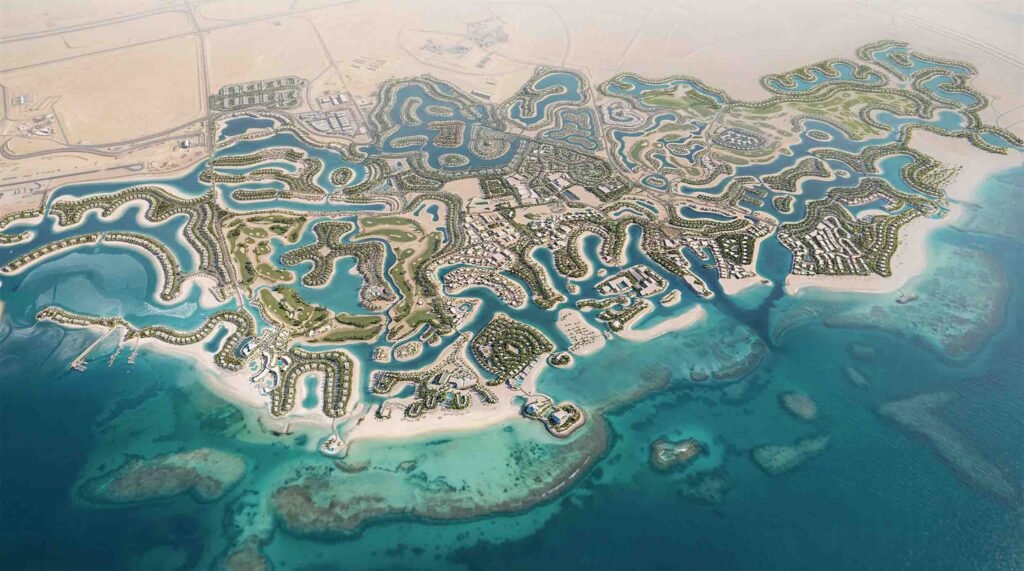
That broader lifestyle infrastructure has helped give El Gouna a more international resident base than many Red Sea destinations.
The town now includes 9,200 residences and around 25,000 residents from more than 50 countries, with international clients generating 39% of company sales.
Its cultural profile has also widened through events such as the El Gouna Film Festival, the El Gouna Squash Open Tournament, El Gouna Beach Polo and International Game Fish Association activity.
The timing of the new launches is notable against a more complex regional backdrop.
Egyptian airspace remains open and operational, flights continue to run on schedule, and El Gouna is positioning continuity, security protocols and everyday liveability as part of its appeal to international buyers and long-stay residents.
Marina Island puts the waterfront at the centre
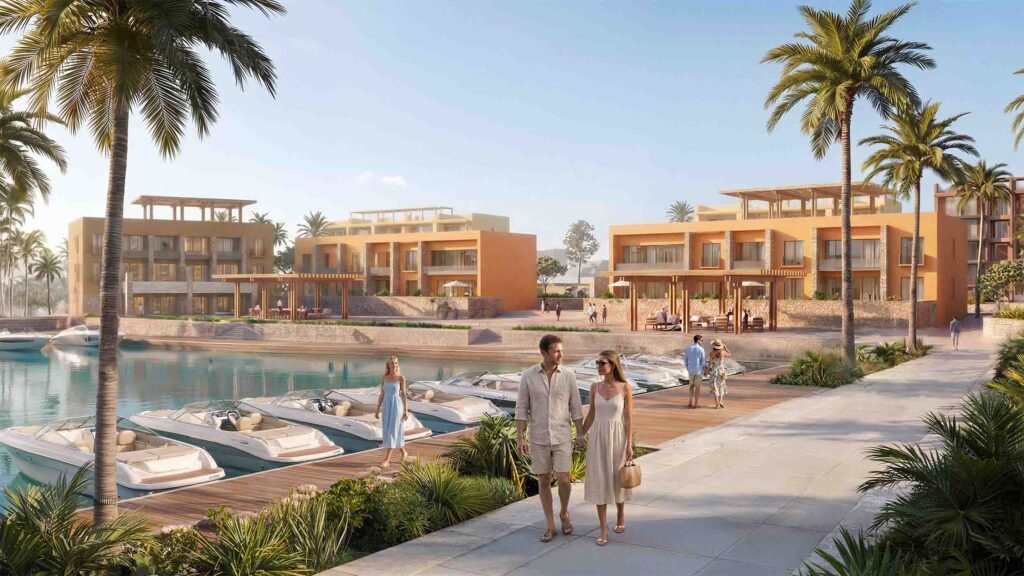
Marina Island by Tuban is the more immediately maritime of the two new developments.
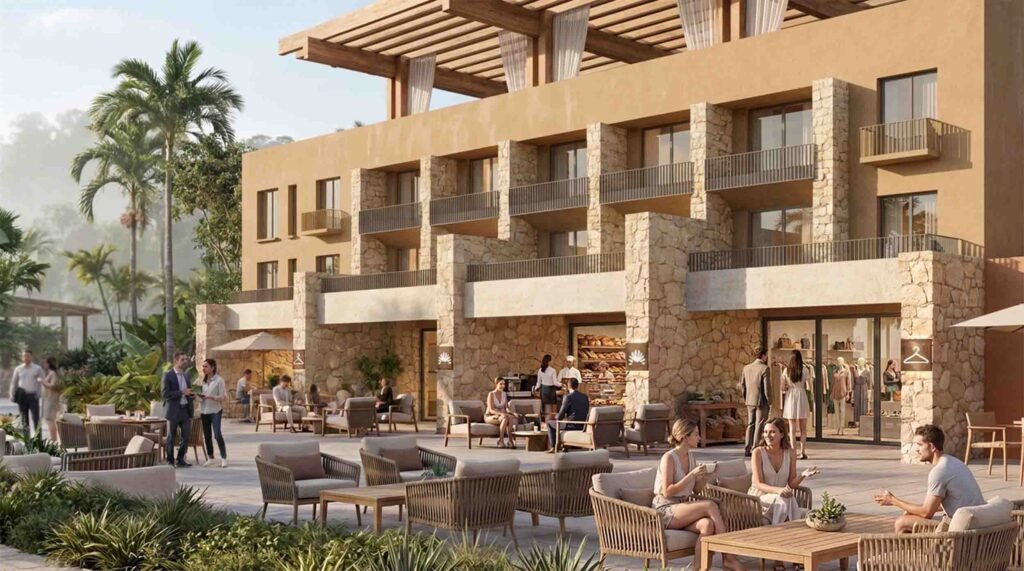
Located in the heart of El Gouna’s central district, it is planned as an island community shaped around a fully operational marina and direct water access.
The key detail is open-to-sea lagoon access, which gives the project a stronger boating and waterfront identity than a conventional residential enclave.
It also keeps the development connected to the centre of the district, so the island concept doesn’t read as isolation.
That balance matters in El Gouna, where the most successful neighbourhoods tend to combine privacy with easy access to daily life.
The architecture is intended to sit within the town’s established design lineage, which has previously drawn on work and influence from figures including Michael Graves, Alfredo Freda and Shehab Mazhar.
Rather than treating the marina as scenery, Marina Island uses it as the organising feature of the address.
For buyers who want the Red Sea experience to be tied to boats, water movement and an active coastal setting, that makes the project one of El Gouna’s clearest expressions of waterfront living to date.
SIBA El Gouna brings multiple architectural voices together
SIBA El Gouna takes a different route.
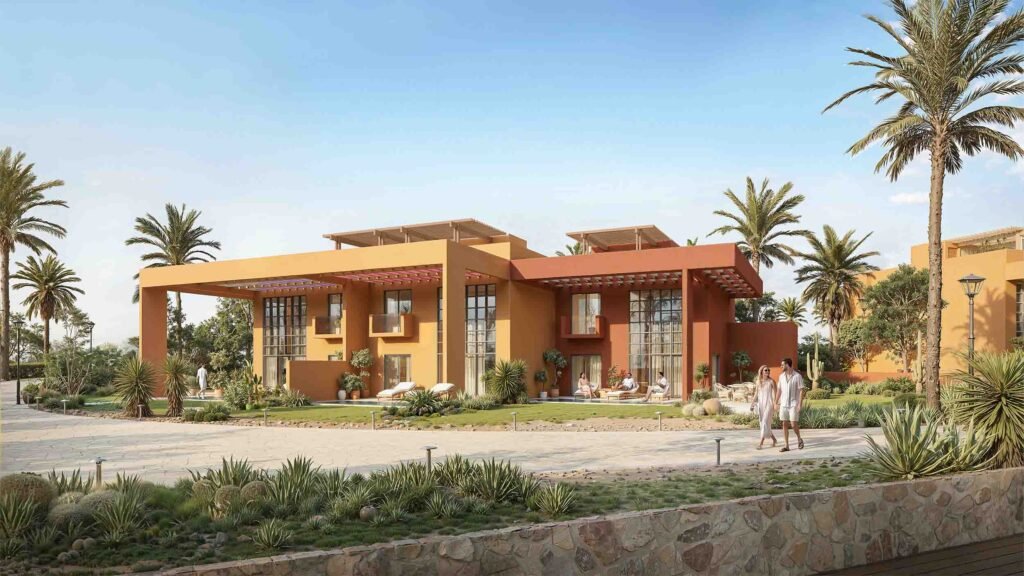
Instead of relying on one design language across the whole development, it is planned as a curated residential collection shaped by several international architecture studios.
The unified masterplan is by Burton Studios, with individual architectural contributions from Unknown Works, Block722, Mesura and OOAA.
The approach gives SIBA a more layered identity, while keeping the homes within the spacing, scale and connection to nature that have long defined El Gouna’s residential character.
Unknown Works, the London studio known for projects including Garden House, brings a sculptural and landscape-led sensibility to the development.
Block722, the Greek studio associated with contemporary Mediterranean residences, contributes a warmer regional reading of space, proportion and material atmosphere.
Mesura adds experience from hospitality and residential work including Mas de Torrent Hotel in Spain, while OOAA brings a more expressive architectural language associated with projects such as Chapel of Sound in China.
The first villa concepts make the strategy clear.
The Triangle Villa by Unknown Works is named for its geometric form, while the Tandem Villa by Block722 is shaped around an interconnected spatial arrangement.
Further launches are planned in the coming months, each expected to introduce a different architectural concept within the same broader address.
Who these launches are speaking to
Marina Island and SIBA are aimed at slightly different instincts within the same buyer universe.
Marina Island will likely appeal to residents who want water access, marina activity and a central location to define the everyday experience.
SIBA is more clearly pitched at design-led buyers who value architectural authorship, individuality and a quieter sense of distinction.
Both projects also fit into a wider expansion of El Gouna’s residential portfolio, following launches such as Nuba El Gouna and Fanadir Shores.
The investment story is part of the wider positioning, with recent figures highlighting ROI reaching 20% over two years and rental yields ranging between 6% and 8% across the destination’s lifestyle developments.
Still, the more interesting point is less about short-term performance and more about continuity.
El Gouna’s strength has been its ability to grow without losing the idea of a town planned around water, movement and community scale.
Marina Island by Tuban and SIBA El Gouna suggest the next phase won’t be defined only by more homes, but by more deliberate design choices.
For the Red Sea market, that distinction is increasingly important.