China Airlines’ Airbus A321neo makes a strong case for taking narrow-body business class more seriously.
On the four-hour hop from Taipei to Palau, the Taiwanese carrier offers a cabin with fully lie-flat seats, large 4K screens and enough design polish to feel closer to a long-haul product than a standard regional recliner.
There are trade-offs, especially around storage, privacy and the 2-2 layout, but the aircraft feels well matched to leisure routes where comfort still matters.

At a glance
- China Airlines operates an Airbus A321neo business class service between Taipei and Palau with 12 lie-flat seats.
- The cabin uses STELIA Aerospace ELYSIUM seats with 15.6-inch 4K screens, a 2-2 layout and a 198 cm flat-bed length.
- The assessed flight departed and arrived on time, with a business class fare of TWD 33,374, approximately $1,040 USD.
A narrow-body cabin with a long-haul mindset
China Airlines is Taiwan’s flag carrier and largest international airline, based at Taoyuan International Airport near Taipei.
The airline was founded in 1959, and its name reflects Taiwan’s historical official name, the Republic of China, rather than any link with Air China, the mainland Chinese flag carrier.
Today, China Airlines operates across Asia, Europe, North America and Oceania, and has been a SkyTeam member since September 2011.

The A321neo sits within a modern fleet that also includes Airbus A350-900 aircraft and Boeing 777-300ERs.
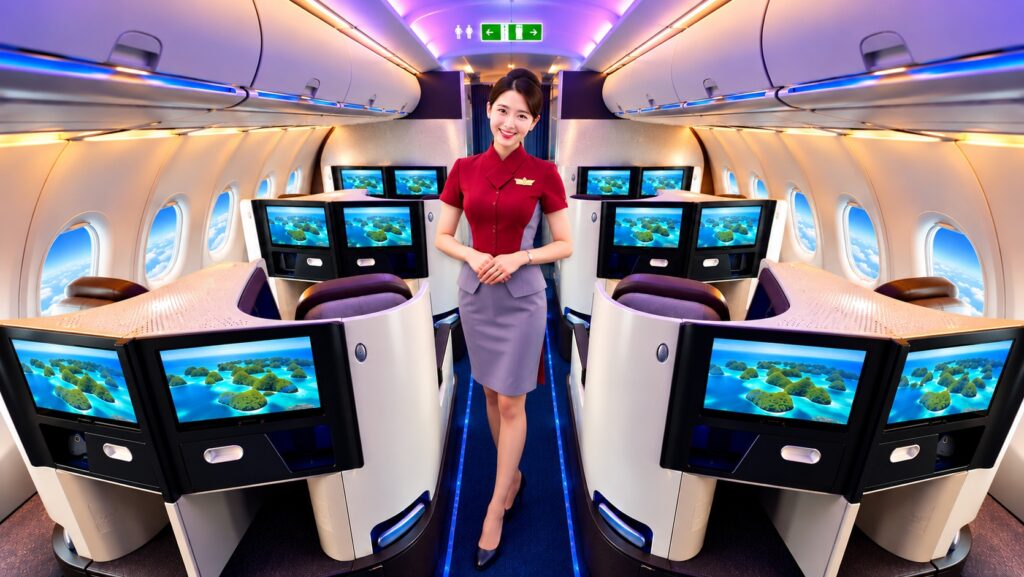
Its business class cabin is small, with 12 seats across three rows numbered 10 to 12 in a 2-2 configuration.
That layout can’t match the direct-aisle-access appeal of newer 1-1 narrow-body business cabins, but China Airlines has worked around the limitation with angled seating and a divider between each pair.

The interior was developed with JPA Design and takes inspiration from Taiwanese landscapes, including a mountain-teahouse theme in business class.
It gives the cabin a warmer, more considered character than the plain corporate interiors still common on many single-aisle aircraft.
The seat is the reason to book it
The main draw is the STELIA Aerospace ELYSIUM seat, which turns into a fully flat bed measuring 198 cm, or 78 inches, in length.

Seat width is 22.5 inches, while pitch is 61 inches, giving the cabin a genuine premium feel despite the aircraft’s narrow-body proportions.
Each seat has a 15.6-inch 4K touchscreen, a small storage compartment beneath the screen and a flap that doubles as a cocktail table.
The side panel includes a reading light, entertainment handset, headphone jack, universal power outlet, headphone hook and another small storage area.

A sliding divider adds separation from the neighbouring passenger and reveals a mirror when moved forward.
The tray table is stored in the shared armrest and offers enough surface area for dining or working on a laptop.
The compromise is the footwell, which is relatively narrow and may feel restrictive for taller passengers or anyone who moves around while sleeping.

For solo travellers, the window seats in rows 10 or 11 are the strongest choices because they feel more sheltered and retain the window view.
Aisle seats in rows 10 or 11 are better for passengers who prioritise easier access, though they naturally feel more exposed to movement in the cabin.
Row 12 is less appealing because it sits directly in front of Economy, where bassinet positions may bring more cabin noise.

Lounge, dining and onboard details
Before departure, eligible passengers can use China Airlines’ flagship lounge at Taiwan Taoyuan International Airport, located one floor above the main concourse.
The lounge is a large open-plan space arranged around a central food station, with armchairs, sofas and dining tables rather than a series of enclosed zones.
Its mood is dark and polished, with warm lighting and wood finishes, though the limited natural daylight makes it feel enclosed.

Food is the lounge’s strongest asset, with Taiwanese and international dishes, hot items, dim sum, salads, fruit, snacks and a noodle station.
On board, the regional business class amenity set is simple and includes a pillow, blanket, slippers and noise-cancelling headphones.
Lunch on the Taipei to Palau flight was served on a single tray after takeoff, with a menu that mixed Taiwanese flavours and international options.

The listed starter was fresh abalone and chicken breast salad with passion fruit vinaigrette.
Main course choices included signature braised beef short ribs with quinoa rice, braised chicken thigh in oyster sauce with black dates and red jujube rice, and seafood fettuccine in tomato sauce.
Bread options included rum raisin roll and black truffle and garlic focaccia, followed by seasonal fruit and premium ice cream.

On the flight assessed, the signature beef short ribs were no longer available by the time the order was taken, which is a practical reminder that pre-order certainty can matter in a small cabin.
The entertainment system is one of the aircraft’s strengths, with a crisp 15.6-inch 4K screen, a straightforward interface and a selection of Hollywood films, international movies, television series and music.
Wi-Fi is also available on the A321neo, with unlimited internet access for business class passengers and Dynasty Flyer Paragon, Emerald and Gold members.

Details & Specifications
| Airline | China Airlines |
|---|---|
| Route | Taiwan Taoyuan International Airport to Palau International Airport |
| Aircraft | Airbus A321neo |
| Aircraft registration | B-18112 |
| Aircraft delivery | 2024 |
| Class | Business Class |
| Cabin layout | 12 seats across three rows in a 2-2 configuration |
| Seat | STELIA Aerospace ELYSIUM |
| Seat width | 22.5 inches / 57 cm |
| Seat pitch | 61 inches / 155 cm |
| Bed length | 198 cm / 78 inches |
| Screen | 15.6-inch 4K touchscreen |
| Distance | 1,700 miles / 2,735 km |
| Flight time | 4 hours |
| Departure | On time at 12:30 pm |
| Arrival | On time at 5:30 pm |
| Fare referenced | TWD 33,374, approximately $1,040 USD |
China Airlines’ A321neo business class isn’t perfect, but it’s a persuasive example of how much better regional flying can be when an airline commits to a proper flat-bed seat.
For travellers heading between Taipei and Palau, the combination of a compact cabin, strong screen, lie-flat comfort and decent dining makes this one of the more appealing ways to cover the four-hour sector.