Kranjska Gora sits in Slovenia’s far north-west, where the Sava Dolinka valley narrows toward Italy and Austria waits just over the Karawanks.
It’s a compact winter village rather than a vast ski machine, with the Julian Alps to the south, the Karawanks to the north and a World Cup slalom hill rising from the edge of town.
That scale is central to its appeal, especially for families, beginners and travellers who want more than a lift-to-lift holiday.
At a glance
- Kranjska Gora offers a small, accessible ski area in Slovenia’s Alpine corner, close to the Italian and Austrian borders.
- Its piste network is modest, but Planica adds major Nordic-sport pedigree with ski-flying hills, cross-country trails and a year-round Nordic centre.
- The village suits families and developing skiers best, while stronger skiers may prefer using it as a base for wider regional day trips.
A village ski area with a clear purpose
Kranjska Gora’s ski terrain sits between roughly 807 and 1,282 metres, giving it a vertical of under 500 metres.
There are around 20 kilometres of marked piste served by about 15 lifts, with the terrain divided into roughly ten kilometres of easy runs, eight of intermediate skiing and two of more difficult slopes.
That means a confident skier won’t find endless mileage here.
By the second day, many advanced visitors will have a clear mental map of the whole ski area.
For the right guest, that’s not a flaw so much as a useful definition.
The nursery slopes sit conveniently at the bottom of the village, and the broad blue runs give families room to move without feeling pushed around by steeper terrain.
The outlier is Podkoren 3, the competition slope that has hosted men’s World Cup racing since 1983.
With a maximum gradient of about 30.5 degrees, it is regarded as the steepest groomed run in Slovenia and gives the ski area a sharper edge than its piste map first suggests.
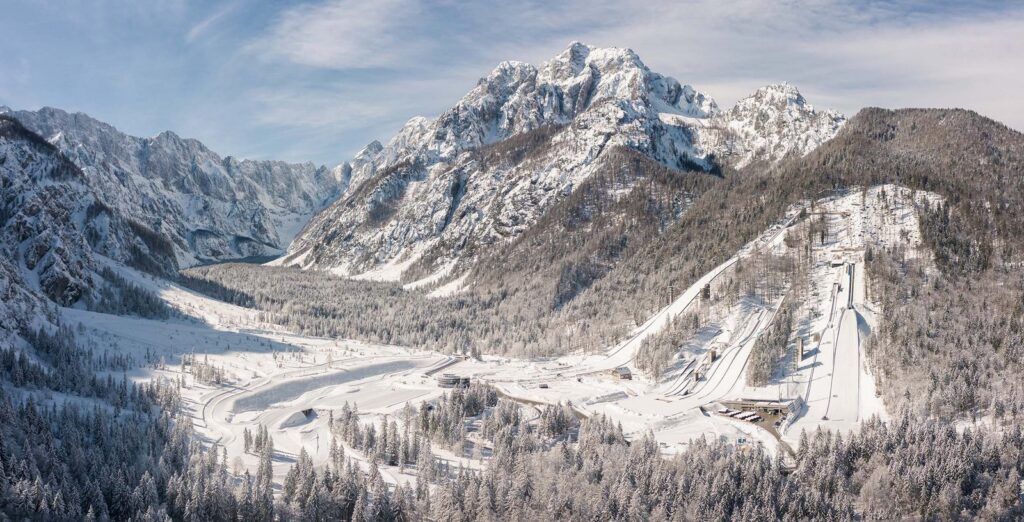
Planica gives the valley its sporting stature
A few kilometres west of Kranjska Gora, Planica changes the tone entirely.
The valley is one of the great names in ski jumping and ski flying, and its history reaches back to 1936, when the first ski jump beyond 100 metres was recorded there.
The Letalnica bratov Gorišek flying hill followed in 1969 and now has a hill size of 240 metres, with its K-point at 200 metres.
In March 2025, the men’s world record on the hill stood at 254.5 metres.
Since 2015, Planica has operated as the Planica Nordic Centre, a roughly €40 million complex with eight jumping hills in total.
The site includes the flying hill, a large hill, a normal hill and five smaller hills for juniors, along with a wind tunnel, a museum and a restaurant in the central building.
Out of season, the empty inrun can be even more revealing than competition footage, because the architecture of flight is suddenly stripped of speed and crowd noise.
Winter days beyond the lift pass
Some of the strongest experiences around Kranjska Gora don’t require downhill skis at all.
Cross-country trails are groomed daily at the Rateče centre, and tracks continue from Planica into the Tamar valley toward the hut at its head.
When snow conditions allow, a longer valley route links Zgornja Radovna, Mojstrana, Gozd Martuljek, Kranjska Gora, Rateče and Planica over roughly 40 kilometres.
Most of the tracks are free to use, while Rateče has charged a small fee in recent seasons, around €6.
There is also a floodlit night loop in the village, which adds a useful evening option without turning the trip into a late-night resort scene.
Lake Jasna is about twenty minutes on foot from the centre, formed by two small man-made lakes with a bronze Zlatorog beside the water.
The horned ibex comes from local legend, and in winter the setting has the stillness of a mountain postcard without requiring much effort to reach.
Near Rateče, the Zelenci reserve offers a different kind of Alpine colour, with a spring pool regarded as a source of the Sava Dolinka holding its bright turquoise tone through winter.
Access, borders and winter realities
Kranjska Gora has no railway station, so most visitors arrive by road.
The nearest rail connection is down the valley at Jesenice, with buses from Ljubljana connecting through it.
Ljubljana Airport is about 66 kilometres away, and the drive to Kranjska Gora takes roughly three quarters of an hour in clear conditions, longer in fresh snow.
Klagenfurt is a comparable distance across the Austrian border, while Trieste is about an hour away, giving the village practical access to three airports in three countries.
The border geography is part of daily life here.
Drive west through Rateče and the road soon crosses into Italy, while Austria can be reached north via the Korensko sedlo crossing or through the Karavanke tunnel.
Travellers making border hops should carry identification even when routine checks aren’t in place, and Slovenian and Austrian motorway tolls operate as separate systems.
Altitude is the main limitation for winter planning.
With the base below 900 metres, Kranjska Gora is low by Alpine standards, and warmer winters make snowmaking especially important across a large share of the pistes.
The season generally runs from early December to early April, though both ends depend heavily on the weather.
One of the region’s most scenic roads is also largely off the winter menu.
The Vršič pass climbs from Kranjska Gora to 1,611 metres through 24 hairpins before dropping into the Trenta valley by another 26 bends.
Built by Russian prisoners of war during the First World War, the route includes the wooden Russian Chapel, which commemorates those killed by an avalanche during the road’s construction.
In winter, snow closes the pass and cars usually get no farther than the hut at Gozd, turning the nearby Soča valley into a much longer drive around through Italy.
That closure matters for itinerary planning, particularly for anyone hoping to combine Kranjska Gora with Bovec or the upper Soča in the same winter week.
Kranjska Gora works best when it’s understood on its own terms.
It’s not the place to chase big vertical all week, but for families, beginners, steady intermediates and travellers drawn to Nordic culture, borderland geography and quiet Alpine scenery, Slovenia’s winter corner has a very particular charm.