Britain’s appetite for fun appears to be moving away from grand gestures and back towards the rituals that punctuate ordinary life.
New research from Caorunn Gin suggests that more than 80% of people in the UK are embracing a more optimistic outlook, with affordable pleasures, social drinks and time with family becoming the moments people are choosing to savour.
For a spirits brand built around crisp Scottish botanicals and the theatre of a well-made serve, it’s a timely cultural note.
At a glance
- Caorunn Gin has released UK research showing that over 80% of Brits are seeking more fun and optimism in everyday life.
- Small wins are increasingly being marked with shared drinks, home rituals, walks, meals and time with family.
- The findings support Caorunn’s “A Delicious Slice of Life” campaign, which celebrates simple moments of connection and enjoyment.
Small wins are becoming social rituals
The most telling detail is how strongly younger adults are leaning into the idea of celebrating ordinary achievements.
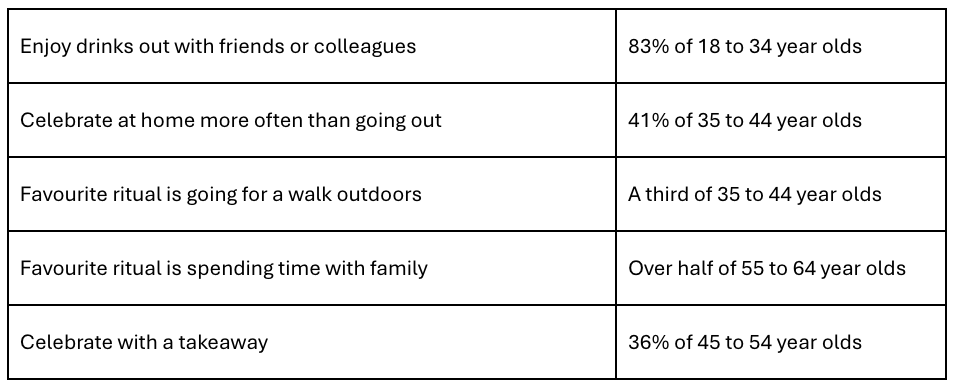
Among 18 to 34-year-olds, 83% said they like to mark life’s small wins over drinks with family or colleagues.
That’s a useful signal for hospitality, particularly as after-work drinks continue to act as a low-key social anchor in city life.
Half of Londoners said they enjoy after-work drinks with friends, compared with around a third in Manchester.
The picture isn’t only about going out, though.
A third of UK adults said they are choosing moments of joy that feel both affordable and meaningful, which gives the trend a more grounded character than a simple return to late nights and spending.
The home serve gets its moment
For 35 to 44-year-olds, the celebratory drink is just as likely to happen at home as it is in a bar.
The research points to people marking small wins on the sofa with a partner or with a drink in the kitchen among friends and family.
That detail matters for gin because the category has long thrived on personal ritual.
The right glass, a clean garnish, good ice and music in the background can turn a simple pour into something with a little ceremony.
Caorunn’s “A Delicious Slice of Life” campaign leans directly into that idea, treating the everyday drink not as an afterthought but as a small occasion in its own right.
A spokesperson for Caorunn Gin said that the moments people remember most are often the simplest, noting that small touches such as garnish, glassware and atmosphere can help make an everyday drink feel worth celebrating.
Connection is outpacing retail therapy
The wider pattern is less about indulgence for its own sake and more about relaxation and connection.
A shared or home-cooked meal was highlighted by a third of 25 to 34-year-olds, while outdoor walks were popular across older age groups, including 41% of 45 to 54-year-olds and more than half of 55 to 64-year-olds.
Time with family also ranked highly, particularly among 34 to 44-year-olds and 55 to 64-year-olds.
There are some very British details in the mix too, including the finding that one in three mums count a lie-in as their chosen moment of happiness.
By contrast, more transactional treats appear to have less emotional pull.
Only 15% of 35 to 44-year-olds said they would choose a massage or manicure as a small reward, while 16% pointed to buying shoes, clothes or accessories and 17% looked forward to an online shopping delivery.
A useful cue for modern drinking culture
The survey, conducted by OnePoll among 2,000 UK adults, lands at a point when many drinkers are more selective about when, where and why they pour something special.
That doesn’t diminish the role of spirits, but it does change the mood around them.
A gin and tonic after work, a drink before dinner or a shared serve in the kitchen now sits closer to lifestyle ritual than routine consumption.
For Caorunn, that’s a natural space to occupy.
The brand’s latest campaign isn’t asking people to wait for a milestone before raising a glass, but to notice the smaller pauses in the day that already carry meaning.
In a luxury landscape increasingly shaped by experience rather than excess, that may be the most relevant message of all.