The Nürburgring has a way of finding weak points, even in the most ambitious performance cars.
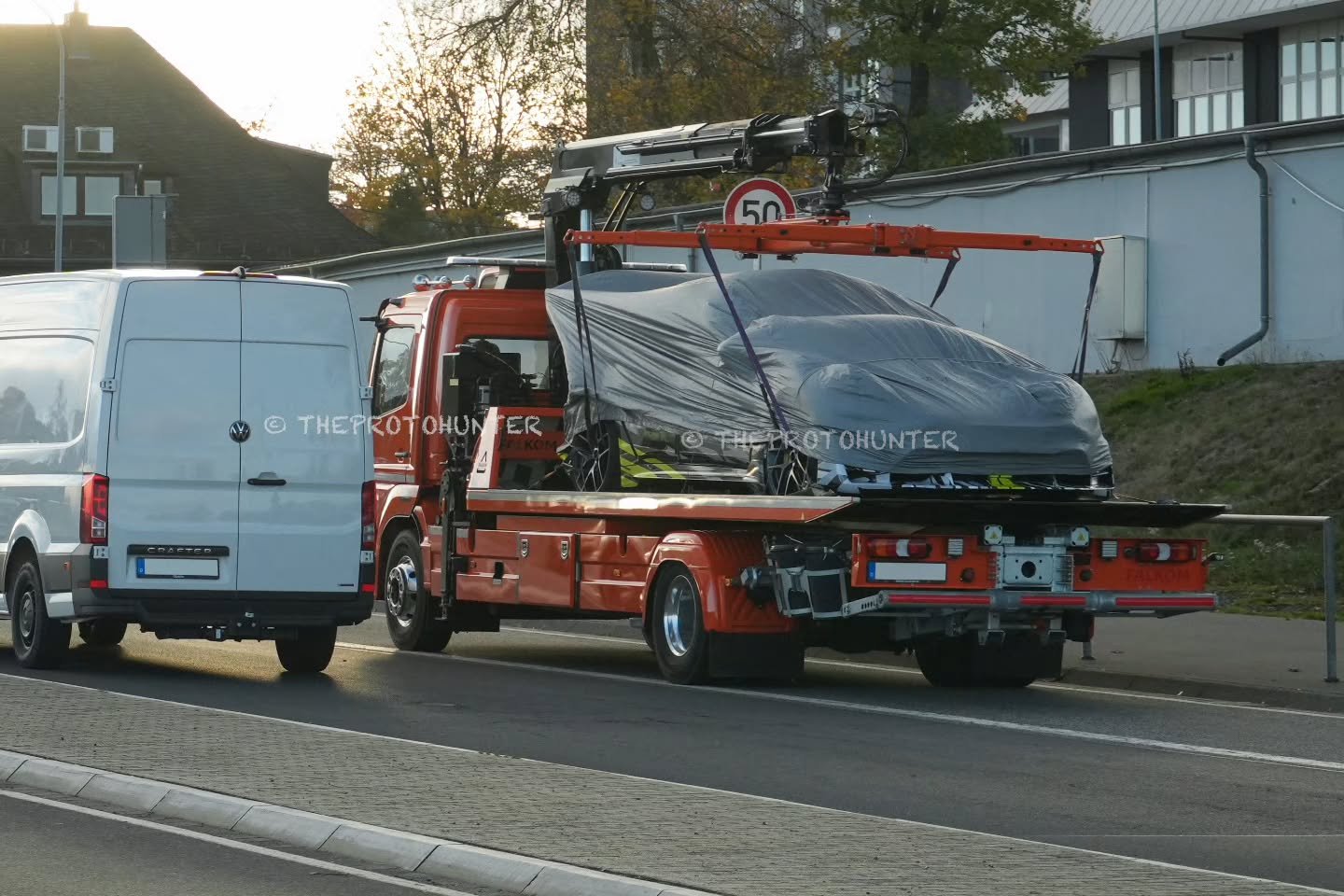
A Xiaomi SU7 Ultra Extreme prototype has reportedly broken down during testing at the circuit, with images shared on social media by @theprotohunter showing the covered EV sitting on a flatbed truck.
The details are still thin, but the sighting matters because Xiaomi’s most serious performance project appears to be moving beyond headline numbers and into the much harder business of track validation.
At a glance
- A Xiaomi SU7 Ultra Extreme prototype has reportedly been towed away from the Nürburgring after a claimed breakdown during testing.
- The covered car shows a visible front splitter, alloy wheels and the outline of a large rear wing.
- The standard SU7 Ultra already makes more than 1,500 hp, while reports suggest the Extreme could approach or exceed 2,000 hp.
A covered prototype on a flatbed
The images don’t reveal much of the car, because the prototype is hidden beneath a cover.
Even so, several key elements are visible enough to identify it as something more aggressive than a regular SU7 Ultra.
The front splitter can be seen below the fabric, while the wheels and the outline of a substantial rear wing point to a track-focused aero package.
What failed, if anything, hasn’t been confirmed.
The social media post claims the car suffered a breakdown during testing, but no mechanical, electrical or software-related cause has been stated.
The Nürburgring is an unforgiving test bench
It’s worth treating the incident with some perspective.
The Nürburgring is routinely used to expose durability issues, cooling limitations, braking demands and chassis behaviour at sustained high speed.
A prototype being recovered during testing doesn’t automatically mean a fundamental problem with the programme.
It does, however, suggest Xiaomi is putting the car through the sort of environment where performance claims have to survive repeated abuse rather than a single controlled launch.
What makes the Extreme interesting
The standard Xiaomi SU7 Ultra is already a serious electric performance sedan by the numbers supplied for the model.
Its tri-motor setup produces more than 1,500 hp, with a claimed 0-62 mph time of 1.98 seconds and 0-124 mph in 5.86 seconds.
The SU7 Ultra Extreme is expected to push beyond that.
Reports suggest output could approach or even exceed 2,000 hp, which would place the car in highly unusual territory for a road-derived electric performance machine.
Power alone won’t define the project, though.
At this level, aero stability, thermal management and repeatability become just as important as acceleration figures, which is exactly why Nürburgring testing attracts attention.
Details & Specifications
| Brand | Xiaomi |
|---|---|
| Model | SU7 Ultra Extreme prototype |
| Vehicle type | High-performance electric prototype |
| Testing location | Nürburgring |
| Visible details | Front splitter, alloy wheels and outline of a large rear wing |
| Reported incident | Claimed breakdown during testing and recovery on a flatbed |
| Standard SU7 Ultra powertrain | Tri-motor electric setup |
| Standard SU7 Ultra output | More than 1,500 hp |
| Standard SU7 Ultra 0-62 mph | 1.98 seconds |
| Standard SU7 Ultra 0-124 mph | 5.86 seconds |
| Expected Extreme output | Reports suggest approaching or exceeding 2,000 hp |
For now, the flatbed images raise more questions than they answer.
Still, the sighting underlines how ambitious Xiaomi’s performance push has become, and how much scrutiny the SU7 Ultra Extreme will face if it’s aiming to turn extraordinary numbers into credible track performance.