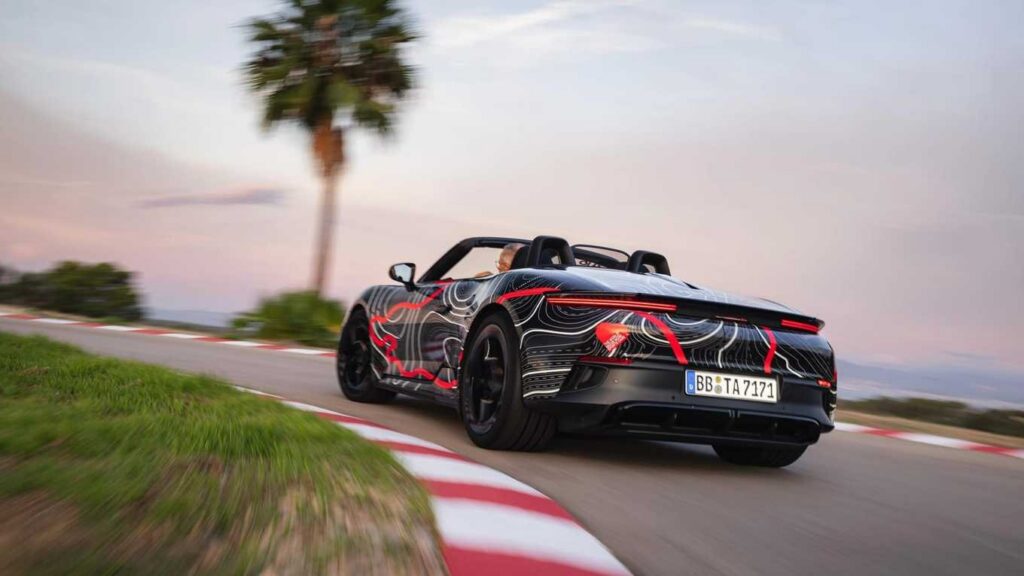
Porsche’s electric 718 Boxster is no longer a distant experiment hiding behind camouflage and speculation.
With development now in its final stages after roughly four million kilometres of testing, Porsche is beginning to put hard numbers behind the next chapter of its compact sports car.
The headline is simple enough. Porsche says the top version will be the most powerful 718 yet, and its acceleration figures put it deep into modern supercar territory.
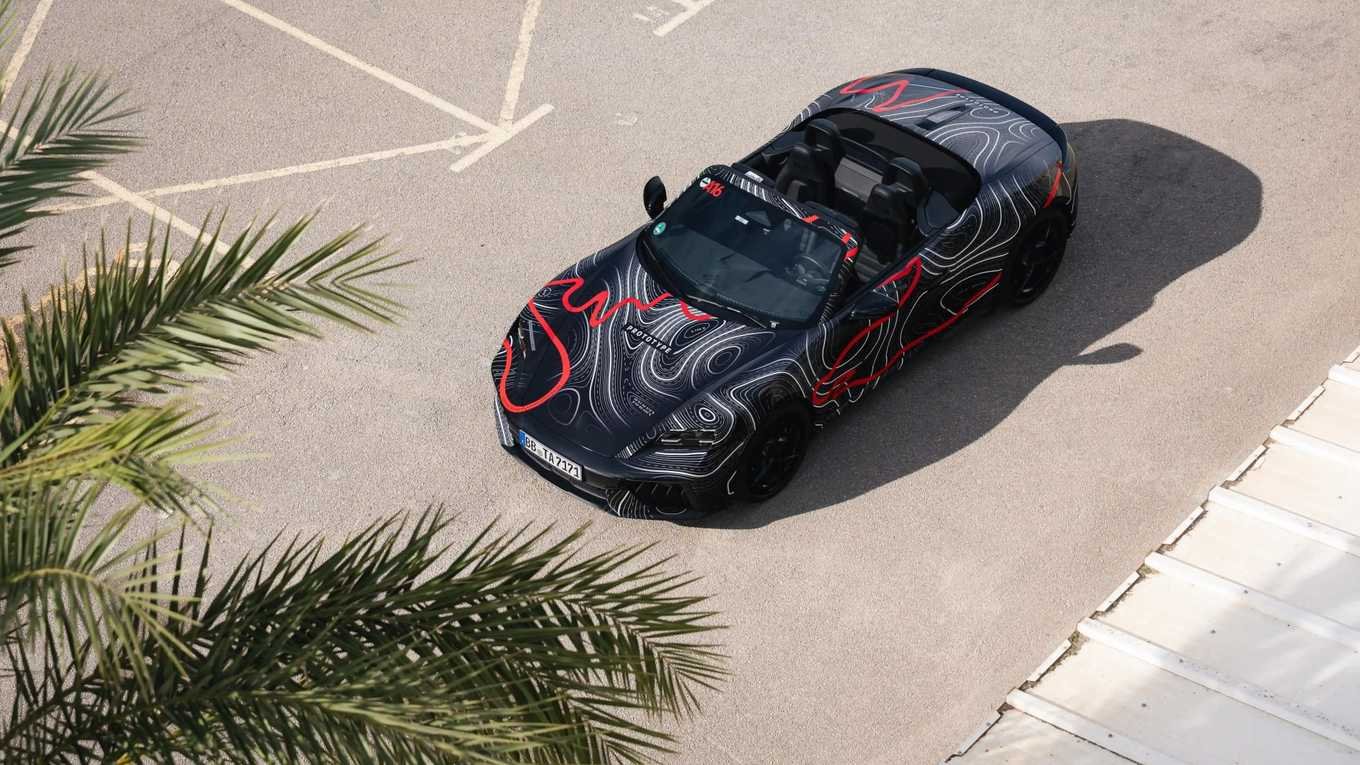
At a glance
- Porsche’s electric 718 Boxster is approaching production with testing now in its final stages.
- The range-topping version is claimed to do 0 to 62 mph in under three seconds while using a single rear-mounted electric motor.
- The production model is due to debut in the first quarter of 2027.
A new benchmark for the 718 line
Porsche says the most potent electric 718 will accelerate from 0 to 62 mph in under three seconds and reach more than 155 mph.
That makes it a very different proposition from the petrol-powered 718s that have defined the Boxster and Cayman line to date.
The more telling claim is power.
Porsche describes the electric model as the most powerful 718 yet, which means it will sit above the 500 hp 718 Cayman GT4 RS in output.
That doesn’t mean it eclipses the GT4 RS in every metric, as the petrol flagship still has a claimed top speed of 195 mph.
Even so, the electric Boxster’s quoted acceleration points to a car built around instant response rather than traditional rev-led theatre.
Rear-drive character without a dual-motor layout
The most interesting engineering choice may be what Porsche hasn’t done.
Rather than using a dual-motor setup, the electric 718 will send power exclusively to the rear wheels through a single electric motor.
That decision matters because the 718 has always been a car defined by balance, compactness and clarity of response.
A rear-drive layout should help preserve that familiar sports-car character, even as the powertrain changes completely.
Porsche has not detailed the battery capacity or motor output, but it has confirmed an 800-volt battery pack positioned behind the seats, in the area traditionally occupied by the engine.
That packaging choice places mass near the centre of the car, an important detail for a model whose reputation depends heavily on handling feel.
Weight and development context
Porsche says the electric 718 weighs roughly as much as a current 911 Cabriolet T-Hybrid.
That’s a useful reference point rather than a full specification, but it suggests Porsche is trying to keep the car within a recognisably sporting envelope rather than simply chasing headline battery capacity.
The development programme has covered around four million kilometres, which indicates how much work has gone into calibrating the car before its public debut.
For Porsche, the electric 718 is not just another EV launch.
It represents the electrification of one of the brand’s most driver-focused model lines, a car family traditionally prized by enthusiasts for its mid-engined proportions and direct feel.
Details & Specifications
| Brand | Porsche |
|---|---|
| Model | Electric 718 Boxster |
| Powertrain | Single electric motor |
| Driven wheels | Rear-wheel drive |
| Battery architecture | 800-volt battery pack |
| Battery placement | Behind the seats, in the space traditionally occupied by the engine |
| 0 to 62 mph | Under three seconds for the range-topping version, according to Porsche |
| Top speed | More than 155 mph, according to Porsche |
| Power positioning | Most powerful 718 yet, above the 500 hp 718 Cayman GT4 RS |
| Weight reference | Roughly as much as a current 911 Cabriolet T-Hybrid, according to Porsche |
| Testing distance | Around four million kilometres |
| Debut | First quarter of 2027 |
The electric 718 Boxster will have to satisfy two very different audiences at once.
It needs to bring new buyers into Porsche’s electric sports-car world while reassuring long-time 718 fans that the shift away from petrol hasn’t diluted the point of the car.
Based on the early figures, Porsche is setting the bar high, not by turning the 718 into an all-wheel-drive missile, but by keeping the focus on rear-drive performance and compact sports-car intent.