
Bremont’s Supernova has always been the brand’s most direct move into space-age sports-watch territory.
The new Supernova Perpetual Calendar GMT Monopusher pushes that idea into more serious mechanical terrain, wrapping a perpetual calendar and home-time display into an all-black integrated-bracelet case.
It’s a notably complicated step for a model better known for its futuristic architecture, rugged presentation and aerospace associations.

At a glance
- Bremont has introduced the Supernova Perpetual Calendar GMT Monopusher as a 20-piece Ultra Black limited edition.
- The watch combines a perpetual calendar, GMT home-time display and crown-integrated monopusher with an Agenhor-developed module.
- Pricing is EUR 35,950 on the black DLC steel bracelet or EUR 35,650 on a black rubber strap.
A darker, sharper Supernova case
The Supernova sits within Bremont’s Space pillar, alongside the brand’s Air, Land and Sea families.
The platform arrived in 2026 with the Supernova Chronograph and has since given Bremont room to explore more ambitious expressions, including a tourbillon and an all-black Hawking edition.
This new version uses a 41mm case in 904L stainless steel with Bremont’s Ultra Black DLC coating.

At 13.9mm thick and 49.7mm lug to lug, it keeps the muscular integrated-sports-watch stance while adding a layer of visual stealth.
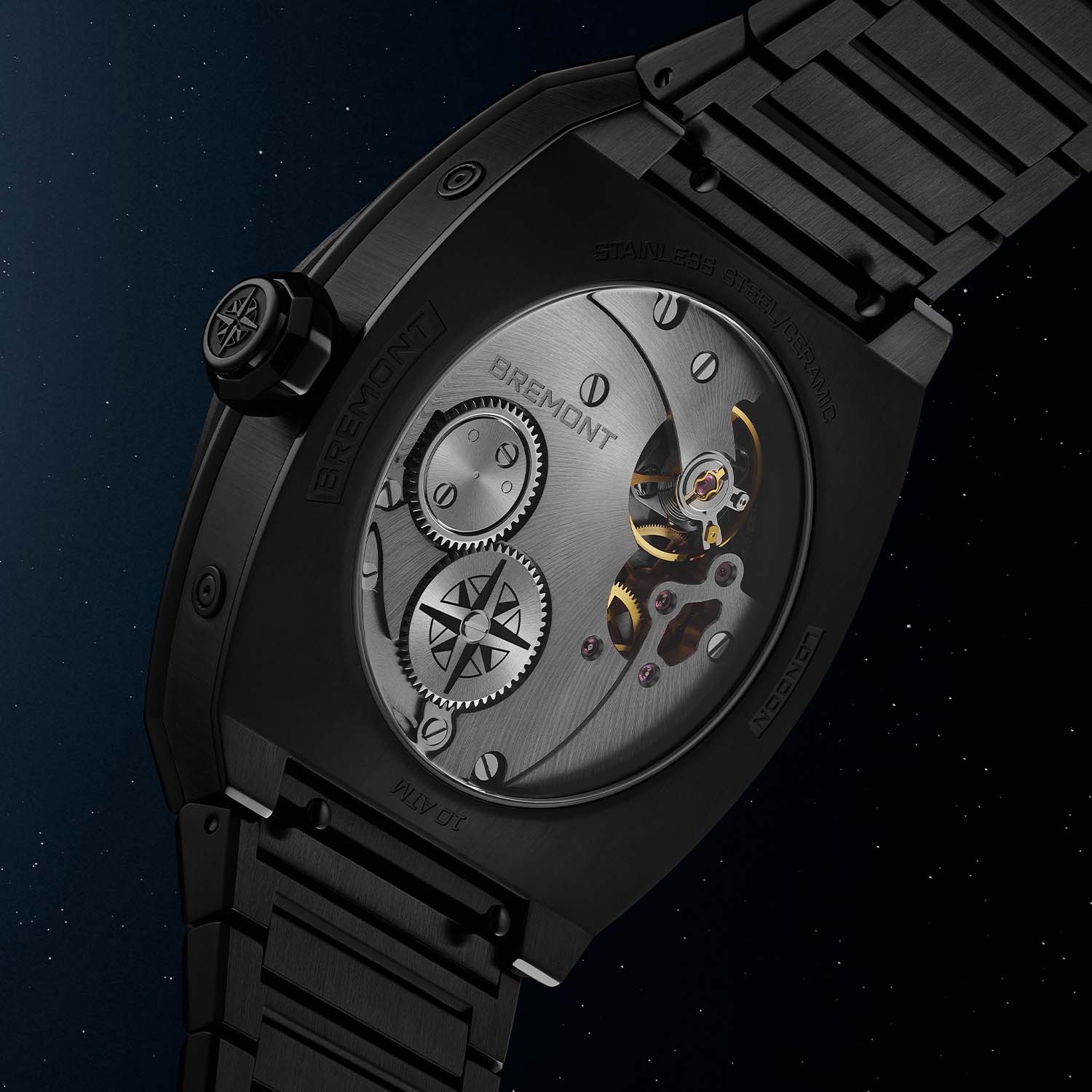
The decagonal black ceramic bezel remains one of the watch’s defining details, with vertically brushed top surfaces and polished scalloped edges giving the case a more architectural feel than a conventional round sports watch.
There’s a useful amount of finishing contrast across the case, with satin-brushed surfaces, polished facets and a black DLC-coated case middle.

The fluted crown integrates the monopusher, while recessed correctors at 2 and 4 o’clock handle adjustments for the date and month or leap-year indications.
A domed sapphire crystal covers the dial, an exhibition caseback reveals the movement, and water resistance is rated to 100 metres.
A dial arranged like a cockpit instrument
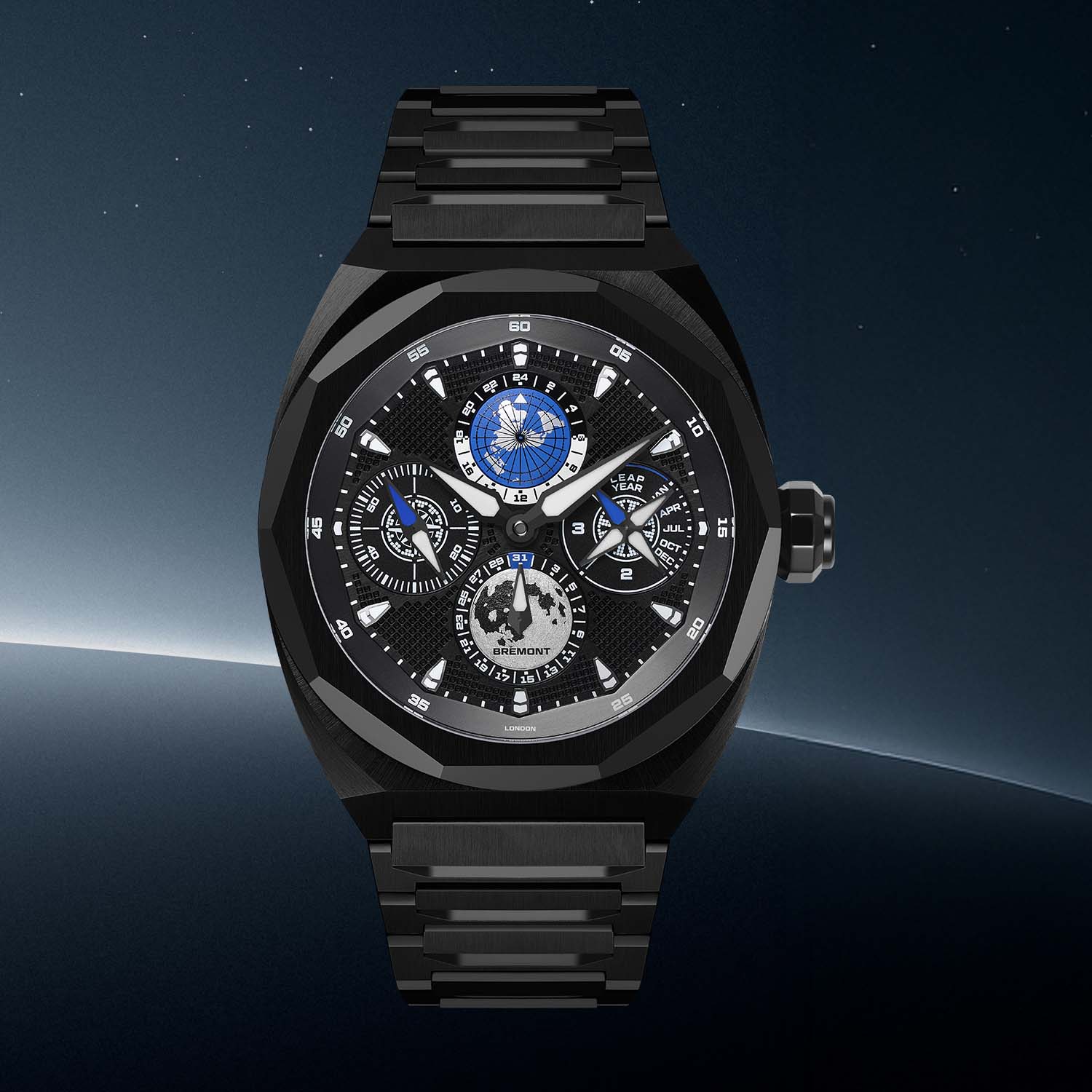
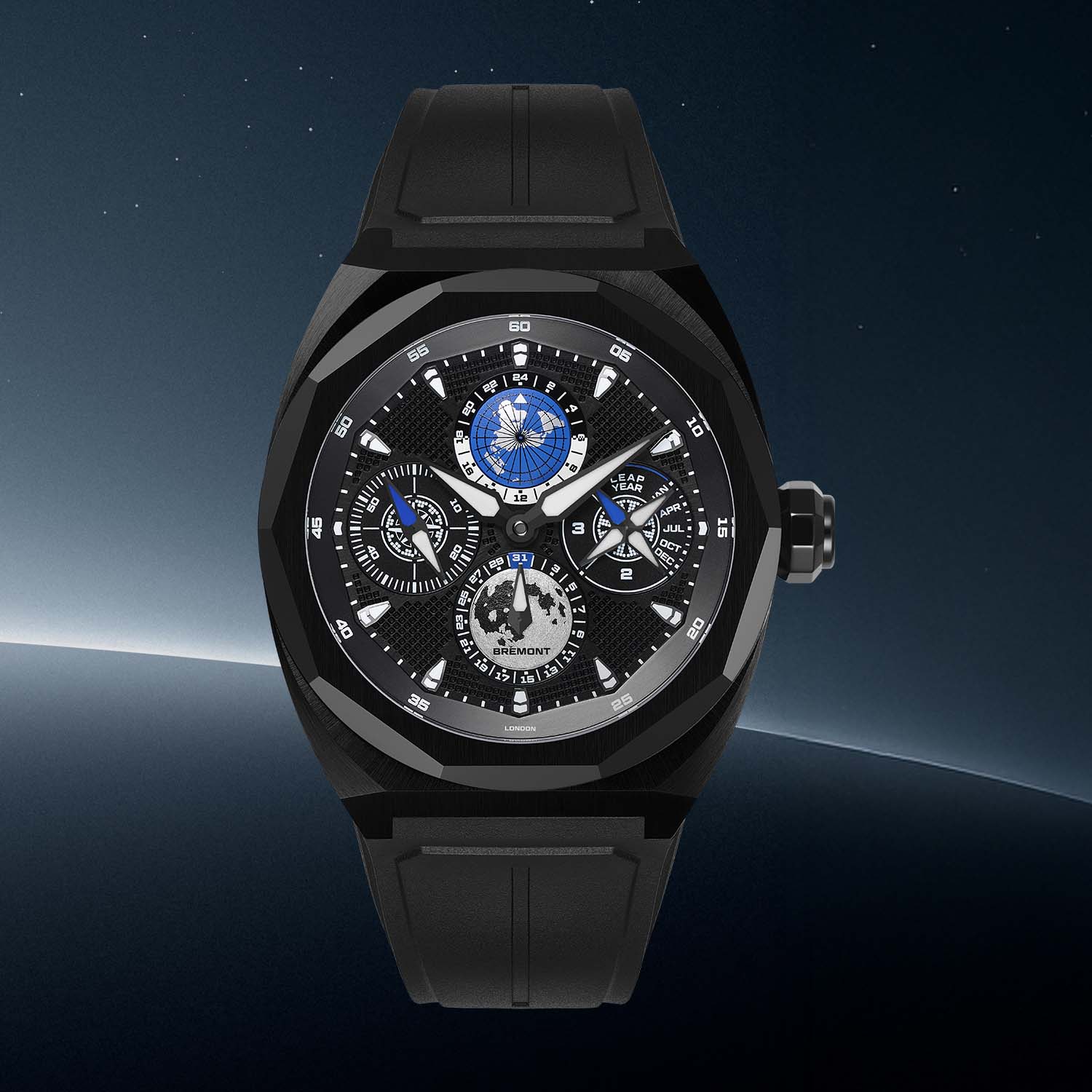
The galvanic black dial uses a perforated grid pattern inspired by spacecraft solar arrays.

That could easily become decorative noise, but Bremont keeps the information organised across four sub-dials.
At 12 o’clock, a rotating domed globe sits on a 24-hour day and night ring for the home-time display.
The indication is read by an arrow pointer and can be adjusted in one-hour increments via the monopusher set into the crown.

At 3 o’clock, a four-blade propeller-style hand displays the month and leap year.
The date is indicated at 6 o’clock by a domed moon disc, while running seconds sit at 9 o’clock in a sector-style sub-dial.
White Super-LumiNova with a blue emission is used on the applied triangular indices, faceted black gold hands and sub-dial indicators.
The result is technical rather than ornate, which suits a watch trying to carry high complication content without losing its instrument-watch edge.
The Agenhor module inside
The mechanical headline is the perpetual calendar GMT module developed exclusively for Bremont by Agenhor.
It’s paired with a Sellita AMT6900 manual-winding base movement to create Bremont calibre BHC9192MH.
The movement offers a 50-hour power reserve and is regulated to -6/+6 seconds per day.
Bremont’s watchmakers assemble the calibre in Henley-on-Thames, tying the Swiss-developed module and base architecture back to the brand’s British manufacturing story.
The same complication concept first appeared in Bremont’s Altitude collection in 2025, but its move into the Supernova case changes the tone completely.
Here, the mechanism feels less dress-complication and more technical travel instrument.
Limited edition positioning
Bremont is limiting the Supernova Perpetual Calendar GMT Monopusher to 20 pieces.
It is offered either on a quick-release integrated black DLC steel bracelet or on a black rubber strap with an adjustable double-folding clasp.
The bracelet version is priced at EUR 35,950, while the rubber-strap version is priced at EUR 35,650.
The watch also arrives with wider context around the Supernova platform.
Bremont has said the Supernova Chronograph was tested under NASA protocols through its partnership with U.S. aerospace firm Astrolab, ahead of a planned lunar adventure now rescheduled for early 2027.
That association gives the collection a clearer identity than a simple design exercise, even if this perpetual-calendar model is best understood as the more horologically ambitious branch of the same idea.
Details & Specifications
| Brand | Bremont |
|---|---|
| Model | Supernova Perpetual Calendar GMT Monopusher |
| Production | 20 pieces |
| Case size | 41mm diameter, 13.9mm thick, 49.7mm lug to lug |
| Case material | 904L stainless steel with Ultra Black DLC coating |
| Bezel | Decagonal black ceramic bezel with brushed and polished finishing |
| Crystal | Domed sapphire crystal |
| Caseback | Exhibition caseback |
| Water resistance | 100 metres |
| Dial | Galvanic black with perforated grid pattern |
| Lume | White Super-LumiNova with blue emission |
| Movement | Bremont calibre BHC9192MH |
| Base movement | Sellita AMT6900 manual-winding base movement |
| Module | Agenhor-developed perpetual calendar GMT module |
| Functions | Perpetual calendar, GMT home time, running seconds, date, month and leap-year indication |
| Power reserve | 50 hours |
| Regulation | -6/+6 seconds per day |
| Bracelet | Quick-release integrated black DLC steel bracelet |
| Strap option | Black rubber strap with adjustable double-folding clasp |
| Price | EUR 35,950 on bracelet, EUR 35,650 on rubber strap |
The Supernova Perpetual Calendar GMT Monopusher is Bremont at its most mechanically assertive, but it’s still framed as a practical, darkly modern sports watch rather than a traditional grand complication.
For collectors drawn to unusual displays, space-era design cues and small-run British watchmaking, that combination is the point.