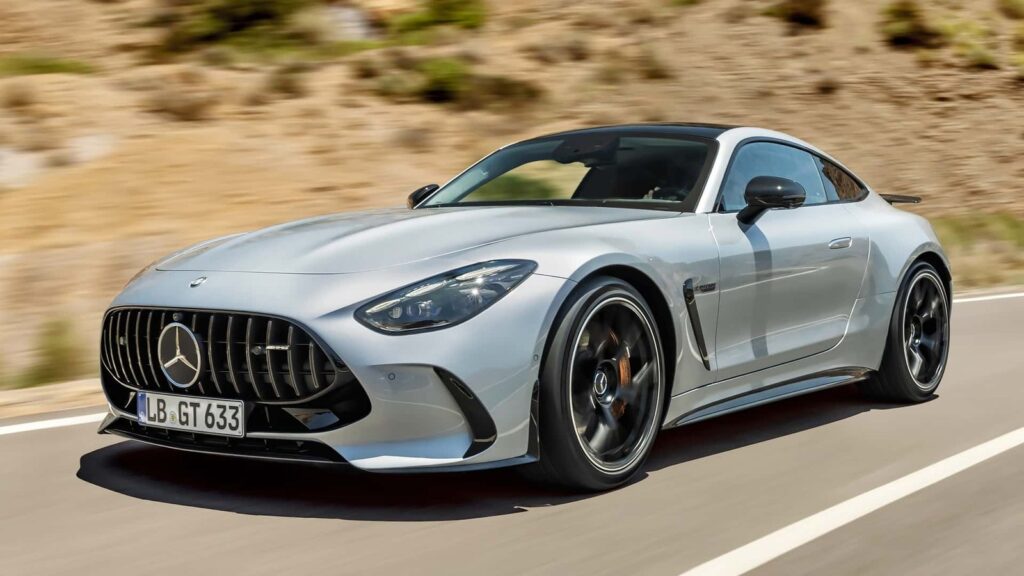
Mercedes-AMG is preparing one of the most aggressive product expansions in its recent history.
The Affalterbach performance brand is looking to move closer to BMW M in global sales, with more than 27 new models planned over the next three years and a target of 200,000 annual deliveries by 2030.
The scale matters because AMG delivered around 145,000 cars last year, while BMW M passed 213,000 units and continued to set the pace in the performance-car market.

At a glance
- Mercedes-AMG is planning more than 27 new models over the next three years as it aims for 200,000 annual sales by 2030.
- The roadmap includes new six- and eight-cylinder models, a return for the GT Black Series, a G63 Convertible and a V8-powered Mythos CLE.
- AMG also plans to simplify its engine range from ten variants to four while continuing to develop electric performance models.
A broader AMG line-up with sharper intent
AMG’s next phase is not a single halo car or a narrow refresh cycle, but a full spread of new products across different segments.
The plan includes fresh six-cylinder and eight-cylinder models, which should matter to buyers who still associate AMG with charismatic combustion engines as much as lap times or badge hierarchy.
Among the most significant names in the pipeline is the GT Black Series, a badge AMG reserves for its most focused road cars.
That return gives the performance division a clear flagship for enthusiasts, while more attainable models are expected to help carry the sales volume.
The CLE family will also play a central role.
A more usable CLE 63 is expected alongside a new C53, while an extreme CLE model under the Mythos line is planned with V8 power.

That Mythos connection is important because it places the car closer to Mercedes-Benz’s more exclusive, collector-facing projects rather than the regular performance catalogue.
Combustion engines are being simplified, not abandoned
The most interesting part of AMG’s strategy may be what happens under the bonnet.
The brand plans to reduce its engine line-up from ten variants to just four, a move that should make development, emissions compliance and global product planning more manageable.
That doesn’t mean AMG is walking away from combustion performance.
Updated versions of the inline-six are expected, along with a reworked V8, giving the brand room to serve buyers who still want the mechanical character that built AMG’s reputation.
The return of more six- and eight-cylinder models also signals a recalibration after a period when electrified four-cylinder performance became one of the most debated chapters in AMG’s modern history.

For many customers, especially in larger markets, engine character remains part of the purchase decision rather than a technical footnote.
Electric AMG models will still be part of the fight
AMG’s expansion won’t be limited to petrol-powered cars.
An electric SUV is being prepared on the GT 4-Door platform, giving the brand another entry in the high-performance EV space.
That car is likely to be strategically important because the performance SUV market continues to absorb buyers who once would have chosen coupes or sedans.
It also gives AMG another way to compete with BMW M beyond the familiar battleground of compact sedans, super sedans and V8 coupes.
AMG’s challenge will be to make its electric models feel distinct, especially as instant torque and huge output figures become increasingly common across luxury EVs.
The badge can’t rely on numbers alone, which puts greater pressure on chassis tuning, driver feel, software calibration and design identity.
The sales race with BMW M is now explicit
The target of 200,000 annual sales by 2030 gives AMG a clear commercial benchmark.
It also shows how much the performance-car business has changed, with premium sub-brands now expected to deliver serious volume rather than operate only as image builders.
BMW M’s 213,000-plus annual deliveries underline the size of the opportunity and the difficulty of the task.
AMG has global recognition, a deep archive of memorable engines and strong nameplates, but it needs a broader and more coherent line-up if it wants to close the gap.
The planned G63 Convertible speaks to that broader approach.
It would sit at the intersection of luxury SUV culture, open-air novelty and AMG status, appealing less to traditional track-day buyers and more to collectors and lifestyle-driven customers.
Taken together, the next three years look set to define AMG’s direction for the rest of the decade.
If the product mix lands well, the brand could become more competitive without losing the combustion-era personality that made it desirable in the first place.