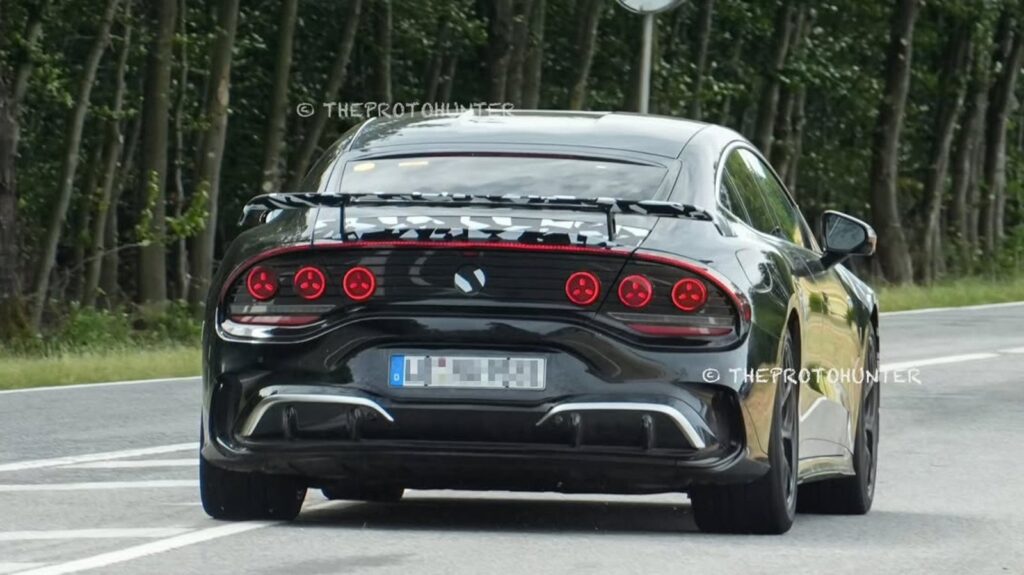
Mercedes-AMG’s electric GT 4-Door already lives in fairly extreme territory, but a new test car suggests the brand may be pushing the format further.
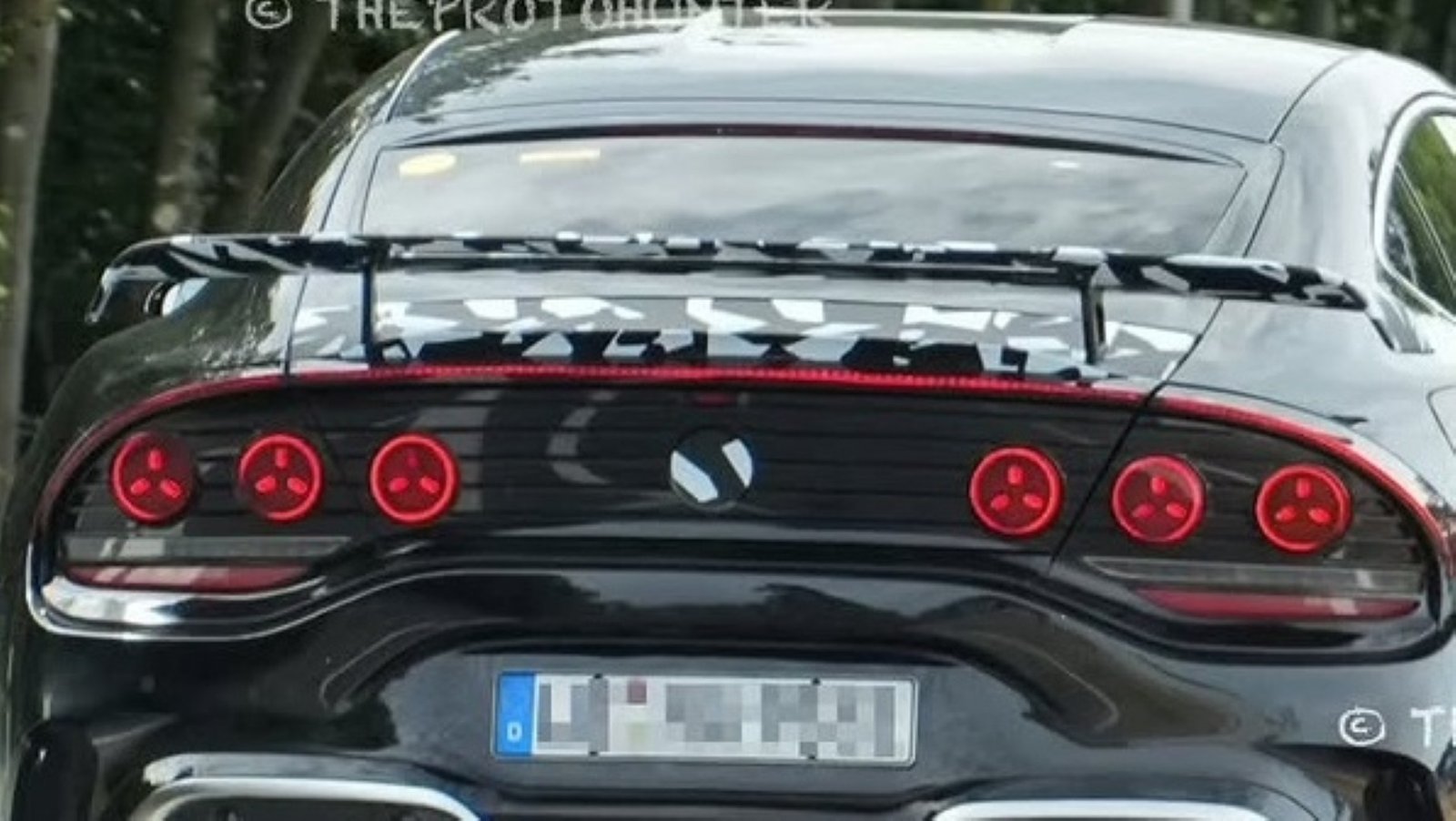
The car appears close to the model currently in the lineup, yet one detail changes the whole mood: a fixed rear wing mounted at the back.
For a car already defined by huge power and supercar-level acceleration, that kind of aero hardware is unlikely to be decorative.
At a glance
- A Mercedes-AMG GT 4-Door test car has appeared with a fixed rear wing, suggesting a more performance-focused version could be in development.
- The wing is camouflaged in black and white and appears smaller than the full width of the car, unlike the movable spoiler on the available model.
- The GT 4-Door already offers up to 1,153 hp in GT 63 form, giving AMG a very serious base for a sharper derivative.
A fixed wing changes the character
The most telling change is the rear wing, which looks permanently mounted rather than retractable or adjustable in the manner of the standard car’s active spoiler.
It’s finished in black and white camouflage, making its shape harder to read, but the proportions appear deliberate rather than experimental.
The wing doesn’t stretch across the full width of the rear deck, which gives it a more integrated look than an oversized racing appendage.
On a car of this size and weight, a fixed aero element would usually point toward higher-speed stability and a more track-minded setup.
The AMG.EA platform already has serious firepower
The current electric GT 4-Door is built on AMG.EA architecture and uses a 106 kWh battery paired with three axial-flux motors.
One motor sits at the front axle, while two are positioned at the rear, giving the car a powertrain layout aimed squarely at high-output performance.

In GT 55 form, the system produces 805 hp and 1,328 lb-ft of torque, enough for a 0-60 mph time of 2.4 seconds.
The GT 63 moves the figures into hypercar-adjacent territory, with 1,153 hp, 1,475 lb-ft of torque and a claimed 0-60 mph run of just 2 seconds.
Both versions are limited to 186 mph, and both feature a simulated V8 soundtrack, a detail that underlines AMG’s attempt to keep some combustion-era theatre in its electric performance cars.

What a harder GT 4-Door could mean
A more focused GT 4-Door would make sense within AMG’s performance hierarchy, especially as electric cars make outright acceleration less of a differentiator.
Once a sedan-shaped EV can reach 60 mph in roughly two seconds, the next battleground becomes repeatability, braking, cooling, aero balance and chassis feel.
A fixed wing alone doesn’t confirm a final production version, but it does suggest AMG is evaluating hardware beyond the existing visual and aerodynamic package.

If the brand is developing a more serious variant, it would likely appeal to buyers who want the GT 4-Door’s four-door usability without giving up the sharper attitude associated with AMG’s most focused cars.
Details & Specifications
| Brand | Mercedes-AMG |
|---|---|
| Model | GT 4-Door |
| Platform | AMG.EA architecture |
| Battery | 106 kWh |
| Motors | Three axial-flux motors, one front and two rear |
| GT 55 output | 805 hp and 1,328 lb-ft of torque |
| GT 55 0-60 mph | 2.4 seconds |
| GT 63 output | 1,153 hp and 1,475 lb-ft of torque |
| GT 63 0-60 mph | 2 seconds |
| Top speed | 186 mph limited |
| Notable feature | Simulated V8 soundtrack |
For now, the fixed-wing GT 4-Door remains an intriguing test car rather than a confirmed addition to the range, but it’s a clear sign that AMG is still looking for ways to make its electric performance flagship feel more than just brutally quick.