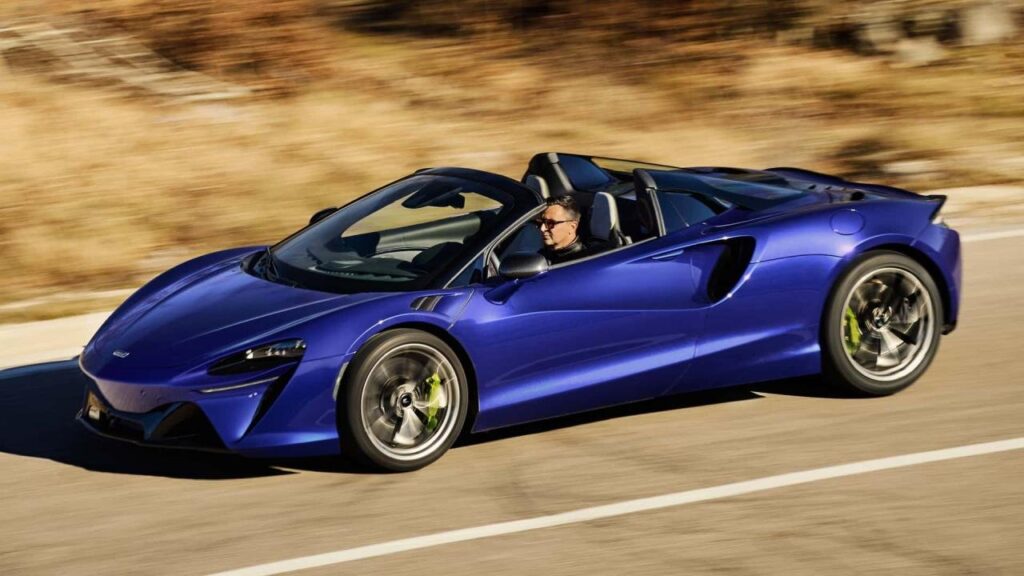
The McLaren Artura looks set to leave the line-up in 2028, ending a relatively short chapter for the brand’s first series-production hybrid supercar.
Launched as the successor to the 570S, the Artura arrived with real strategic weight, but its timing proved difficult.
By the time McLaren’s hybrid had found its footing, Ferrari and Lamborghini had moved the conversation on with considerably more powerful electrified rivals.

At a glance
- McLaren is expected to phase out the Artura in 2028, with the P34 set to take its place.
- The Artura launched with a 3.0-litre twin-turbo V6 hybrid powertrain, later updated in the Artura Spider to 690 hp and 531 lb-ft.
- Its run was shaped by delayed deliveries, early technical concerns and a fast-changing hybrid supercar market.
The Artura’s place in McLaren’s modern line-up
When McLaren announced the Artura in 2020, it was positioned as the replacement for the 570S and the new gateway into the marque’s supercar range.
It also marked a major technical shift, moving the entry McLaren formula away from the familiar V8 layout and into a V6 hybrid era.
On paper, that made sense for a brand built around lightweight engineering and compact performance packages.

The difficulty was timing.
Deliveries were held back as the industry dealt with Covid disruption and the semiconductor shortage, two factors that hit low-volume performance car makers particularly hard.
That delay meant the Artura entered customer hands in a market that had already started to change around it.
Italian hybrid rivals raised the benchmark
The Artura was originally framed against cars such as the Ferrari F8 Tributo and Lamborghini Huracan, both key reference points in the junior supercar class.
But Ferrari’s 296 GTB changed the measure of the segment with a hybrid powertrain producing 820 hp.
Lamborghini then moved into the same electrified space with the Temerario, bringing 907 hp to the table.

Against that backdrop, the Artura’s original 670 hp output looked less dramatic than it might have at launch.
Performance figures never tell the whole story with a McLaren, especially when weight, response and chassis tuning are central to the appeal, but showroom perception matters in this part of the market.
For some buyers, the delayed introduction and early technical issues made the Artura a tougher sell at precisely the moment its rivals were arriving with headline power numbers.
The Artura Spider gave the car a sharper second act
McLaren didn’t walk away from the Artura formula after the coupé’s difficult start.
In 2024, the company introduced the Artura Spider with a revised version of the 3.0-litre twin-turbo V6 hybrid powertrain.
Output rose to 690 hp and 531 lb-ft of torque, while the 8-speed transmission was also revised.
That update gave the Artura range a more convincing technical story and broadened its appeal to buyers who wanted the added theatre of an open-top McLaren.
Even so, the Spider arrived into a segment where electrified supercars were already being judged by extremely aggressive numbers.
Details & Specifications
| Brand | McLaren |
|---|---|
| Model | Artura |
| Positioning | Entry-level hybrid supercar |
| Predecessor | McLaren 570S |
| Powertrain | 3.0-litre twin-turbo V6 hybrid |
| Original output | 670 hp |
| Artura Spider output | 690 hp |
| Artura Spider torque | 531 lb-ft |
| Transmission | Revised 8-speed transmission on Artura Spider |
| Artura Spider introduction | 2024 |
| Expected end of production | 2028 |
| Successor | McLaren P34 |
What the P34 needs to deliver
The P34 will inherit more than an empty slot in the McLaren catalogue.
It will arrive with the job of reasserting McLaren’s authority in a hybrid supercar class that has become faster, louder in its numbers and less forgiving of compromised launches.
The Artura still matters because it helped move McLaren into series-production hybrid territory and created the engineering bridge for what comes next.
Its replacement will need to make that transition feel decisive from day one.