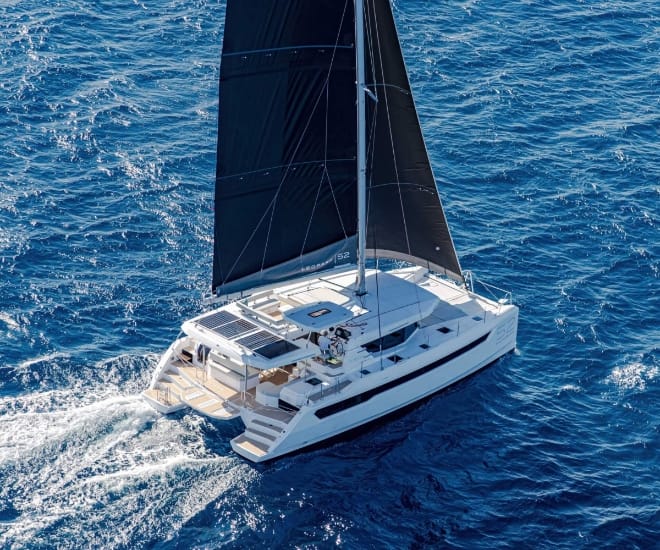
The Leopard 52 steps in as the new flagship of Leopard’s sailing catamaran line, replacing the Leopard 50 with a larger, more powerful and more adaptable platform. Following its 2025 debuts in Cannes and the United States, the 52 has also made its Asia premiere at the Singapore Yachting Festival and earned the Sailing Catamaran 14-18m title at the Yacht Style Awards 2026.
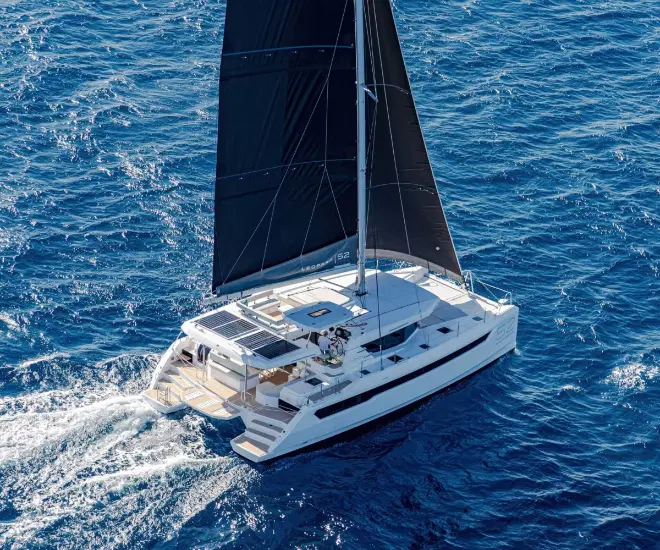
A Bigger Leopard With More Sail and Sharper Hulls
Built in South Africa by Robertson and Caine, the Leopard 52 was developed with Simonis Voogd and the builder’s in-house design team. The hulls use a refined stepped form with narrow entries for improved agility, while carrying enough volume above the waterline to support the yacht’s substantial interior. The result is a catamaran aimed at two demanding audiences at once: private owners planning extended cruising and charter operators needing durability, flexibility and easy handling.

The rig is one of the most meaningful upgrades. Compared with the Leopard 50, the 52 carries a taller mast, a longer boom and 17 per cent more upwind sail area. In stronger breeze, the boat has shown the ability to hold speeds in the eight-knot range upwind and reach around nine knots in gusts without immediately calling for a reef, underlining that this is not merely a volume-focused refresh. Optional Ullman aramid sails add a more performance-minded specification for owners who want extra response.
Semi-Flybridge Helm, Forward Cockpit and Connected Living
Leopard’s familiar semi-raised helm remains on the starboard side, with two electric winches, line jammers and a bench for two. The arrangement keeps sailing operations concentrated without committing to the windage of a full flybridge. Guests are not isolated from the helm either, thanks to an upper coachroof lounge with seating, a table and a sunpad, creating a social sailing position without compromising the boat’s practical character.

The 52 also keeps one of Leopard’s most useful signatures: the forward cockpit, reached either from the side decks or through the watertight forward saloon door. It adds a protected seating area forward, broad sunpads, trampoline space and a direct airflow path through the saloon when the door is open. Aft, the cockpit is arranged around a port-side dining area, an L-shaped sofa to starboard and a barbecue zone, while an optional hydraulic platform enhances swim access, tender handling and day-to-day waterside living.
Hybrid Propulsion and Serious Cruising Options
Standard propulsion comes from twin 57hp diesel engines, with 80hp upgrades available. The more forward-looking option is the Joool serial hybrid system, pairing a 1,600W solar array with a 24kW range-extending generator, a 27kWh lithium battery bank and twin 25kW electric pods. The system is designed to run with minimal input from the skipper, including automatic generator activation when the batteries reach 40 per cent. Hydro-regeneration is available under sail, though meaningful returns require higher boat speeds.

- Length class: 52ft sailing catamaran
- Builder: Robertson and Caine, South Africa
- Design input: Simonis Voogd and Robertson and Caine
- Rig: taller mast, longer boom, 17 per cent more upwind sail area than Leopard 50
- Propulsion: twin diesels or optional serial hybrid electric system
- Solar capacity: up to 1,600W on the aft coachroof
- Cabins: three to six guest cabins, with optional crew cabin in the port forepeak
Layouts for Owners, Charter Fleets and Long-Range Living
Accommodation flexibility is central to the Leopard 52’s appeal. In owner configuration, the starboard hull can be given over largely to a master suite with a forward-facing bed, vanity area and a large private bathroom, joined by a separate VIP cabin. Alternatively, the same hull can be arranged with three en-suite cabins. The port hull is just as configurable, with options for guest cabins, a long aft cabin with cockpit access, forward or aft utility spaces, laundry equipment and storage for tools and spares.
That modularity is what makes the Leopard 52 particularly compelling. A private owner can specify a genuine liveaboard cruising catamaran with utility space, solar capacity, a proper navigation station and modern domestic options such as an induction cooktop, dishwasher and wine fridge. A charter operator can choose four, five or six guest cabins without making the boat feel improvised. For buyers who want a large catamaran that balances easy handling, social deck space and real cruising competence, the Leopard 52 looks like a confident new benchmark for the brand.