A 16cm wrist has a way of making a watch collection more honest. Recently, that has meant reassessing anything that wears too wide, too long or simply too loud on the wrist, and giving more attention to watches around 38mm and below. The result is a compact dozen that makes a persuasive case for smaller watches—not as compromise pieces, but as the most wearable part of the box.

The 38mm-and-under dozen currently earning wrist time
The current small-watch group is varied rather than precious: German minimalism, Chinese dress-watch character, Japanese everyday staples, affordable digital-analogue Casios and a couple of rectangular experiments. Case diameter only tells part of the story, so lug-to-lug matters just as much here. A 36mm watch with a 47mm span can wear larger than expected, while a 38mm case with short lugs can feel almost tailored.

- Nomos Club Campus — 36mm case, 47mm lug-to-lug
- Maison Celadon Imperial Plum — 38mm case, 45mm lug-to-lug
- Proxima PX1690-369 — 37mm case, 46mm lug-to-lug
- Pierre Paulin Jump Hour — 38mm case, 46mm lug-to-lug
- Timex Q Warp — 38mm case, 45mm lug-to-lug
- Casio AQ-230GA-9DMQYES — 30mm case, 39mm lug-to-lug
- Casio Tank Dark — 37mm case, 42mm lug-to-lug
- Seiko SARB035 — 38mm case, 44mm lug-to-lug
- Seiko SARB033 — 38mm case, 44mm lug-to-lug
- Seiko SARB070 — 38mm case, 44mm lug-to-lug
- Seiko SNXS73K1 — 36mm case, 44mm lug-to-lug
- Seiko SNK805K2 — 37mm case, 43mm lug-to-lug
Why rectangles are suddenly doing the heavy lifting
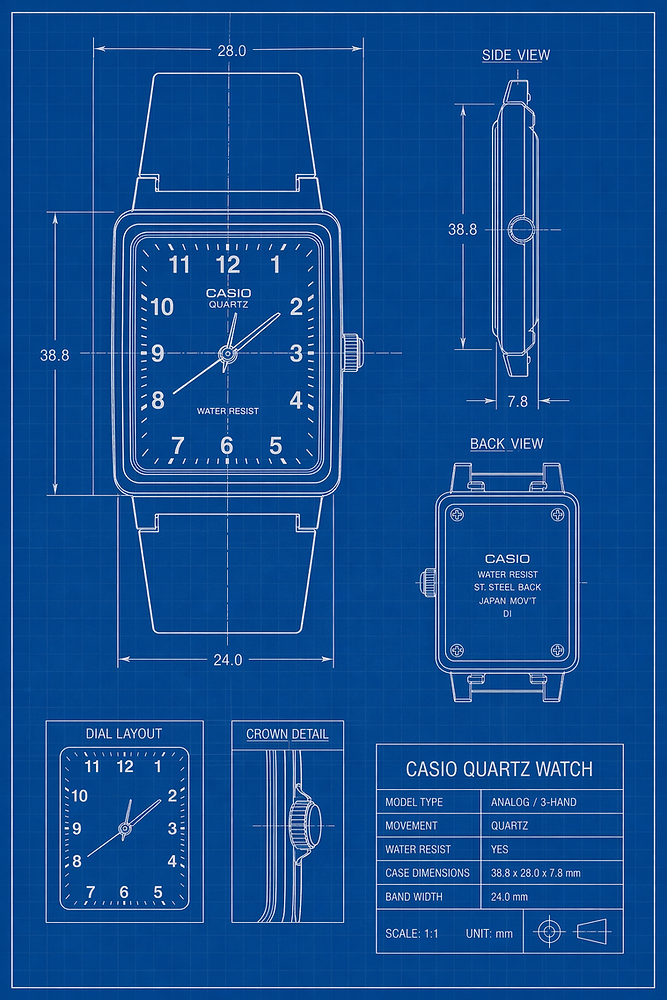
The most interesting shift is not just toward smaller watches, but toward watches that are not round. The Casio AQ-230 and the darker Tank-style Casio both show why rectangular cases are so useful for slim wrists: they usually sit flatter, keep their visual footprint tidy and avoid the overhang problem that can make larger round sports watches feel ungainly. The Tank Dark, in particular, is the kind of inexpensive watch that can quietly embarrass far more expensive pieces on pure fit.
Rectangular watches also carry a different design language. They tend to lean dressier and more Art Deco, with Cartier’s Tank, Longines’ DolceVita and Jaeger-LeCoultre’s Reverso forming the obvious reference points. That does not make the shape delicate by default; it makes proportion matter. In an era when smaller men’s watches are again part of the conversation, a compact rectangle can look intentional rather than undersized.

The Seiko core and the problem with larger favorites
The Seiko cluster gives the collection its backbone. The SARB033, SARB035 and SARB070 all share that sweet 38mm/44mm sizing that explains why the SARB line remains so loved: restrained diameter, sensible lug span and enough dial presence to work as daily watches. The SNXS73K1 and SNK805K2 add even more compact dimensions, proving that affordable Seiko can still be one of the easiest answers for smaller wrists.
The harder question is what happens to the bigger watches. A 40mm or 41mm case is not automatically out of bounds if the lugs are controlled; a Cartier Ronde at 40mm, for example, can work because its lugs are short and elegant. The same review needs to happen with pieces like a Tudor Black Bay Red Bezel, Zenith Synopsis or black Seiko Alpinist. If they fit, they stay in the conversation. If they do not, the collection may be better served by a Cartier Tank, Santos, Rolex Oyster Perpetual 36mm, Echo/Neutra Rivanera or something similarly compact.

A smaller collection does not mean a smaller wish list
Downsizing rarely cures watch enthusiasm; it just sharpens it. The dream list still has room for a Rolex Oyster Perpetual 116000 in 36mm with a silver 3-6-9 dial, the newer steel-and-gold 36mm Oyster Perpetual, a Jaeger-LeCoultre Reverso, a 37mm Vacheron Constantin 222, a 37mm Bulgari Octo and a gold 36mm Cartier Ronde. That is the real lesson of going small: the field may look narrower, but the best options become more focused, more wearable and often more interesting.