London has plenty of omakase counters, but JUNO feels unusually personal from the moment you step inside.
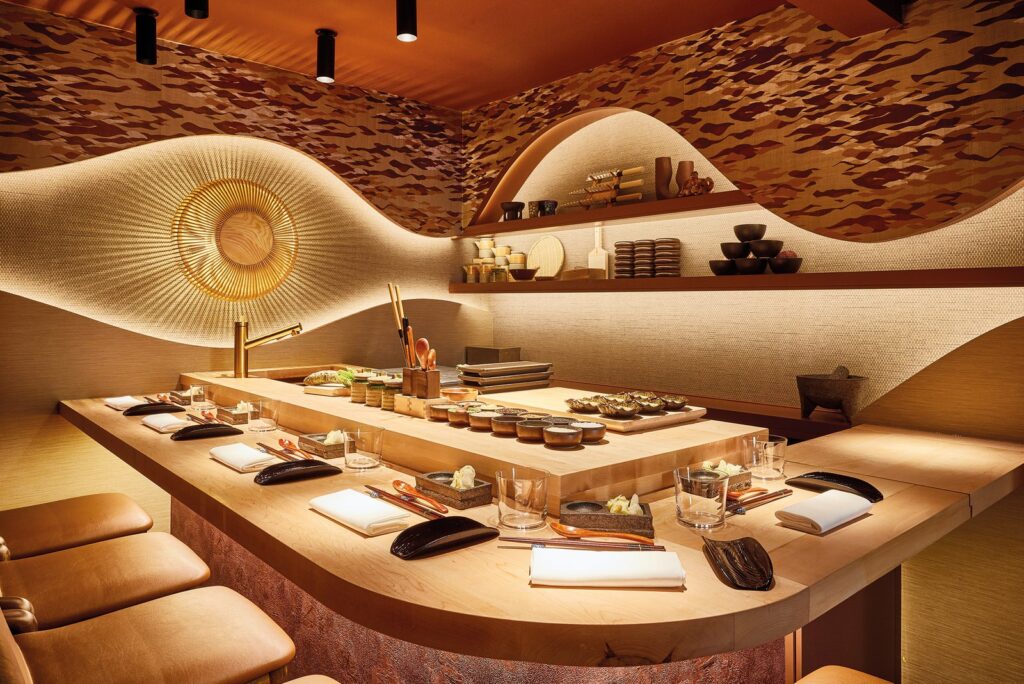
Set upstairs from Los Mochis near Notting Hill Gate, the restaurant moves from the colour and energy of Japanese-Mexican dining into a quieter room of warm timber, careful lighting and just six seats at the counter.
It’s intimate enough that the meal becomes part dinner, part conversation, with Head Sushi Chef Han Heung guiding guests through technique, ingredients and the thinking behind each piece.
At a glance
- JUNO is a six-seat omakase counter above Los Mochis in Notting Hill, serving a 15-course menu shaped by the day’s fish selection.
- The experience blends Japanese edomae technique with Mexican accents, from jalapeño to chicatana ant powder.
- The menu is priced at £230 per person, with sake, Takumi and wine pairings available from £120 per person.
A six-seat counter above Los Mochis
JUNO’s scale is part of its appeal.
With only six guests seated around the counter, there’s little distance between diner and chef, and that closeness gives the evening its rhythm.
The setting also makes the ingredients feel less abstract.
Before the meal begins, guests are introduced to the fish box, with cuts that may include Canadian snow crab, Valencian otoro and shima-aji from Ehime.
Chef Han selects the fish daily, so the 15-course menu isn’t locked into a fixed script.
That daily adjustment gives JUNO a sense of immediacy, especially when seasonal details enter the conversation, such as needlefish in Japan.
Edomae craft with Mexican accents
The Japanese foundation is precise and disciplined, particularly in the handling of shari.
Each piece of rice is shaped with a few quick motions, holding together just long enough before loosening softly as it’s eaten.
Kurodai, or black sea bream, shows the restraint of the cooking.
The fish is cut cleanly, balanced against the rice and finished with purple shiso powder dried and ground by Chef Han from fresh Japanese leaves.
Even the way the nigiri is eaten is considered, with guests guided through the edomae habit of turning the piece so the fish touches the tongue first.
JUNO also moves between Tokyo-style nigiri and more elaborate Osaka-style expressions, but the distinctive twist comes from the Mexican pantry.
Hamachi might arrive on a black-glazed plate with hana hojiso flowers, a slice of jalapeño and a terracotta-toned powder made from chicatanas, Mexico’s flying ants.
The effect isn’t fusion for spectacle.
The Mexican elements are used with control, adding brightness, sourness and texture without masking the fish.
Pairings and price
The 15-course omakase menu is priced at £230 per person.
For drinks, JUNO offers a sake pairing at £120 per person and a Takumi pairing at £170 per person.
Wine pairings are also available, with a Classic pairing at £120 per person and a Signature pairing at £210 per person.
That positions JUNO firmly in London’s special-occasion dining category, but the format gives the experience a more direct kind of value than a conventional tasting menu.
You’re not simply watching plates arrive from a kitchen you’ll never see.
You’re sitting inside the process, learning why a fish was chosen, why a powder matters and how a single piece of nigiri can shift depending on temperature, texture and seasoning.
Who JUNO will appeal to
JUNO is best suited to diners who enjoy precision but don’t want formality to harden into stiffness.
It’s for the omakase regular who has seen the format before, and for the curious diner who wants Japanese technique presented with a wider cultural range.
The small room also matters.
This is not a background restaurant for a long table or a loud night out, but a counter for paying attention.
What makes JUNO persuasive is how lightly it wears its ideas.
The Mexican ingredients bring a clear point of difference, yet the meal remains anchored in fish, rice, timing and touch.
In a city crowded with omakase options, JUNO earns its place by making the format feel more intimate, more inquisitive and distinctly its own.