The jumping hour has always sat slightly apart from mainstream watch design.
It gives mechanical watchmaking the clarity of a digital display, but without surrendering the tension, timing and theatre of gears doing something precise at exactly the right moment.
In recent years, that appeal has become hard to ignore, with established maisons and independent creators revisiting the complication through everything from Art Deco apertures to openworked mechanical architecture.

At a glance
- Jumping hour watches are seeing renewed attention across major manufactures and independent watchmakers.
- The complication replaces a continuously moving hour hand with an instantaneous change, often shown through a window or digital-style display.
- Recent examples range from the A. Lange & Söhne Zeitwerk Date to Cartier’s Tank Guichets, Audemars Piguet’s Neo Frame Jumping Hour and niche independent interpretations.
A different way to read mechanical time
A conventional watch asks the eye to follow hands as they sweep or step around the dial.
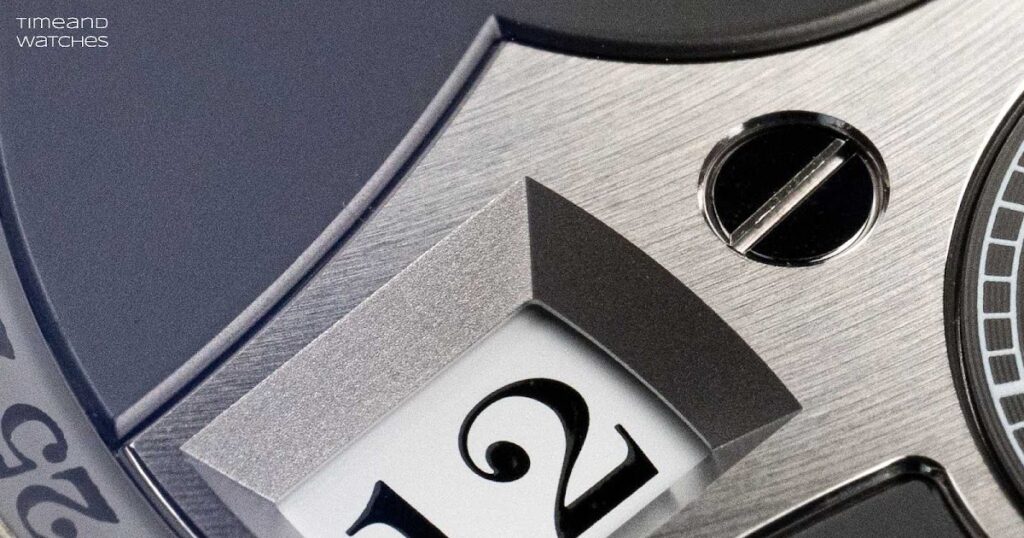
A jumping hour changes that relationship by making the hour appear all at once, typically through an aperture, while the minutes are displayed by a hand, track or secondary indication.
The result is direct, almost architectural.

There’s less visual ambiguity than on many traditional dials, and the jump itself becomes the mechanical event.
That’s what makes the complication so fertile for modern watch design.
It can look vintage, as with window-based Art Deco displays, or radically contemporary when the mechanism is exposed, enlarged or placed within an unconventional case shape.

Why the complication feels current again
The A. Lange & Söhne Zeitwerk, introduced in 2009, remains the modern reference point for mechanical digital time displays.
Its influence can be felt in the broader confidence watchmakers now show when moving away from classical hands and indices.
The Zeitwerk Date builds on that language with instantaneous jumping numerals and a peripheral glass ring date indicator, reinforcing the idea that digital clarity can still feel deeply mechanical.

What’s changed is the range of interpretations around it.
Some brands are using jumping hours to revive historical forms, while others see the complication as a framework for technical complexity or a cleaner way to present useful information.
That spread is the most interesting part of the current moment.

Recent jumping hour watches to know
The latest wave isn’t defined by one aesthetic.
It moves from platinum annual calendars to racing chronographs, from travel-minded complications to deliberately unconventional independent pieces.
| Watch | What stands out |
|---|---|
| A. Lange & Söhne Zeitwerk Date | Instantaneous jumping numerals paired with a peripheral glass ring date indicator. |
| Audemars Piguet Neo Frame Jumping Hour | Art Deco-inspired architecture in a pink gold case with a black PVD sapphire crystal dial and dual apertures. |
| Baltic SpaceOne & Théo Auffret Seconde Majeure | A space-age design built around a jumping hour module developed with independent watchmaker Théo Auffret. |
| Berneron Quantième Annuel | A round platinum watch combining a cross-architecture movement, annual calendar layout and jumping hour display. |
| Cartier Tank Guichets | A reinterpretation of the 1928 Tank Guichets, using a pure window-based digital display rooted in Art Deco design. |
| Chronoswiss Neo Digiteur | A rectangular, high-contrast update of historical regulator-style jumping hour displays. |
| Cyrus Ethereal Twin Orbital | A highly complex construction pairing a double-axis tourbillon with an orbital jumping hour mechanism. |
| Czapek Time Jumper | An independent take focused on a minimalist dial and a crisp direct-read time display. |
| Louis Vuitton Escale Complications | Métiers d’art dials combined with high complications and a seamless jumping hour display in a travel-oriented collection. |
| M.A.D.Editions M.A.D.3 Vincent Calabrese | A vivid reinterpretation of Vincent Calabrese’s progressive jumping-hour concept. |
| MeisterSinger Panthero Jumping Hour | A move away from the brand’s signature single-hand layouts toward a clean, instrument-style display. |
| TAG Heuer Monaco Speed 12 | A racing-linked chronograph that integrates a piston-inspired jumping hour complication into the square Monaco profile. |
From heritage codes to experimental mechanics
Cartier’s Tank Guichets shows the heritage side of the equation with particular clarity.

By returning to a 1928 design built around time windows rather than hands, it illustrates how the jumping hour can feel historically grounded rather than futuristic.
At the other end, pieces such as the Cyrus Ethereal Twin Orbital push the complication into far more complex territory.
There, the jumping hour is not just a display choice but part of a larger mechanical performance involving an orbital system and a double-axis tourbillon.

Independent watchmaking gives the format another kind of energy.
Berneron’s Quantième Annuel uses the complication within an annual calendar, while Czapek’s Time Jumper leans into a more restrained direct-read approach.
M.A.D.Editions takes a more playful route with Vincent Calabrese, connecting the format to one of independent watchmaking’s most recognisable conceptual voices.

Who the jumping hour speaks to
For collectors, the appeal is partly intellectual.
A jumping hour watch makes the passage of time feel mechanical in a way that’s visible, sudden and satisfying.
For design-focused buyers, it offers an alternative to the familiar hierarchy of central hands, hour markers and sub-dials.

The complication can create a cleaner dial, a more graphic face, or a display that feels closer to an instrument than a traditional dress watch.
That range explains why the format now appears across such different categories.
It can support the severity of a Lange, the elegance of a Cartier, the architecture of an Audemars Piguet, or the eccentricity of M.A.D.Editions without losing its identity.

The best jumping hour watches don’t use the mechanism as a novelty.
They use it to rethink how mechanical time can be read, staged and enjoyed in a market that still has room for genuinely different displays.