Some cars still stop the room even when the room is an ordinary stretch of road.
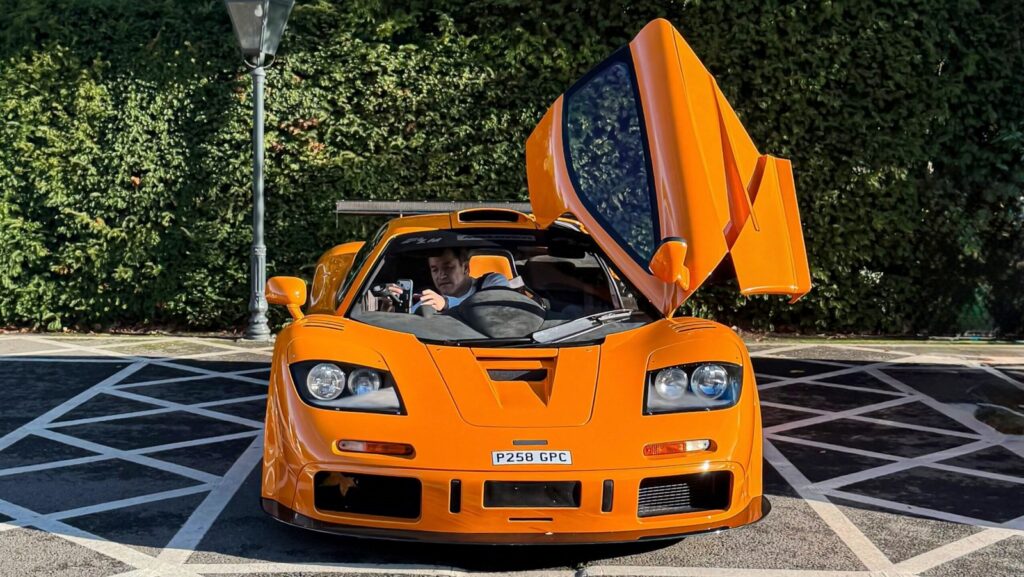
Images shared by @spottingcars.uk show a McLaren F1 LM casually parked in the UK, finished in the Papaya Orange shade so closely tied to McLaren’s identity.
In daylight, the colour does exactly what it should, pulling the eye toward the F1’s compact proportions, clean surfaces and purposeful details without making the car look overworked.
At a glance
- A rare McLaren F1 LM has been pictured parked in the UK in Papaya Orange.
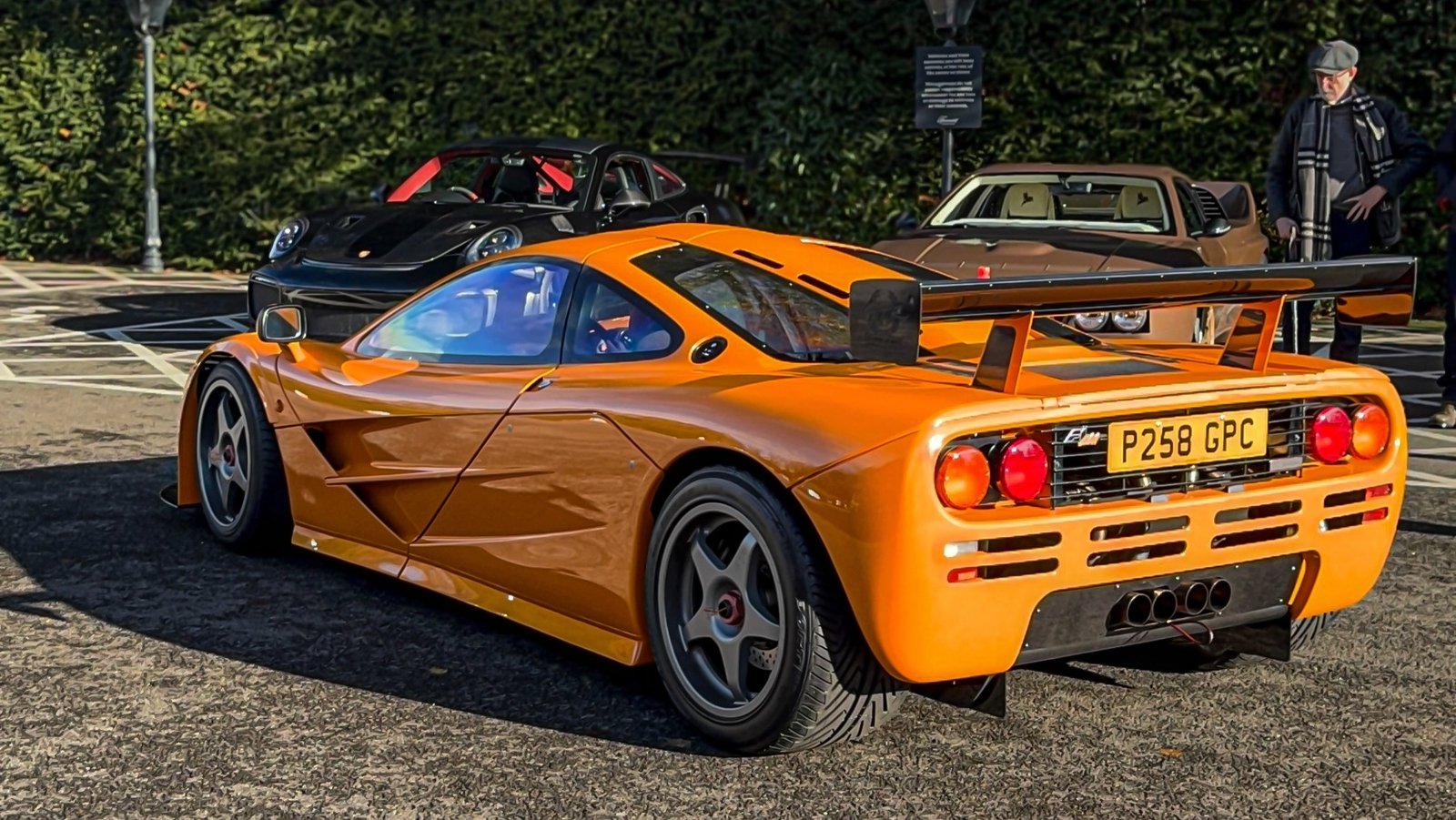
- The LM features the F1’s central driving position, upward-opening doors, fixed rear wing and high-downforce upgrades.
- Built to celebrate McLaren’s 1995 Le Mans victory, the F1 LM was limited to five customer cars.
A Le Mans tribute in Papaya Orange
The McLaren F1 LM exists because of one of the defining moments in McLaren road-car history.
It was built to celebrate the marque’s 1995 Le Mans victory, and unlike a standard F1, it wears its intent more openly.
The fixed rear wing and high-downforce changes give the car a more aggressive visual character, but the underlying shape remains remarkably disciplined.
That tension is part of the LM’s appeal.
It’s more purposeful than the already extraordinary F1, yet it hasn’t lost the clarity that made Gordon Murray’s original layout so compelling.
The cabin still feels radical
The doors open upwards, exposing a cabin that’s more focused than decorative.
At the centre is the driver’s seat, flanked by two passenger seats, a layout that still feels exceptional decades after the original F1 arrived.
There’s little sense of ornament for its own sake.
The cabin’s sparseness suits the LM’s brief, keeping attention on weight, position and the act of driving rather than comfort theatre.
The BMW V12 and the LM formula
Power comes from a naturally aspirated 6.1-litre BMW V12 producing 671 hp.
That figure still carries weight because the F1 LM belongs to a very specific era of supercar engineering, before hybrid assistance and active systems became the default language of extreme performance.
Only five customer examples were made, which is why a casual public sighting lands differently from the usual parade of modern exotics.
It’s not simply valuable or rare, it’s one of the clearest expressions of McLaren’s road-and-racing crossover.
Details & Specifications
| Brand | McLaren |
|---|---|
| Model | F1 LM |
| Exterior colour | Papaya Orange |
| Engine | Naturally aspirated 6.1-litre BMW V12 |
| Power | 671 hp |
| Seating layout | Central driving position with two passenger seats |
| Doors | Upward-opening doors |
| Aerodynamics | Fixed rear wing and high-downforce upgrades |
| Production | Five customer cars |
| Purpose | Built to celebrate McLaren’s 1995 Le Mans victory |
The F1’s long design shadow
The sighting also arrives at a moment when McLaren F1 designer Peter Stevens has been commenting on the reaction to several recent car designs, including the Ferrari Luce and Jaguar Type 01.
Stevens, whose career also includes work with Lamborghini and BMW, has suggested that some of the criticism aimed at those newer designs has been overstated.
It’s a useful reminder that the F1’s reputation wasn’t built on nostalgia alone.
The car remains influential because its decisions were unusually clear, from the seating layout to the mechanical specification and the way every visible element appears to serve a purpose.
Seeing an F1 LM parked in the open strips away the museum-glass distance and makes the point more directly.
Even standing still, this Papaya Orange LM looks like a car designed around conviction rather than fashion.