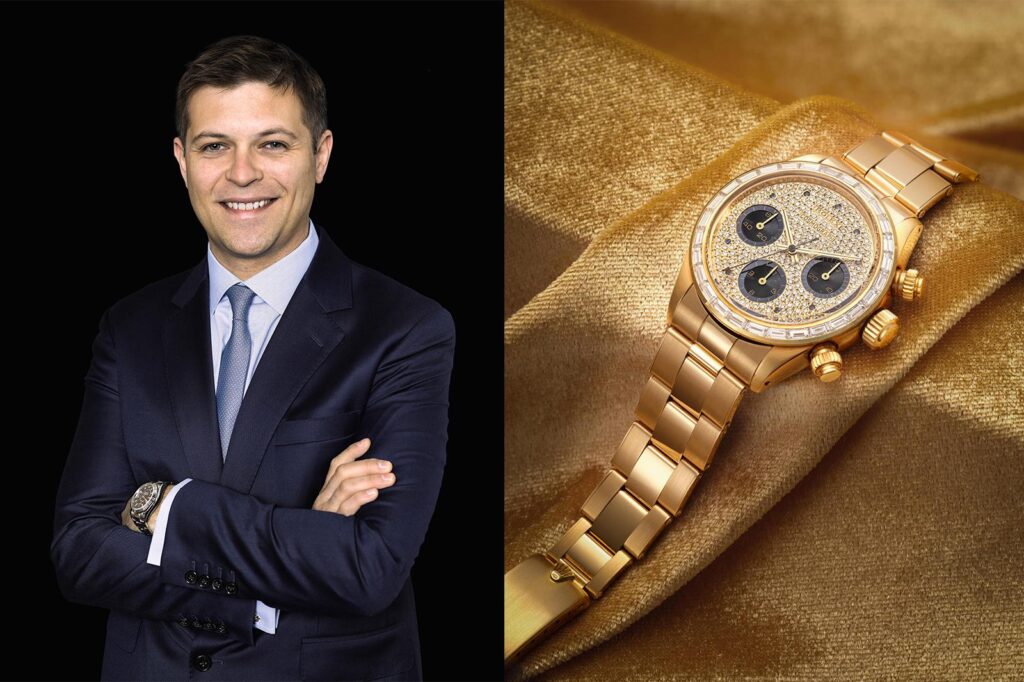
Sam Hines, Global Chairman of Watches at Sotheby’s, sits at one of the most influential crossroads in collecting, where scholarship, rarity and timing can turn a watch into an international event.
Now based in Hong Kong, Hines has spent more than two decades in the auction and luxury watch worlds, with senior roles spanning Sotheby’s, Christie’s, Phillips and Loupe This before his return to Sotheby’s in June 2024.
A Hong Kong vantage point on the global watch market
Hines’ role is not simply to stand at the rostrum when the bidding begins.

He oversees a global team handling valuations, consignments, cataloguing and pricing, while also meeting collectors and dealers across major regions.
The business now runs on two distinct tracks, with curated live auctions reserved for the rarest and most consequential pieces, and online sales often focused on modern commercial watches from the past two or three decades.
The Cartier Crash record that sharpened the market’s appetite
Among the recent results tied to Hines’ tenure is a 1987 Cartier London Crash that sold for HK$15,616,000, about US$1.99 million, setting a Cartier auction record.

The result underlines how far the Crash has moved from cult design object to serious trophy watch, especially when London-made examples with the right period character reach the market.
It also reflects the current strength of shaped watches, where design rarity can command the kind of attention once reserved almost exclusively for complicated Patek Philippe or blue-chip Rolex references.
F.P. Journe and the power of modern independent watchmaking
Hines has also handled important work by François-Paul Journe, a watchmaker whose early production has become one of the defining categories of contemporary collecting.

A platinum F.P. Journe Chronomètre à Résonance from circa 2002 sold in Hong Kong for HK$5,080,000, about £479,430 including buyer’s premium.
The appeal is technical as much as it is emotional, with the Résonance using two balances that interact to improve stability while displaying two time zones.
For collectors, early Journe pieces now occupy a rare space, combining independent authorship, limited production and a complication that is closely identified with the watchmaker himself.

The Olmsted Complications Collection was a once in a generation sale
The Olmsted Complications Collection showed another side of the market, built not around modern wristwatch demand but around deep horological history.
Assembled over roughly 60 years by an American connoisseur, the 84-piece collection focused on high complication pocket watches and chronometer clocks from the 19th and early 20th centuries.
The sale brought US$22.9 million, about £16.8 million including buyer’s premium, with every lot sold and the total more than tripling the pre-sale estimate.
Its standout was the Audemars Piguet “Grosse Pièce” from 1921, an 18k gold double-dial pocket watch with 18 complications including a one-minute tourbillon, grande and petite sonnerie, chronograph, perpetual calendar and a celestial chart for the London night sky.
Estimated at US$500,000 to US$1 million, the watch achieved US$7,736,000, about £5.7 million including buyer’s premium.
The Rolex Daytona ref. 6270 shows how scholarship changes value
Few Rolex Daytonas carry the aura of the ref. 6270, a factory gem-set yellow gold Cosmograph originally commissioned for Sultan Qaboos bin Said Al Said of Oman through Asprey in the early 1980s.
The model is significant because it was the first factory gem-set Daytona, with diamonds and sapphires giving the familiar chronograph an entirely different status.
A circa 1985 example known as “The King” sold in Hong Kong for HK$40,635,000, about £3.84 million including buyer’s premium, against an estimate of HK$16 million to HK$32 million.
When Hines sold a ref. 6270 in 2013, it achieved around US$1 million, but deeper research now suggests fewer than 10 examples are known, helping explain the reference’s remarkable climb.
The watches associated with Hines’ career show where the top of the auction market is heading, toward pieces with unmistakable identity, documented rarity and enough horological weight to stand apart when the bidding starts.