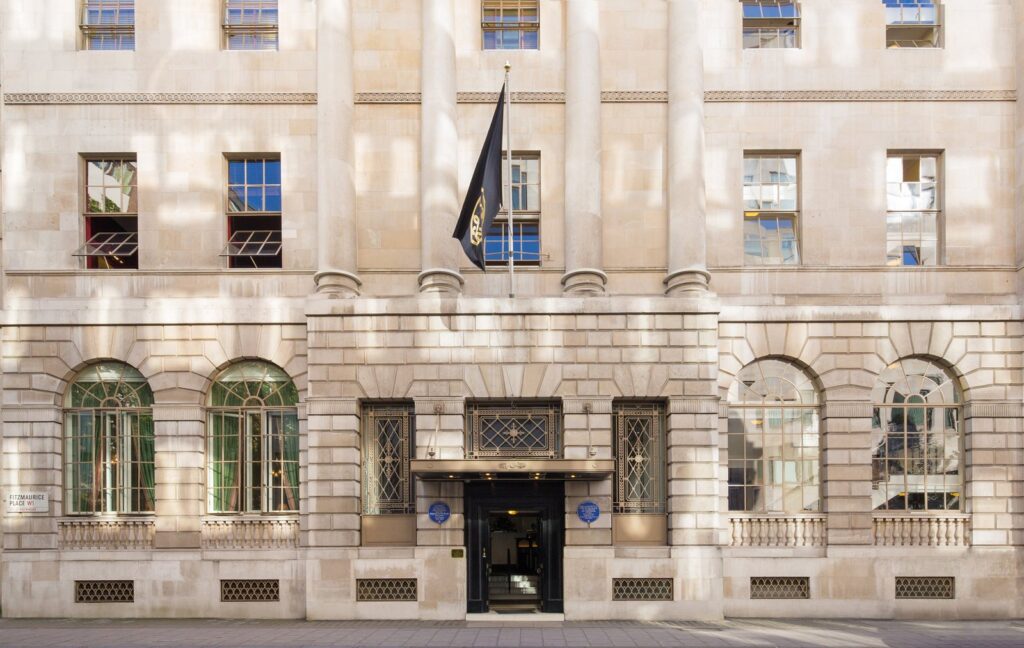
Mayfair has no shortage of discreet doors, but The Lansdowne Club carries a particular weight.
Set on Fitzmaurice Place, moments from Berkeley Square, it’s a private members’ club where Georgian bones, art deco confidence and modern hospitality sit together without strain.
Its appeal lies in that balance between history and everyday usefulness, with dining, bedrooms, events, sport and social life all folded into one quietly self-assured address.

At a glance
- The Lansdowne Club is a historic private members’ club in Mayfair, established in 1935.
- It combines Georgian architectural heritage with art deco interiors, dining, accommodation, wellness facilities and a celebrated fencing salle.
- The club was London’s first to admit men and women on equal terms, a founding principle that remains central to its identity.
A Mayfair address with political and architectural weight
The Lansdowne Club occupies part of what was once Lansdowne House, one of Mayfair’s great aristocratic residences.
The house was designed in 1763 by Robert Adam for John Stuart, the 3rd Earl of Bute, who had served as Prime Minister.
It later passed to William Petty, 1st Marquess of Lansdowne, another figure close to the centre of British political life.
The building’s story is not simply decorative.
In 1774, Joseph Priestley conducted experiments here under Lord Shelburne’s patronage that led to the discovery of oxygen.
In 1783, the Treaty of Paris, which ended the American War of Independence, was drafted in the Bow Room, now known as the Round Room Bar.
The house remained connected with diplomacy into the modern era, with links to the Anglo-Japanese Alliance and the Entente Cordiale between Britain and France.
Its architecture has travelled too.
When Westminster City Council cut a new road through the estate in 1930, the house was altered substantially, yet important interiors were preserved and later recreated in major American institutions including the Philadelphia Museum of Art and the Metropolitan Museum of Art in New York.
Today, that layered history is still legible in the club’s mix of Georgian elegance and art deco drama.
The club that opened the door differently
The Lansdowne Club was founded in 1935 with a notably progressive position for its time.
It became London’s first club to admit men and women on equal terms, avoiding the rigid professional, political or gendered structures that defined many older institutions.
That decision still gives the club much of its character.
Rather than feeling like a museum to private-club formality, it has the air of a social house that happens to come with serious architecture.
The roll call of past guests and associates adds colour without overwhelming the place.
Figures connected with the club’s history include Richard Dimbleby, James Mason, Beryl Cook, Paul Smith, Prince Rainier III of Monaco and Grace Kelly.
Harry Gordon Selfridge, founder of Selfridges, also lived at Lansdowne House from 1921 to 1929, bringing a more theatrical Mayfair energy to the address.
The club’s resident cats, Harry and Rose, nod to Selfridge and his wife, Rosalie, with the kind of eccentricity that old London institutions tend to do best.
Dining, rooms and the rhythm of club life
Food at The Lansdowne Club is handled with the same preference for restraint over performance.
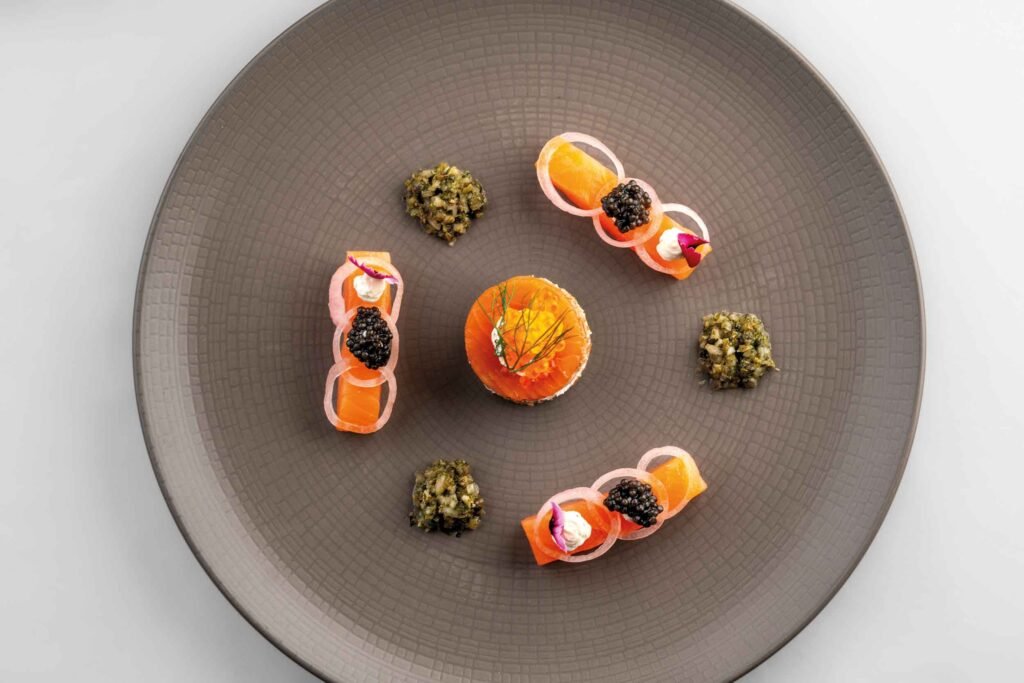
The Courtyard Brasserie offers a lighter register, with dishes such as salmon tartare, superfood salad with poached salmon and braised beef short rib fitting the mood of a bright, informal room.
More formal dining is led by Executive Chef Henry Brosi, formerly Executive Chef at The Dorchester for more than two decades.
His menus draw on seasonal British and European produce, with the kind of classical grounding that suits the building.
The Dining Room serves breakfast, lunch and dinner, while the Adam Drawing Room offers a quieter setting for coffee and conversation.
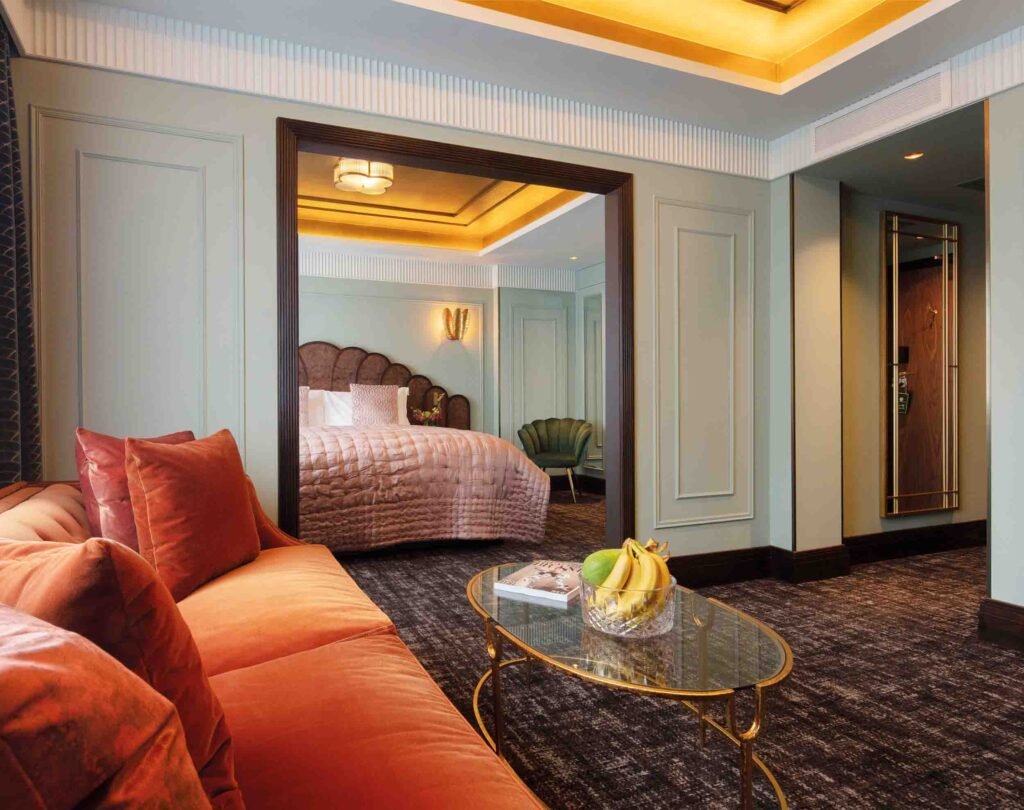
For members and guests staying overnight, the club’s accommodation adds a useful dimension to its appeal.
A Deluxe Suite brings a king-sized bed, a sitting area with a chaise longue, generous wardrobes, a writing desk, dressing table and tea and coffee facilities.
The marble bathroom, deep tub, white robes and Jo Loves amenities give the room a polished but not overworked finish.
The club is also a strong setting for private events.
The ballroom brings the greatest sense of occasion, while the Shelburne, Findlay and Sun Rooms, along with the Library, offer smaller spaces for meetings, lectures, exhibitions, weddings and dinners.
Fencing, swimming and the art deco health club
Wellness is not an afterthought at The Lansdowne Club.
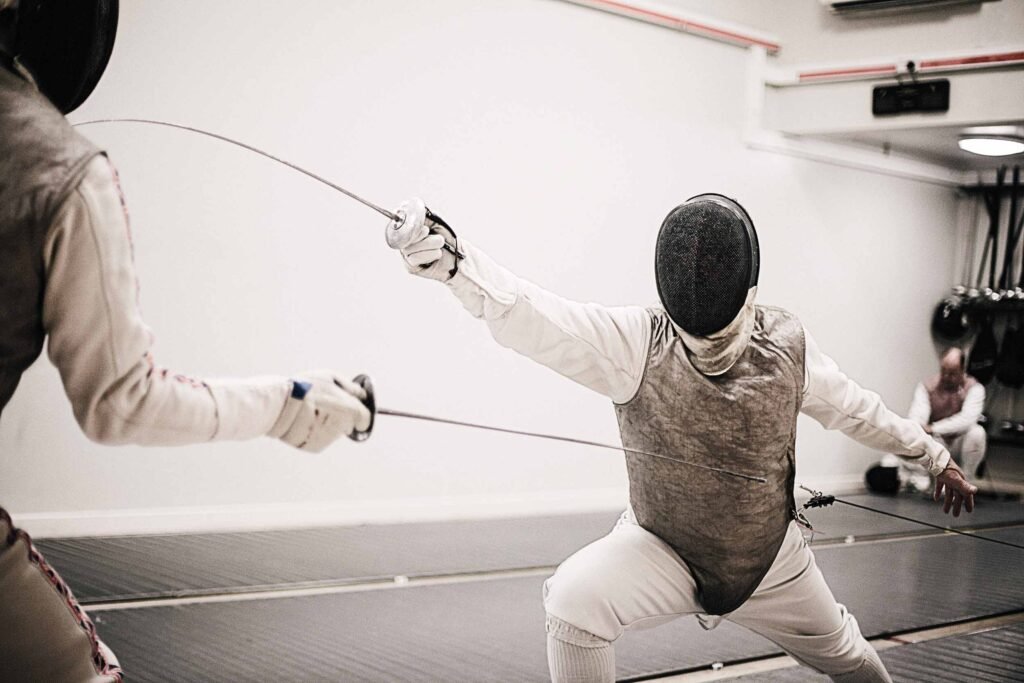
The facilities include a two-floor gym, squash courts, a 25-yard pool and a fencing salle, all shaped by the club’s wider art deco atmosphere.
Fencing is the distinctive thread.
The salle d’armes was established in 1935 by members of the Royal Automobile Club and remains active today.
Classes, coaching and informal bouts make it accessible to beginners as well as experienced fencers.
It gives the club a physical rhythm that’s rare in Mayfair, with the sound of footwork and foils cutting through the calm in a way that feels precise rather than disruptive.
That sporting tradition also says something useful about the club itself.
The Lansdowne is formal enough to respect its past, but not so fixed that it feels frozen by it.
Its Grade II listed status, confirmed in 1970, protects the architectural substance, while a refurbishment in 2000 helped bring greater comfort to the everyday experience.
Reciprocal arrangements with clubs around the world extend its usefulness beyond London, particularly for members who travel frequently and value familiar standards without the anonymity of a hotel.
For anyone drawn to Mayfair’s quieter side, The Lansdowne Club offers a persuasive version of private-club life.
It’s historic without being stiff, social without being loud, and luxurious in the most effective sense of the word, by making the city outside feel briefly optional.