The Honda Civic Type R has never needed much help earning credibility, but an HRC-badged version would move the FL5 into more serious track-day territory.
The car is being tipped for a 2027 production arrival, likely following a facelifted Civic Type R that Honda could show before the end of the year.
Rather than chasing a single headline lap time, the appeal here is shaping up around a broader set of upgrades, with more power, better cooling, sharper aero and hardware aimed at sustained circuit use.

At a glance
- Honda’s Civic Type R HRC could enter production in 2027 as a hotter version of the FL5-generation Type R.
- The model is expected to draw from the Tokyo Auto Salon concept, including revised aero, cooling, brakes, suspension and lightweight components.
- Output could rise from the current US-spec Type R’s 315 hp to around 335 hp through software, intake and exhaust changes.
A Tokyo concept with production intent
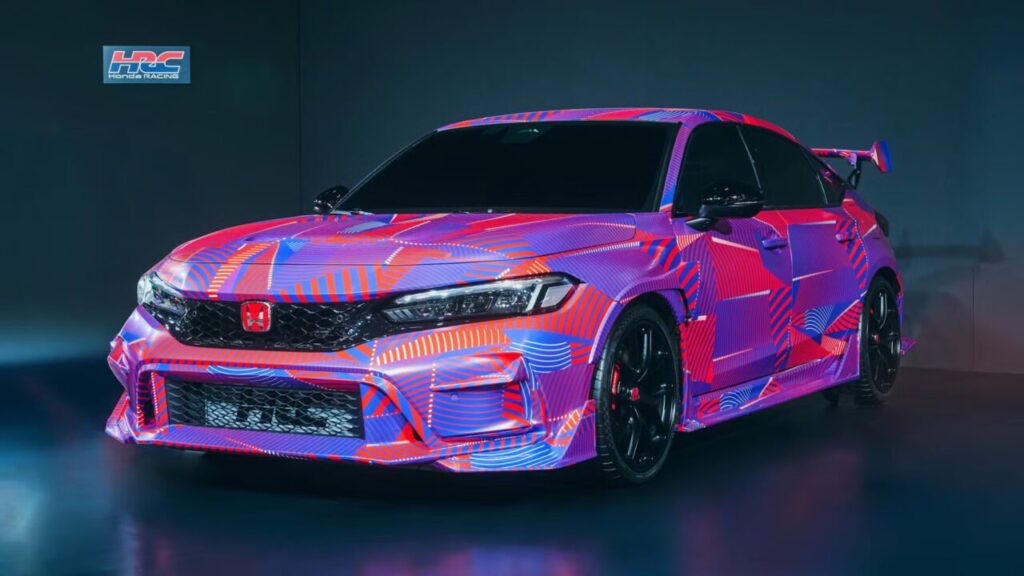
The Civic Type R HRC concept shown at the Tokyo Auto Salon gave a fairly clear preview of the direction Honda is considering.
The visual changes were purposeful rather than theatrical, with a larger front intake, twin air guides, an extended front lip and more aggressive treatment at the rear.
Larger rear-wing endplates and a more substantial diffuser pointed to a car designed to work harder at speed, not simply look louder in a paddock.
The concept also wore HRC-branded cooling hardware and an Akrapovic exhaust, both of which fit neatly with the idea of a factory-developed Type R that can handle repeated hard laps.
More power without losing balance
The current US-market Civic Type R makes 315 hp from its turbocharged 2.0-litre four-cylinder, already enough to make it one of the most capable front-drive performance cars on sale.
Japanese reports have put the potential HRC figure at around 335 hp, with gains expected to come from software calibration plus intake and exhaust upgrades.
That would be a meaningful lift without pushing the Type R into a numbers-first identity.
Hideki Kakinuma, closely associated with Type R development, is understood to be targeting balanced performance improvements rather than building the car around another Nürburgring record attempt.
That approach matters because the FL5’s reputation rests as much on precision and usability as it does on outright pace.

Track hardware beyond the badge
The HRC name only works if the mechanical changes justify it, and the expected parts list suggests Honda knows that.
Revised suspension tuning would be the core upgrade, particularly if Honda wants the car to feel more composed under repeated braking and high-speed direction changes.
Bigger brakes are also expected, which would address one of the first areas owners typically upgrade when taking a fast road car onto a circuit.
Forged wheels and extra carbon-fibre components are also being discussed, with weight reduction likely to be part of the package rather than the whole story.
The most interesting version of this car wouldn’t necessarily be the lightest Civic Type R possible, but the one with the best balance between stiffness, cooling, durability and feedback.
Details & Specifications
| Brand | Honda |
|---|---|
| Model | Civic Type R HRC |
| Expected arrival | 2027 |
| Expected basis | Facelifted FL5 Civic Type R |
| Engine | Turbocharged 2.0-litre four-cylinder |
| Current US-spec Type R output | 315 hp |
| Potential HRC output | Around 335 hp |
| Notable concept hardware | HRC-branded radiator and Akrapovic exhaust |
| Expected chassis upgrades | Revised suspension tuning, bigger brakes and forged wheels |
| Expected aero changes | Larger front intake, twin air guides, extended front lip, larger rear-wing endplates and more substantial diffuser |
If Honda brings the Civic Type R HRC to production with the restraint implied so far, it could become the most compelling version of the FL5 rather than just the most extreme.
For drivers who already admire the Type R’s clarity but want more stamina on track, that’s exactly the kind of evolution worth waiting for.