Koenigsegg has moved the Gemera from long-anticipated promise to finished customer car.
The first example of the Swedish marque’s four-seat Mega-GT has now rolled off the assembly line, six years after the concept first put a family-friendly spin on the hypercar formula.
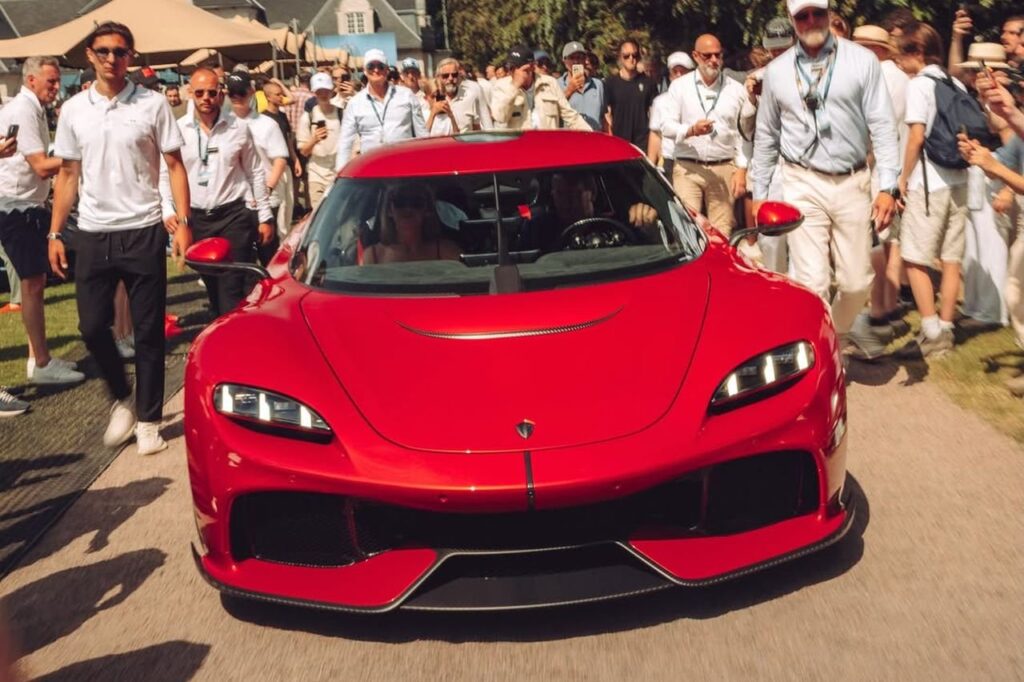
Finished in a vivid red, the milestone car is the opening chapter in a planned run of 300 units and is expected to head to Switzerland after its public debut.

At a glance
- The first customer Koenigsegg Gemera has completed assembly, marking the start of deliveries for the four-seat hypercar.
- The production Gemera uses a 5.0-litre twin-turbo V8 with three electric motors for a combined 2,300 hp.
- Koenigsegg plans to build 300 examples, with the first car set for a public appearance at the Aurora Concours.
A red Gemera begins the customer era
The first customer Gemera was shown by Christian von Koenigsegg, giving the car’s production milestone a suitably personal introduction.
Its bright red finish suits a car that has always occupied a dramatic corner of the Koenigsegg catalogue, even by the brand’s standards.
The Gemera was unveiled in 2020 as something unusual in the hypercar world, a four-seater designed to carry more than one passenger without abandoning extreme performance.

Koenigsegg calls it a Mega-GT, a term that fits the car’s unusual brief more accurately than the familiar supercar or grand tourer labels.
Production was announced in April, and the completion of the first customer example brings that plan into the visible, physical stage collectors have been waiting for.
The production car has grown sharper
The Gemera that customers will receive is not a carbon copy of the early concept.

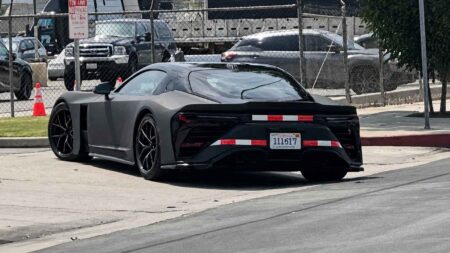
The production version adopts conventional wing mirrors rather than camera mirrors, a practical shift that also makes the car look a little more familiar on the road.
It also gains more assertive aerodynamic hardware, including a rear wing, an aggressive front splitter and an S-duct.
Those additions form part of the optional Ghost Package, which gives the Gemera a more track-focused visual and aerodynamic character.

That matters because the Gemera’s appeal has always rested on contradiction.
It offers four seats, yet it wears the kind of aero treatment and engineering ambition usually reserved for two-seat hypercars.
From compact hybrid concept to V8 flagship
The Gemera’s biggest evolution sits behind its performance figures.
Koenigsegg originally planned the car around a 2.0-litre twin-turbo three-cylinder plug-in hybrid setup, a characterful and unconventional approach even for a brand known for unorthodox engineering.
The final production car instead uses a 5.0-litre twin-turbo V8 paired with three electric motors.
Combined output is rated at 2,300 hp and 2,028 lb-ft of torque, figures that place the Gemera in a rare class even among modern electrified hypercars.
Power is sent to all four wheels through Koenigsegg’s 9-speed Light Speed Tourbillon Transmission.
On paper, that gives the Gemera the defining elements of a contemporary flagship Koenigsegg, huge combustion power, serious electric assistance and a transmission concept far removed from conventional automatic thinking.
Details & Specifications
| Brand | Koenigsegg |
|---|---|
| Model | Gemera |
| Body style | Four-seat Mega-GT hypercar |
| Production | 300 units planned |
| Powertrain | 5.0-litre twin-turbo V8 with three electric motors |
| Power | 2,300 hp |
| Torque | 2,028 lb-ft |
| Transmission | 9-speed Light Speed Tourbillon Transmission |
| Driven wheels | All-wheel drive |
| Aerodynamics | Rear wing, front splitter, S-duct and optional Ghost Package elements |
| First customer car | Finished in brilliant red |
| Public appearance | Aurora Concours |
| Expected destination | Switzerland |
The first customer Gemera matters because it turns one of Koenigsegg’s most ambitious ideas into a delivered product.
For collectors, it’s the moment the Mega-GT stops being a future-facing experiment and becomes a tangible addition to the modern hypercar landscape.