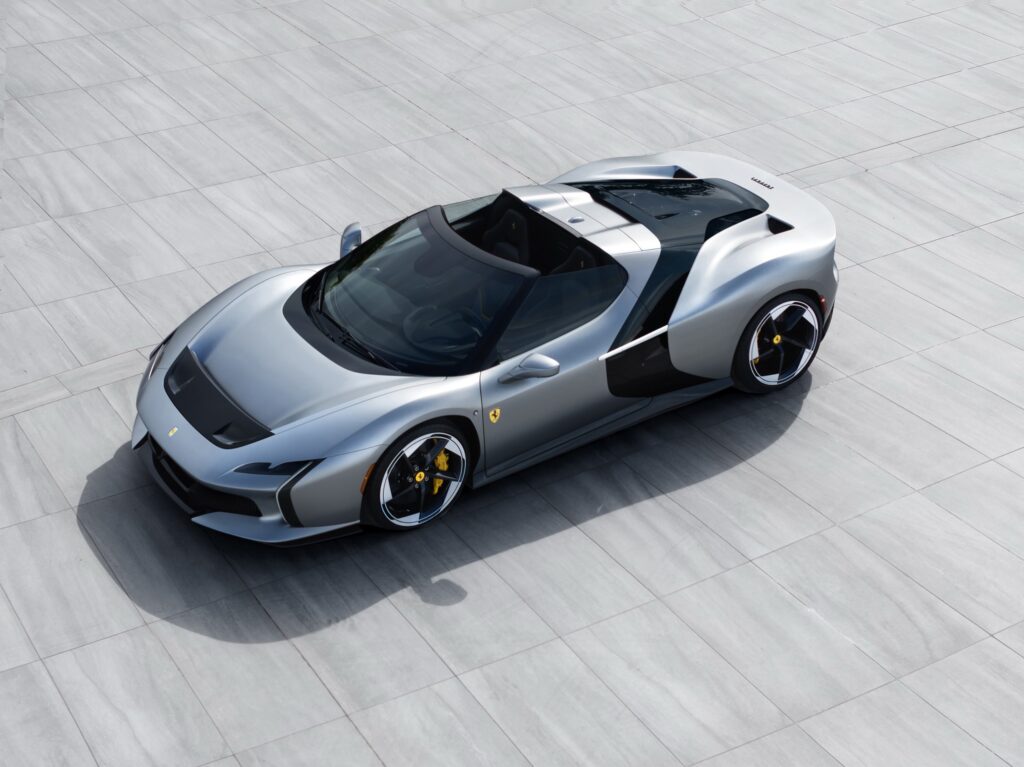
The Ferrari HC25 is a one-off open-top supercar created through Maranello’s Special Projects programme, and it arrives with the kind of timing that gives a private commission wider significance.
Revealed on 15 May 2026 during Ferrari Racing Days at Circuit of the Americas in Austin, Texas, the HC25 was developed over two years for a single client in collaboration with the Ferrari Design Studio.
A 720 cv V8 without hybrid assistance
The heart of the HC25 is the familiar but still formidable 3.9-litre twin-turbocharged 90-degree V8, a dry-sump unit producing 720 cv at 7,000 rpm and 770 Nm of torque from 3,250 rpm.
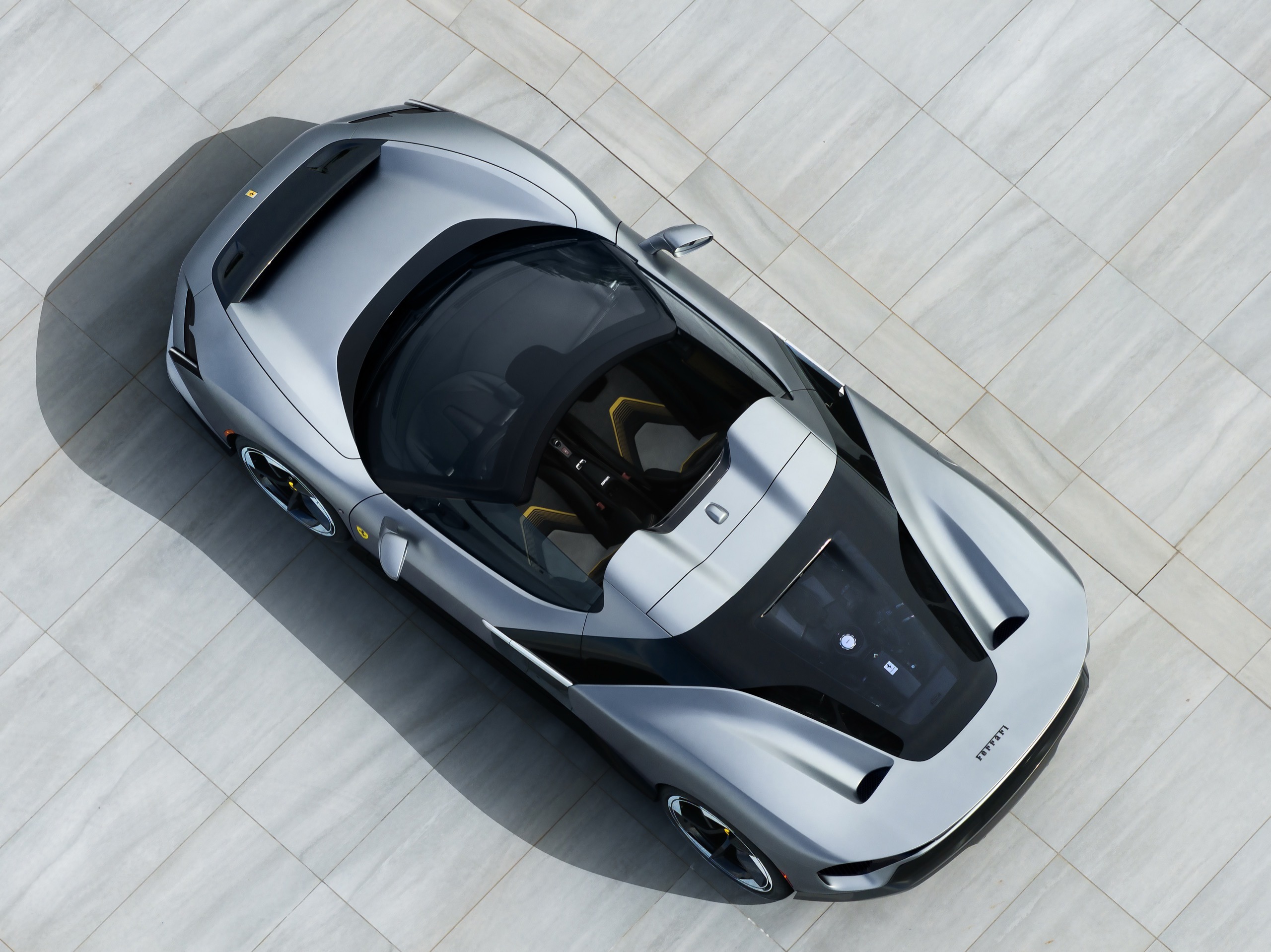
It sends power to the rear wheels through a seven-speed dual-clutch F1 gearbox, giving the roadster a 0–100 km/h time of 2.9 seconds and a claimed top speed of 340 km/h.
The detail that gives the car its emotional charge is what it does not have, because there is no electric motor and no plug-in system assisting the combustion engine.
Ferrari selected the F8 Spider architecture because it represents the final open mid-rear-engined Prancing Horse spider to use the non-hybrid turbocharged V8 layout.
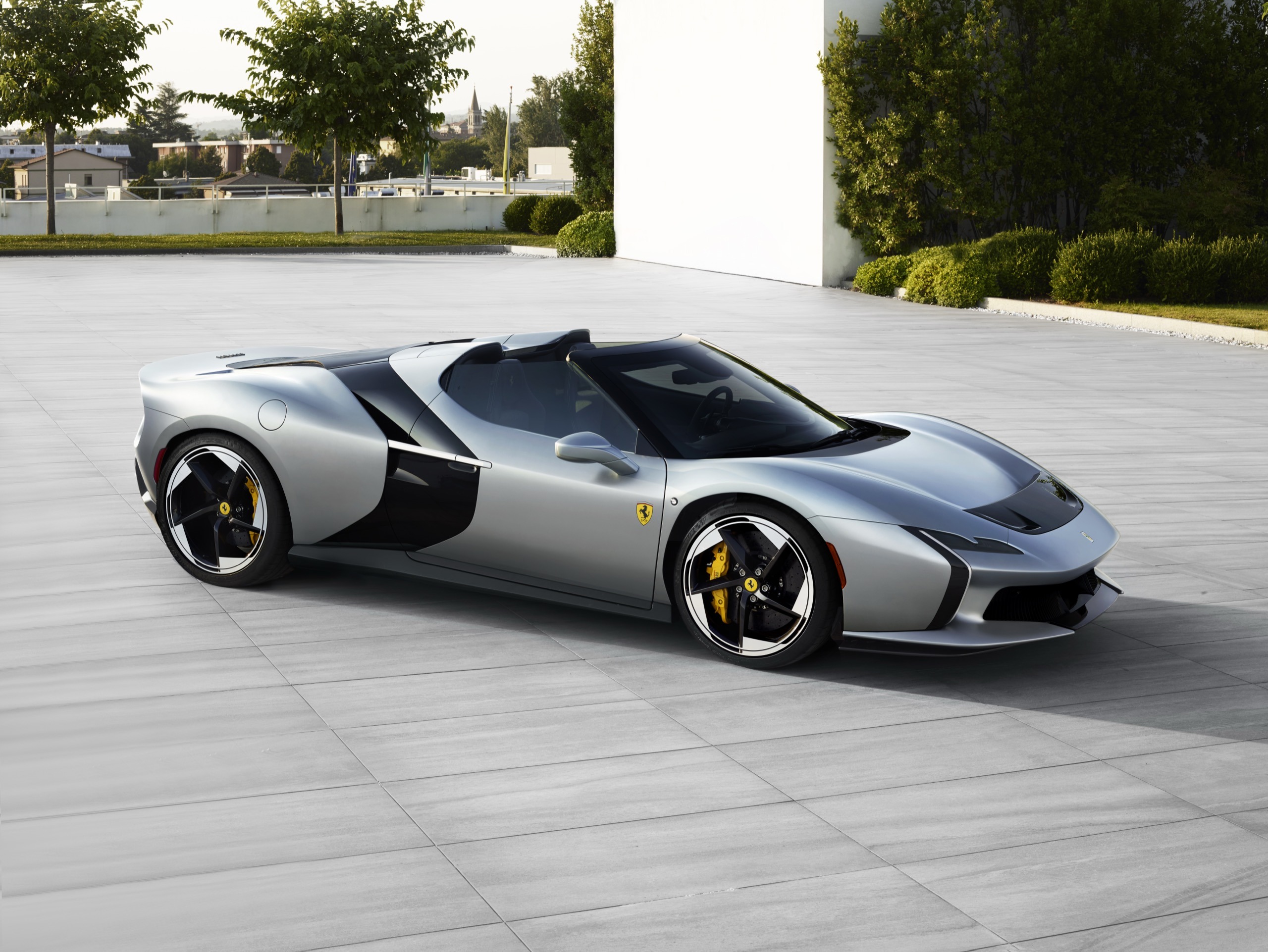
F8 Spider proportions with a lower, longer stance
The HC25 measures 4,758 mm long, 2,006 mm wide and 1,183 mm tall, with a 2,650 mm wheelbase.
Against the production F8 Spider, it is 147 mm longer and 23 mm lower, changes that help the car look more stretched, planted and visually composed.
The lowered roofline and reshaped glazing reduce the apparent height of the cabin, while the bodywork draws the eye toward the horizontal mass of the car rather than the cockpit opening.
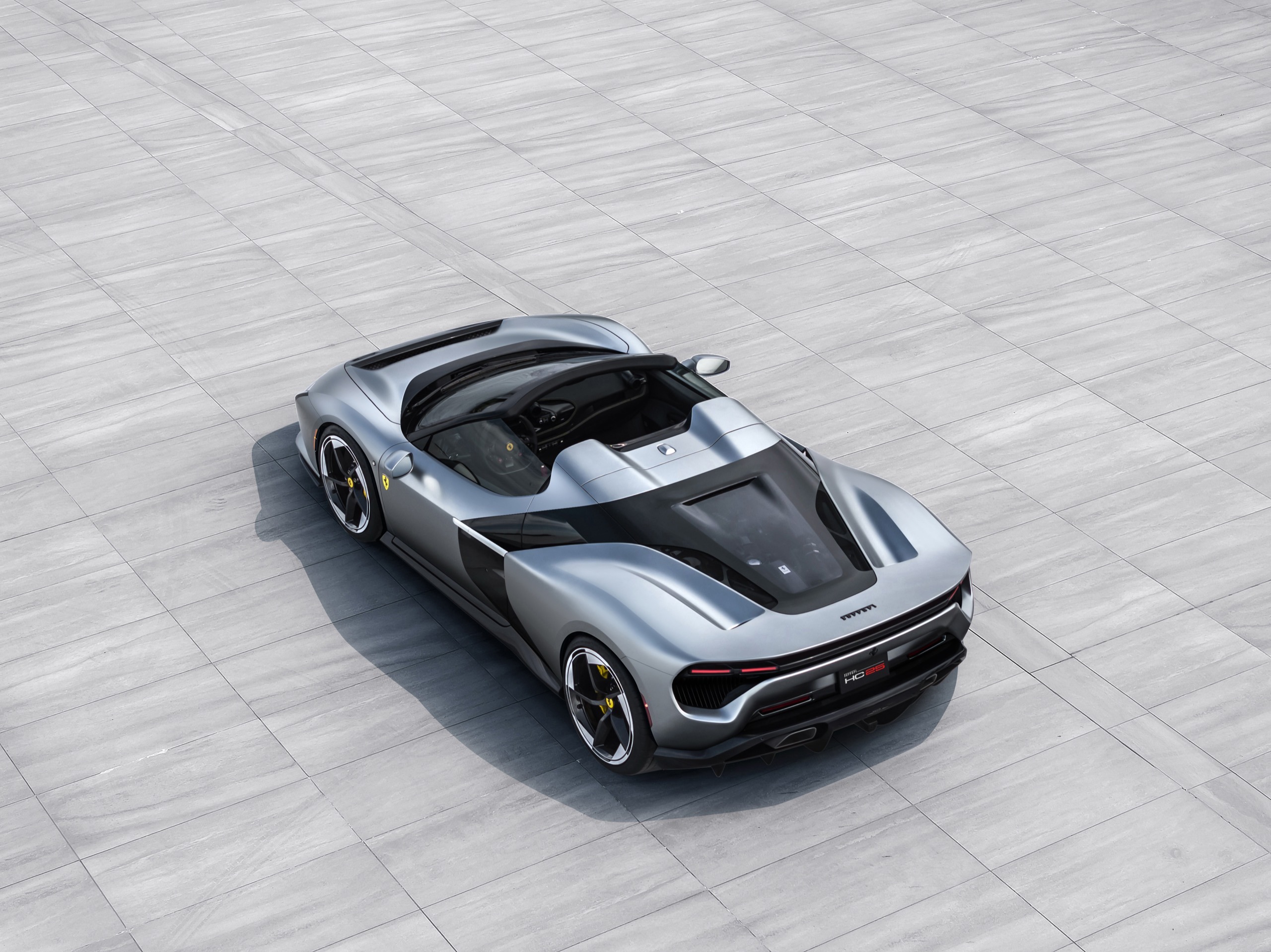
Ferrari has not treated the HC25 as a simple rebodied F8, but as a bridge between eras, with design cues that look toward newer cars such as the F80 and 12Cilindri while retaining the mechanical character of the previous V8 generation.
The black ribbon gives the body its identity
The most distinctive visual element is the glossy black band that wraps through the middle of the car, dividing the matt Moonlight Grey bodywork with unusual precision.
It is not merely a graphic device, as the band incorporates radiator air intakes and heat extraction paths for the powertrain.
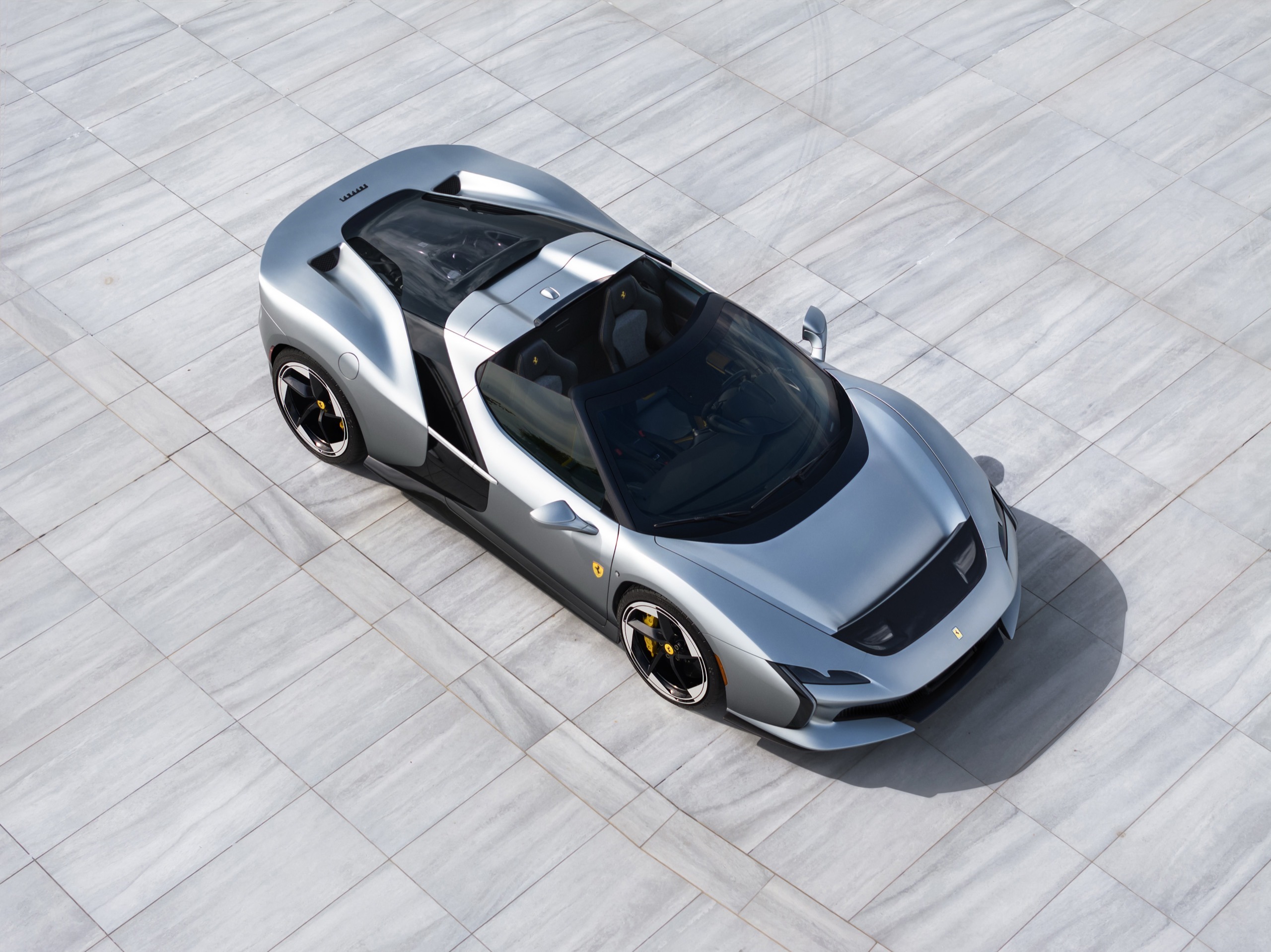
The front end introduces a slim new headlamp treatment with a central indentation and vertically arranged daytime running lights, a first for Ferrari.
Those lights use the leading edge of the front wings to create a boomerang-like signature, a shape that is echoed inside the cabin rather than left as an isolated exterior flourish.
The door handle is another small but telling detail, integrated into a long blade milled from solid aluminium that visually connects the two body sections separated by the black band.
A private commission with public significance
The HC25 is the third one-off Ferrari to use the F8 platform, following the SP49 Unica in 2022 and the SP-8 roadster in 2023.
Its chassis electronics are thoroughly modern, including eDiff3, F1-Trac, high-performance ABS/EBD with Ferrari Pre-fill, SCM-E, FDE+, and Side Slip Control 6.1.
The braking hardware is serious as well, with 398 x 223 x 38 mm front discs and 360 x 233 x 32 mm rear discs.
It rides on 20-inch wheels front and rear, wearing 245/35 ZR20 tyres at the front and 305/35 ZR20 tyres at the rear, with five-spoke rims that use diamond-finished outer edges and recessed grooves to add visual diameter.
Ferrari has not announced a public price, which is expected for a single-client Special Projects car of this nature.
What matters is the intent, because the HC25 takes the last pure mid-engined V8 spider formula from Maranello and gives it a bespoke body, a sharper visual identity and a sense of closure.
For the client who commissioned it, the HC25 is a personal Ferrari; for everyone else, it is a carefully judged goodbye to an era before electrification became inseparable from Maranello’s fastest open cars.