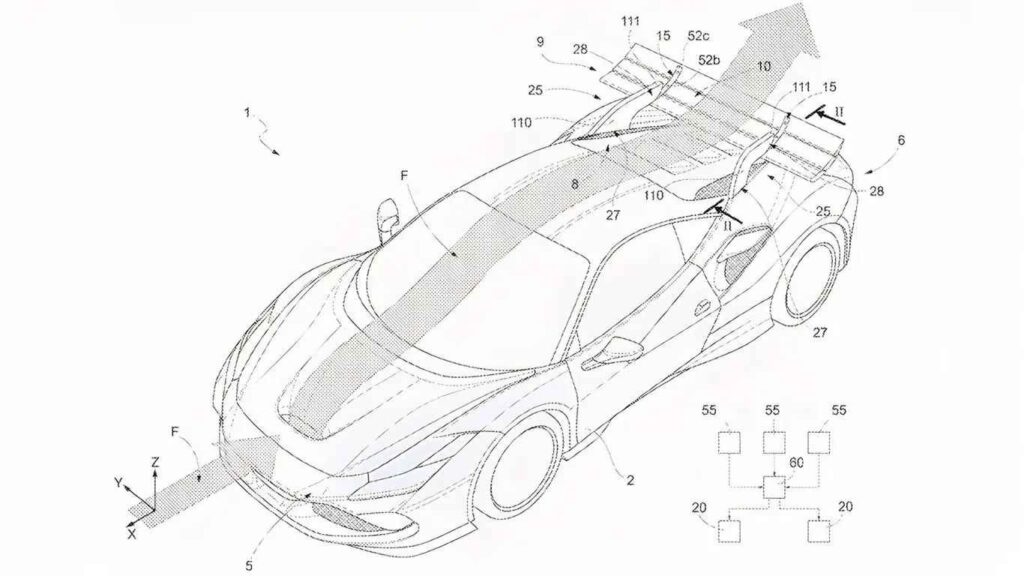
Ferrari’s latest aerodynamic idea looks less like a simple moving wing and more like a surface that can change character as the car demands it.
The concept centres on a flexible rear wing able to bend and twist, potentially shifting downforce across the car during hard cornering before settling into a lower-drag form on the straight.
At a glance
- Ferrari has filed a patent for a flexible rear-wing system with elements that can deform rather than simply pivot.
- The design uses multiple aero sections on a flexible base, controlled by independent actuators to vary shape and load.
- There’s no confirmed production plan, but the idea points to a more adaptive future for Ferrari aerodynamics.
A rear wing designed to reshape under load
Conventional active aero generally works by moving rigid panels through hinges, flaps or deployable surfaces.
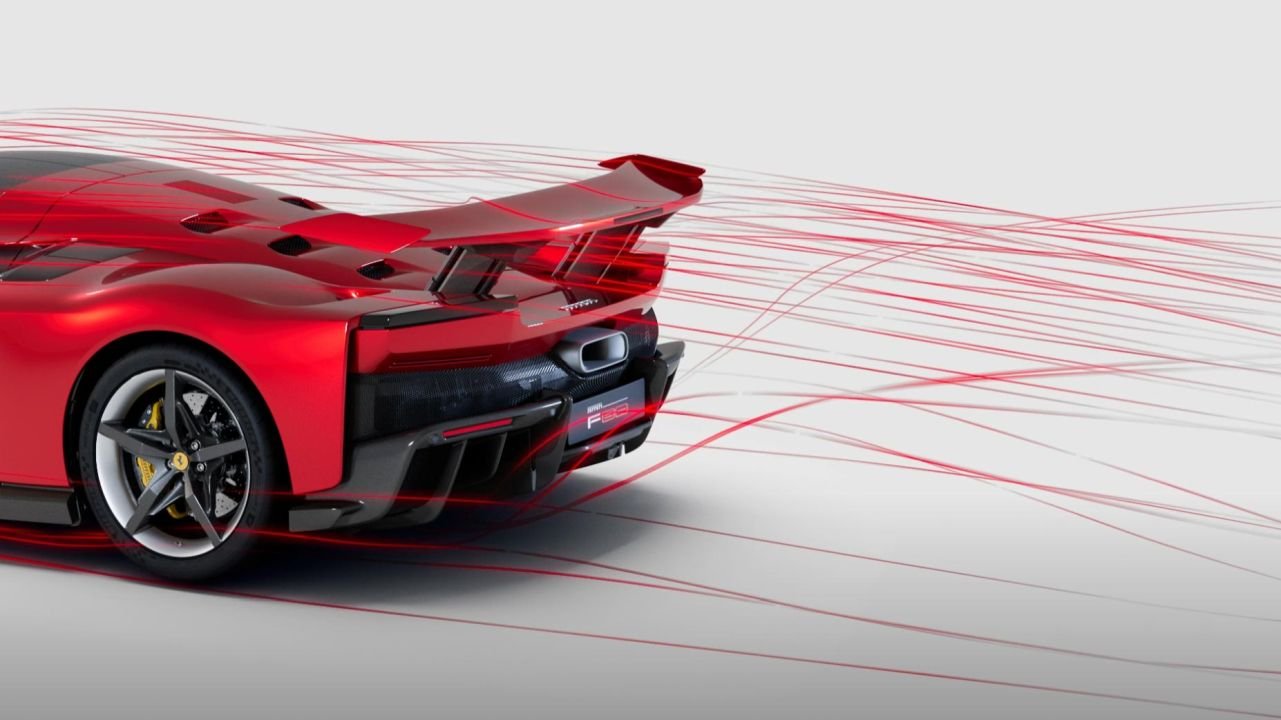
Ferrari’s concept adds another layer by allowing the wing itself to flex, with several aerodynamic elements mounted to a deformable base.
Independent actuators would control those elements, letting the wing alter its form laterally rather than moving as one fixed piece.
In simple terms, the car could ask the rear wing for different behaviour on the left and right sides, depending on steering angle, speed and load.

How lateral aero could help a Ferrari corner
The intriguing part isn’t just that the wing moves, but that it could distribute downforce from one side of the car to the other.
During aggressive cornering, that could help tune stability and grip by changing how aerodynamic load is applied across the rear axle.
On a straight, the wing could return to a more neutral shape to cut drag and improve efficiency.

That makes the idea especially relevant for high-performance road cars, where outright cornering ability and straight-line speed often compete for the same design space.
The production challenge behind the idea
Turning a flexible aero surface into a road-ready Ferrari would be far from straightforward.
The wing would need materials capable of repeated deformation under heavy aerodynamic load without adding unnecessary weight or losing precision over time.

It would also have to survive heat, vibration, weather and the kind of long-term durability testing expected of a production car.
For now, the patent shows where Ferrari’s thinking may be heading rather than confirming a feature for an upcoming model.
Details & Specifications
| Brand | Ferrari |
|---|---|
| Technology | Flexible active rear-wing concept |
| Core design | Multiple aerodynamic elements mounted on a flexible base |
| Control method | Independent actuators |
| Primary function | Lateral deformation to vary downforce across the rear wing |
| Straight-line behaviour | Returns toward a more neutral shape to reduce drag |
| Production status | No production confirmation |
Part of a wider push into driver-focused technology
The flexible wing isn’t the only recent Ferrari patent aimed at rethinking familiar performance hardware.

The brand has also filed a patent for an electronic H-pattern manual shifter designed for use with an automatic transmission.
Taken together, these ideas suggest Ferrari is looking at both ends of the driving experience, from how air moves around the car to how a driver interacts with the drivetrain.
Whether this morphing rear wing reaches a showroom or remains an engineering exercise, it’s a clever glimpse at how the next generation of supercar aerodynamics may become less mechanical and more adaptive.