Czinger is taking its most radical idea into open-air territory.
The Los Angeles hypercar maker has teased the 21C Spider ahead of its public reveal at Pebble Beach on August 14, bringing the brand’s additive-manufacturing approach to a more exposed version of the 21C. For a company built around 3D printing, hybrid performance and unconventional packaging, a Spider variant is more than a simple roof delete.
At a glance
- Czinger Vehicles will reveal the 21C Spider to the public at Pebble Beach on August 14.
- The open-top hypercar is expected to retain the 21C’s tandem 1+1 seating layout and additive-built construction philosophy.
- Final specifications haven’t been detailed, though the coupe’s hybrid V8 package gives a clear indication of the performance territory Czinger is working in.
An open-air take on the 21C formula
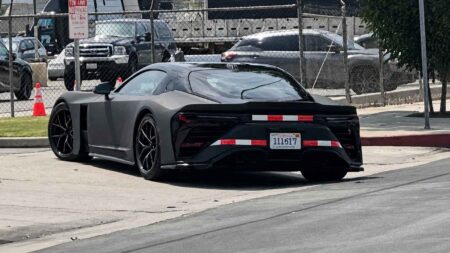
The 21C Spider is expected to stay close to the visual language of the existing 21C, which means a narrow, fighter-jet-style canopy profile and a cabin arranged with the driver ahead of the passenger.
That tandem 1+1 seating layout remains one of the car’s defining traits, giving the 21C family a footprint and silhouette unlike most modern hypercars.
The Spider body style raises a more interesting engineering question than it might on a conventional supercar.
Removing a fixed roof from a car that relies on extreme stiffness, advanced materials and careful airflow management can create compromises, so the final execution will be watched closely by collectors and engineers alike.
Why Czinger’s manufacturing method matters
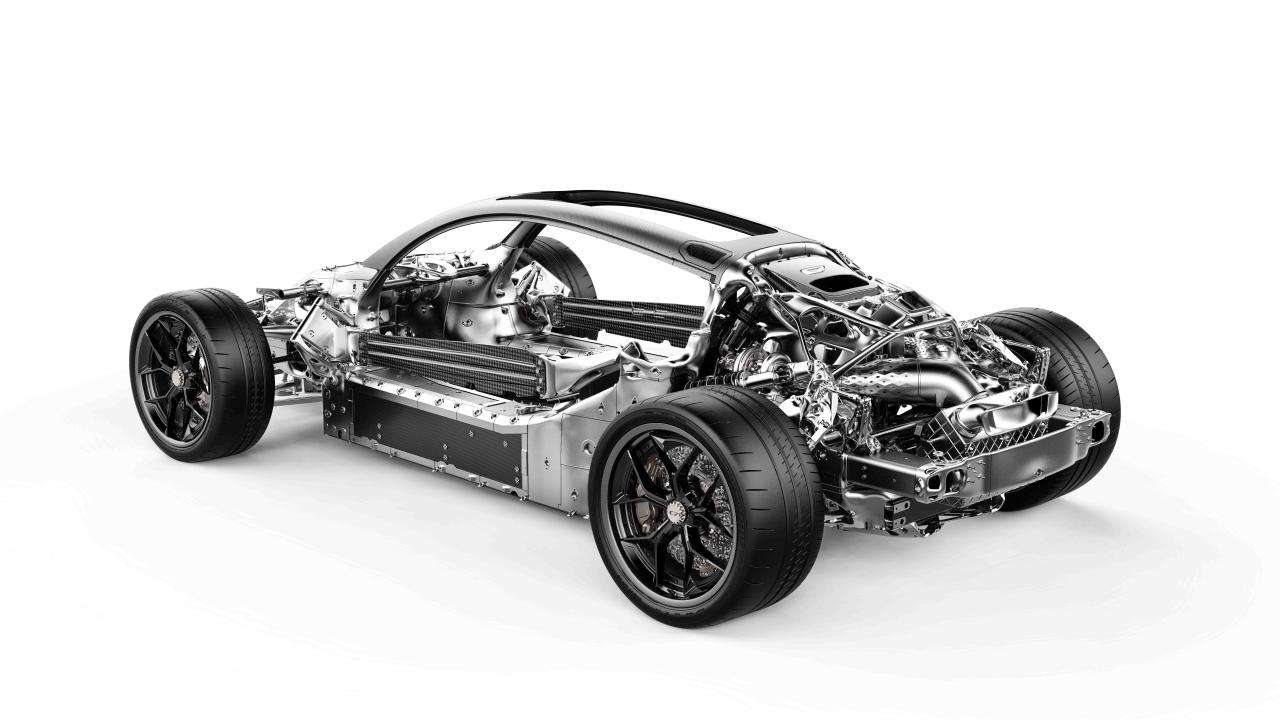
Czinger’s identity is tied to 3D printing and additive manufacturing, a process the company uses to rethink how structural components are designed and produced.
Rather than shaping a car around traditional production methods, Czinger’s approach allows complex, weight-efficient parts to be created with forms that would be difficult to achieve through conventional casting or machining.
That philosophy should carry directly into the Spider, where structural reinforcement and aerodynamic tuning will be especially important.
The key unknown is how much extra mass the open-top version carries compared with the hardtop 21C, and how Czinger has balanced that against rigidity and aero performance.
Hybrid power and Nürburgring context
Czinger hasn’t published the Spider’s final mechanical specification, but the existing 21C gives the clearest clue to the brand’s performance baseline.
The 21C coupe uses a 2.88-litre twin-turbocharged V8 paired with three electric motors, producing a combined 1,250 hp sent to the rear wheels.
That hybrid layout places the 21C in the most serious tier of modern hypercars, where electric assistance is used as much for response and torque delivery as headline output.
The 21C also returned to attention earlier this year after testing at the Nürburgring, prompting speculation about whether Czinger may be targeting a new lap benchmark.
Whether the Spider is developed with the same circuit intent or a slightly more expressive character remains to be seen, but Pebble Beach is a fitting stage for that distinction to become clearer.
Details & Specifications
| Brand | Czinger Vehicles |
|---|---|
| Model | 21C Spider |
| Body style | Open-top hypercar |
| Seating | Tandem 1+1 configuration |
| Manufacturing approach | 3D printing and additive manufacturing |
| Public debut | August 14 at Pebble Beach |
| Related model | Czinger 21C coupe |
The 21C Spider gives Czinger a chance to show that its additive-built hypercar architecture can support more than a single dramatic body style.
If the company preserves the 21C’s intensity while adding the theatre of an open cabin, Pebble Beach could deliver one of the week’s more technically interesting debuts.