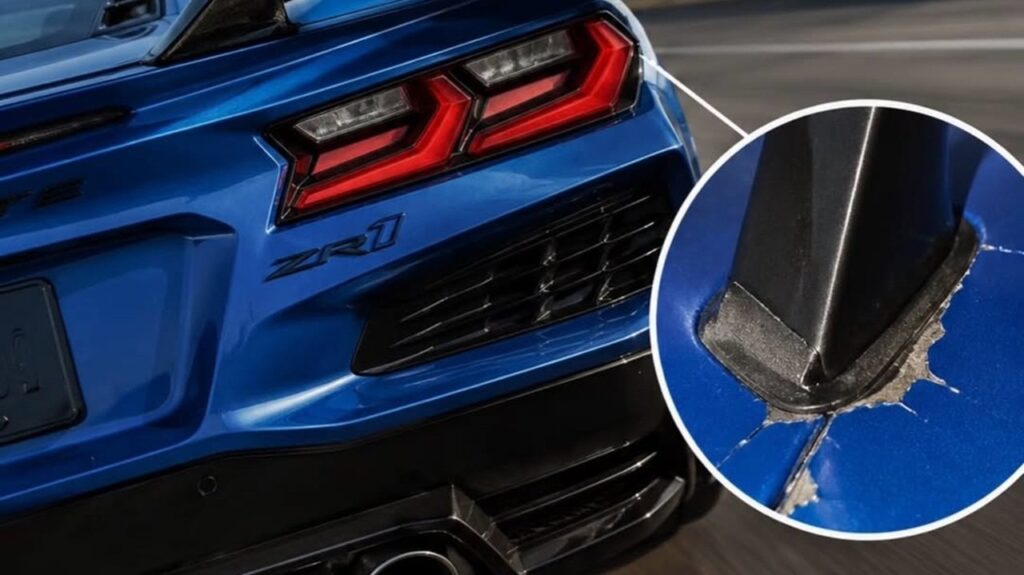
The Corvette ZR1’s aerodynamic package is meant to make the car feel planted at speeds most road cars will never see.
Now, that same aero intensity is drawing attention for a less glamorous reason, with some owners reporting paint damage around the rear wing area after repeated high-speed track use.
The discussion centres on cars that have reportedly been run beyond 180 mph, where the ZR1’s rear aero hardware is doing serious work.

At a glance
- Some Corvette ZR1 owners have reported paint chips or small cracks near the rear wing area after high-speed track use.
- Chevrolet has claimed the ZR1 can generate up to 1,200 pounds of downforce at speed, placing heavy loads around the wing and its mounting points.
- No official cause has been confirmed by Chevrolet, and the issue is not being described as a structural failure.
The ZR1’s aero load is the centre of attention
The ZR1 is built around big-speed stability, and its rear wing is a central part of that brief.
Chevrolet has stated that the car can generate up to 1,200 pounds of downforce at speed, a figure that puts it firmly in serious track-machine territory.
That load has to travel through the wing supports and into the surrounding body structure, which is why the reported paint damage has attracted attention around the mounting area.

The concern is not that the wing is coming loose or that the bodywork is failing in a dramatic way.
Instead, the reports describe smaller cosmetic marks, including chips and hairline cracking in the paint near the rear aero hardware.
High-speed track use appears to be the common thread
The reports appear to be tied most closely to sustained or repeated high-speed running rather than ordinary road use.

Speeds above 180 mph create an environment where aerodynamic forces rise sharply, and the rear wing is asked to generate meaningful grip rather than simply provide visual drama.
Under those conditions, even small amounts of flex or stress around adjoining panels can become visible in the paint over time.
That does not automatically point to a defect, but it does underline how extreme aero packages can expose the difference between a fast road car and a car being used near the outer edge of its performance envelope.

No confirmed Chevrolet explanation yet
Chevrolet has not publicly confirmed whether the paint damage is directly linked to the ZR1’s downforce, wing loads or another factor.
Until that happens, the most sensible reading is cautious.
The reported marks are worth monitoring, especially for owners who plan to use the car regularly on high-speed circuits, but there is currently no confirmed indication of a structural problem.
For buyers and collectors, the distinction matters because cosmetic paint damage and compromised mounting integrity are very different issues.
Details & Specifications
| Brand | Chevrolet |
|---|---|
| Model | Corvette ZR1 |
| Reported area of concern | Paint around the rear wing and mounting area |
| Reported use case | High-speed track running, including runs exceeding 180 mph |
| Claimed downforce | Up to 1,200 pounds at speed |
| Confirmed cause | Not publicly confirmed by Chevrolet |
The ZR1 remains a car defined by extreme performance hardware, and this episode is a reminder that serious aero brings serious loads with it.
For owners who use the car as intended on track, keeping an eye on the rear wing area after high-speed sessions now seems like a practical step rather than an overreaction.