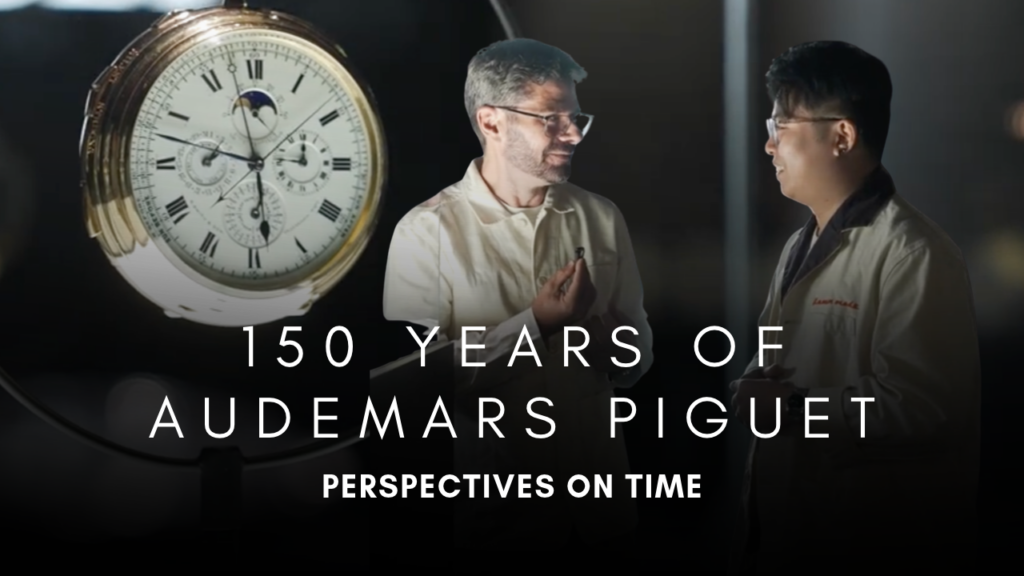
Audemars Piguet is taking its 150th anniversary story to Singapore with “Perspectives on Time,” a focused exhibition at the National Museum of Singapore.
Held at The Gallery Theatre from 10 to 13 September, the exhibition follows the Manufacture from its 1875 founding in Le Brassus through archival pocket watches, astronomical complications, openworked movements and chiming watches.
For collectors, it’s the kind of presentation that places familiar modern Audemars Piguet signatures back into a much longer technical lineage.
At a glance
- Audemars Piguet’s “Perspectives on Time” exhibition marks 150 years of watchmaking since the Manufacture’s founding in Le Brassus in 1875.
- The exhibition is arranged across four chapters covering archival watches, celestial complications, openworking and acoustic watchmaking.
- It is held at The Gallery Theatre at the National Museum of Singapore from 10 to 13 September.
A Singapore setting for Audemars Piguet’s anniversary year
“Perspectives on Time” is built around four distinct chapters, each looking at a different part of the brand’s technical and artistic identity.
The format matters because Audemars Piguet’s history can’t be reduced to one icon or one complication.
The exhibition begins with “Looking Back and Beyond,” a historical section that traces 150 years of production through archival pocket watches and wristwatches.
That opening chapter sets the tone by anchoring the contemporary Manufacture in the work that began in Le Brassus in 1875.
| Chapter | Focus |
|---|---|
| Looking Back and Beyond | Archival pocket watches and wristwatches from across 150 years |
| Guided by the Cosmos | Astronomical complications, calendars and celestial timekeeping |
| The Beauty Within | Openworked movements and visible mechanical architecture |
| Giving Time a Voice | Minute repeaters, chiming watches and acoustic watchmaking |
Calendars, celestial cycles and the long view of time
The second chapter, “Guided by the Cosmos,” looks at Audemars Piguet’s interest in astronomical complications and the measurement of celestial cycles.
This part of the exhibition connects historic watchmaking with one of the most intellectually demanding areas of mechanical horology.
Among the highlighted pieces is the 1921 “Grosse Pièce” pocket watch, described as featuring 19 complications and requiring seven years to complete.
Its presence gives the exhibition a substantial historical anchor, especially for visitors interested in the grand-complication tradition that shaped high watchmaking before the modern wristwatch era fully took hold.
The chapter also points to contemporary work through the Calibre 7138 perpetual calendar.
That movement is presented as being designed for intuitive adjustment entirely through the crown, a detail that speaks to a modern priority in complicated watchmaking.
Openworking as structure, not decoration
“The Beauty Within” turns the focus from what a watch displays to how a movement is constructed and revealed.
The chapter examines openworking, the painstaking process of removing material from plates and bridges to expose the mechanical architecture beneath.
In Audemars Piguet’s context, the point is not simply transparency.
Openworking has to preserve structural integrity while creating visual balance, which is why the discipline sits somewhere between engineering, finishing and composition.
It’s also one of the clearest ways to understand how the Manufacture treats a movement as both mechanism and object.
Minute repeaters and watches that speak
The final chapter, “Giving Time a Voice,” focuses on acoustic complications and Audemars Piguet’s history with minute repeaters and chiming watches.
Pieces such as the Supersonnerie and RD#1 are used to explore this side of the Maison’s work.
Live demonstrations accompany the chapter, an important detail for a category of watchmaking that can’t be fully understood through a display case alone.
Chiming watches are judged not only by mechanical complexity, but also by rhythm, clarity and the character of their sound.
By ending with sound, the exhibition gives visitors a more physical encounter with watchmaking than a purely visual retrospective could offer.
“Perspectives on Time” will likely appeal most to collectors, design-minded visitors and anyone interested in how traditional complications continue to evolve inside a contemporary watch manufacture.
It’s an anniversary exhibition with a clear point of view, less about nostalgia than about showing how 150 years of accumulated craft still informs the watches Audemars Piguet chooses to make today.