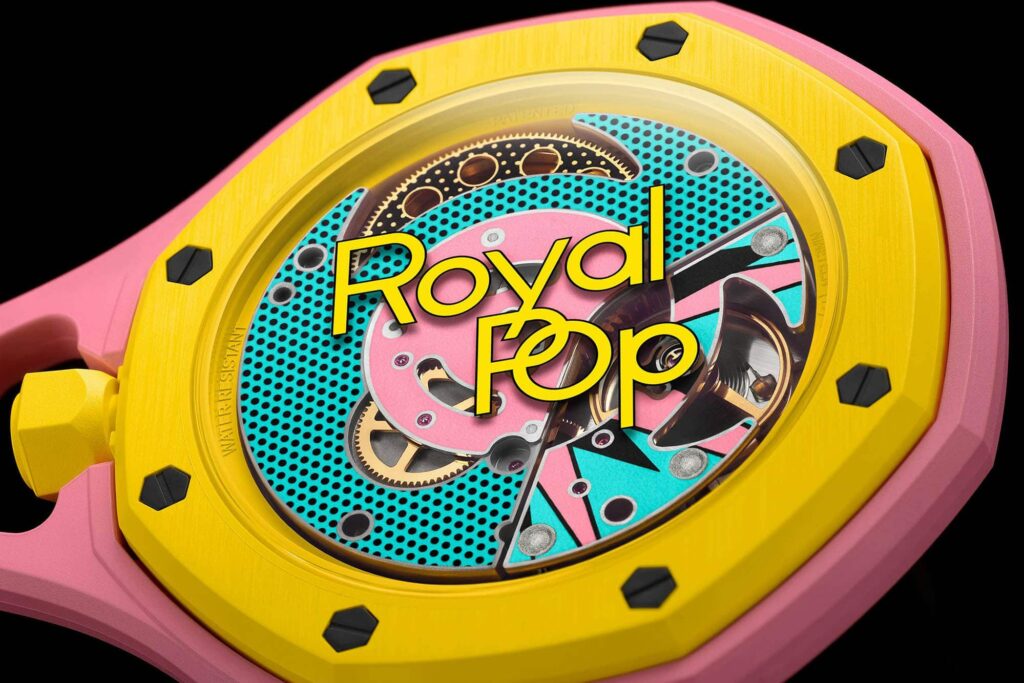
Audemars Piguet and Swatch have delivered the most controversial watch launch of the year with the Royal Pop, a bioceramic take on Royal Oak codes that became less about the watch itself and more about the chaos surrounding its release.
The collaboration was never going to be quiet.
Swatch already proved with the MoonSwatch that a plastic, accessible riff on an untouchable icon could move beyond watch collecting and into mainstream culture, and adding Audemars Piguet’s octagonal silhouette to the formula only raised the stakes.

Royal Oak codes in a Swatch-shaped storm
The Royal Pop’s appeal is easy to understand even before getting into the details.
It takes one of modern watchmaking’s most recognizable design languages, the integrated bracelet sports watch defined by the Royal Oak, and reframes it through Swatch’s colorful, mass-market lens.
That combination makes it a strange object.

It is not a Royal Oak in any meaningful haute horlogerie sense, but it borrows enough of the visual language to make the association unavoidable.
For casual buyers, it offers a playful entry point into a design usually locked behind allocation lists and five-figure pricing.
For collectors, it sits somewhere between novelty, provocation and brand experiment.
The boutique-only playbook reached its limit
The problem was not that people wanted the watch.
The problem was that the launch plan seemed almost designed to turn demand into pressure.
In the days before the May 16 release, buyers began lining up well in advance at Swatch boutiques, with some camping out for days rather than hours.
By launch morning, scenes from cities including New York, Mumbai and Milan showed crowds that had moved far beyond the orderly line culture brands like to imagine when they stage in-person drops.
Several boutiques canceled sales as safety concerns mounted, leaving many who had waited outside with nothing to show for it.
That outcome was predictable.
The MoonSwatch launch in 2022 had already demonstrated how quickly a boutique-exclusive release can attract speculators, resellers, curious bystanders and genuine enthusiasts into the same compressed physical space.
Scarcity was the real complication
The Royal Pop may be a simple watch, but its most powerful mechanism was scarcity.
When a product has global attention, an instantly legible design hook and uncertain availability, the market does the rest.
Resale platforms, social media and short-form video turn a release into a live event, and the line outside the store becomes part of the marketing whether the brands admit it or not.
That dynamic can create attention on a scale no advertisement can buy, but it also shifts the burden onto retail staff and customers standing in the street.
For a collaboration attached to Audemars Piguet, a manufacture whose reputation rests on control, craft and exclusivity, the optics were especially uncomfortable.
A safer relaunch is the only sensible move
There were better options available.
Swatch and Audemars Piguet could have used online queues, randomized raffles, registration windows, regional lotteries or timed ordering periods to remove the incentive for multi-day camping.
None of those systems is perfect, and every high-demand drop will still produce disappointment.
But disappointment online is very different from disorder outside a boutique.
If the Royal Pop is to have a life beyond launch-day footage, the brands need to reset the release with a safer and more transparent allocation process.
The watch itself will still find an audience, especially among buyers who enjoy design crossovers and do not mind the tension between prestige and play.
Yet its first chapter will be remembered less for bioceramic cases or Royal Oak references than for a launch that made the product feel secondary to the spectacle.